
“Killing Eve”: A Retrospective
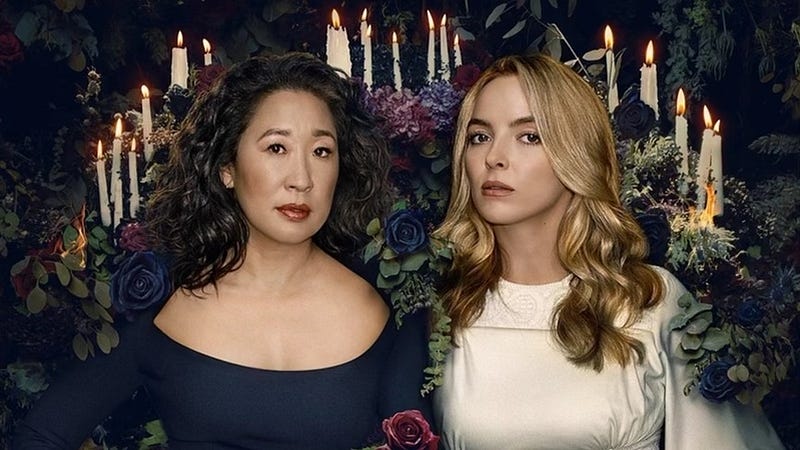
On April 10, the 4-season, 32-episode run of Killing Eve came to an end. The Emmy-winning BBC America series was based on a series of electronic novellas and starred Sandra Oh and Jodie Comer as an MI-5 agent and assassin, respectively, who developed a mutual obsession with one another. The series won widespread acclaim early on for audaciously and cleverly upending the spy genre and boldly incorporating black comedy, feminism, and queerness.
One of the most fascinating aspects of the series was how each season had a different female head writer. Phoebe Waller-Bridge helmed the 1st season shortly before she picked up 3 Emmys for the 2nd season of Fleabag. Emerald Fennell took over for the 2nd season and subsequently won the Best Original Screenplay Oscar for Promising Young Woman. The somewhat less acclaimed third and fourth seasons were helmed by Suzanne Heathcoate and Laura Neal, respectively. This revolving door of talented women ensured that a show that delved deep into female criminality, sociopathy, and desire always retained a fresh female perspective.
Throughout its run, Killing Eve defied expectations at nearly every turn. When you expected it to ratchet up the drama, it presented the most macabre of humor. When you expected it to become romantic, sudden tragedy would strike. Sure, there were some of the conspiracies and shocking betrayals you expect from a spy drama, but by and large the series avoided doing what you expected it to do. And that’s what made its spectacularly conventional and uninspired finale so utterly disappointing.
Rather than overly fixate on the show’s lackluster end, I decided to craft a retrospective of the show from its inception. Below, I review each season, picking out the best episode and performance from each.
Season 1 (2018)
Within the first few minutes of the pilot it becomes clear that Killing Eve is far from your typical BBC MI-5 drama. This should not have been surprising considering it centered on women, stars a Canadian-Asian woman, is based on a series of electronic novellas, and was initially adapted for television by an offbeat comedy writer. We are swiftly introduced to Eve Polastri (Sandra Oh), a quirky MI-5 desk agent who is fascinated by female serial killers. Her life becomes completely upended when she is put on the case of a mysterious psychopathic assassin named Villanelle (Jodie Comer) after she proves to be the only one who has any insight into Villanelle and truly understands how dangerous she is.
Before long, Eve and her colleague Bill (David Haig) are fired from MI-5 for their dogged pursuit of Villanelle and then are swiftly recruited by MI5 Russia section director Carolyn Martens (Fiona Shaw) to continue to pursue Villanelle off book. They bring along Eve’s sharp-tongued assistant Elena (Kirby Howell-Baptiste) and reticent hacker Kenny (Sean Delaney), who is revealed to be Carolyn’s son. Things quickly begin to unravel as Bill is murdered, Carolyn is revealed to be more mysterious than she originally seemed, and Villanelle catches on that she is being pursued by Eve.
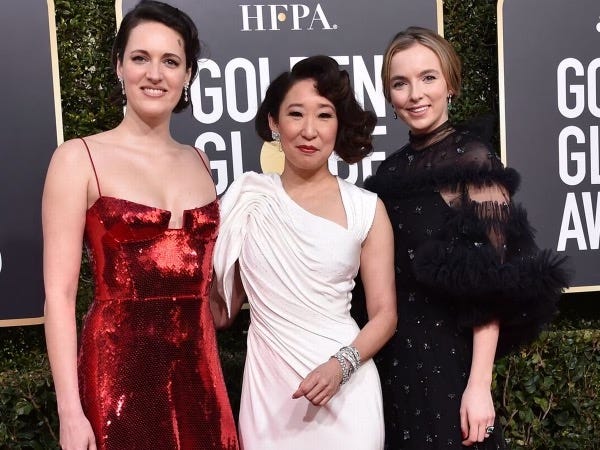
The dynamic between Eve and Villanelle, who we learn is a Russian national named Oksana Astankova, establishes itself as the crux of the series within just a few episodes. They are obsessed with each other in a way that cannot be readily comprehended. The connection between them is cerebral, sexual, and almost spiritual. Yet somehow it never goes to Silence of the Lambs-style tragedy or Bound-style lesbian erotica. It stays firmly grounded in its quirky characters, which series developer and head writer Phoebe Waller-Bridge imbues with multiple complexities and offbeat, often endearing humor.
It certainly helps that Eve and Oksana/Villanelle are brought to life by two immensely gifted actresses. Eve is played by Sandra Oh, who broke out in HBO’s Arliss, appeared in a number of memorable films including Sideways and Under the Tuscan Sun, and was nominated for a slew of awards for her work on the ABC medical soap Grey’s Anatomy. Yet even Christina Yang, her unforgettable Grey’s character, can’t hold a candle to Eve, arguably her best role to date. She combines a no-nonsense dedication with a profound tenderness and light-heartedness that proves to be a balancing act that very few actresses could pull off. (Her performance in the 1st season should have given Oh her 1st Emmy win, but she remains inexplicably a 12-time loser.) She is matched by relative newcomer Jodie Comer, who not only nails the accents, costume changes, and physical demands that her role requires but fully embodies the depths of her character’s psychopathic tendencies without ever reducing her to a caricature. The supporting cast is uniformly excellent as well, with Shaw, Haig, Kim Bodnia (as Villanelle’s handler Konstantin), and Owen McDonnell (as Eve’s kind husband Nico) providing particularly strong support.
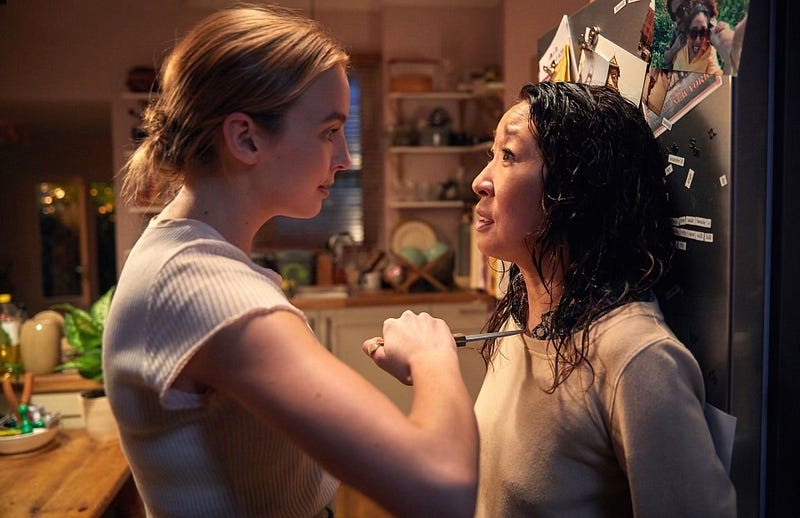
Killing Eve proves to be a damn fine spy thriller in its 1st season, but that’s not what makes it so special and unique. What makes it so singular is the dominance of women’s voices both behind and in front of the camera. The show has few overtly feminist messages and is never preachy, yet it is feminist to its core. It involves two strong complex women at its center (three if you count Carolyn, which I would) and it delves into what makes them tick. It is interested in what fascinates their brains, moves their emotions, and stokes their lust. Unfortunately, when Eve and Villanelle finally have a showdown on the season finale, it is frustratingly unsatisfying and the season ends on a relatively weak note. This is in part because of what feels like a perfunctory end and a shameless cliffhanger, but it is also because the buildup has been so fascinating and intense that nearly any resolution was bound to disappoint.
Best Episode: “I Have a Thing About Bathrooms” (Episode 5)
Best Performance: Sandra Oh, “I Have a Thing About Bathrooms” (Episode 5)
Season 2 (2019)
Season 2 of Killing Eve had the odds stacked against it for several reasons. First, there’s just the general nature of the sophomore slump in which most shows that break out in their 1st season generally struggle to maintain quality in their follow-up outing. Second, there’s the change in show-runner. The immensely gifted Phoebe Waller-Bridge moved on to other projects, handing over the reins to Emerald Fennell (who would win an Oscar within 2 years but was relatively unknown at the time). Third, there’s the nature of the show itself and the note the first season ended on. Not only was the cliffhanger a bit shameless (clearly Villanelle doesn’t die as her dynamic with Eve is the linchpin of the series) but it appeared to end the cat-and-mouse game. They had finally met and just as the fallout from Sam and Diane kissing on Cheers and the various plot threads of Game of Thrones starting to converge there was the risk of the tension being gone.
Thankfully, the tension only escalates in Season 2. The writers cleverly separate Eve and Villanelle for several episodes and move them on other things. Eve is recalled to London by Carolyn and asked to track down a new female assassin known as “The Ghost.” The new assassin appears to be responsible for a host of mysterious deaths surrounding Aaron Peel, a megalomaniac tech company CEO who turns out to be a true sociopath. Meanwhile, Villanelle struggles to survive, having been stabbed by Eve and having escaped her sadistic new handler, Raymond.
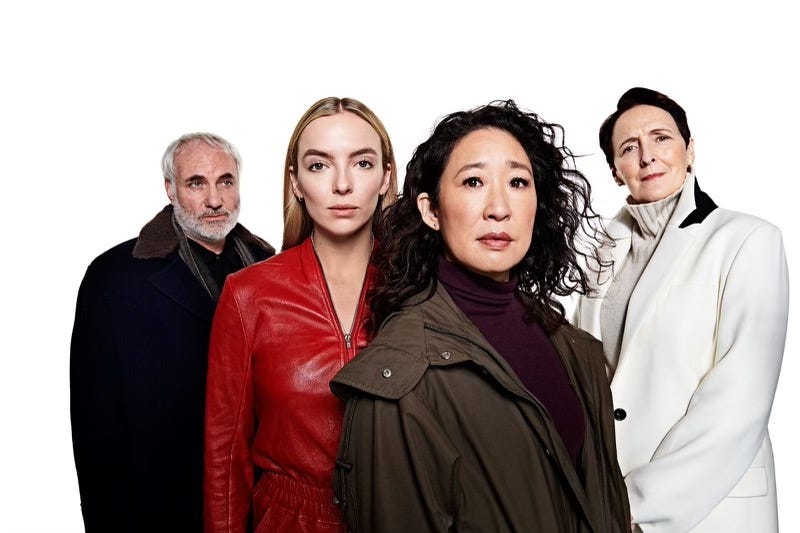
Although Eve and Villanelle are both otherwise preoccupied, they just can’t stop thinking about each other. Their mutual obsession leads to the further degradation of Eve’s marriage to Niko, the dissolution of which provides great material for Oh and McDonnell (but unfortunately introduces us to Gemma, the most cloying character of the show’s run). It also leads Villanelle to do some deep soul searching. The two come back together mid-season when Eve recklessly enlists Villanelle’s help to find “The Ghost” and then to take down Aaron Peel. The twists here would seem convoluted if it wasn’t a show about two women so obsessed with each other they are willing to make dangerously foolish decisions.
Once Eve and Villanelle are reunited, the season’s central theme becomes abundantly clear — it is a profound and complex examination of female sociopathy. Eve, who has been playing around with her darker instincts since stabbing herself with a knife in the pilot just to see what it felt like, is finding herself increasingly emotionally callous and risk-taking. Villanelle, meanwhile, is finding herself increasingly bored and numb and going to great lengths to feel something … to feel anything. It is a fascinatingly complicated dynamic with no clear blueprint in film or television.
Thankfully, Oh and Comer are more than up to the task. Oh is compelling throughout, even as viewers’ empathy for the character declines, and she is especially brilliant in any scene involving her interactions with Nico, Villanelle, or the criminal psychologist Martin (Adeel Akhtar). But this season, she takes a backseat to Jodie Comer. In Season 1, Comer showed an impressive commitment to the role, but she mostly got to play quirky and mysterious. Here, we go deeper into her psyche (even though we learn nothing more about her past) and Comer is a revelation. She won a well-deserved Emmy for her performance in the season’s best episode ,“I Hope You Like Missionary!” The supporting cast is uniformly excellent as well, with Shaw and McDonnell doing even better work than they did in Season One, Bodnia and Delaney continuing to do strong work, and Nina Sosanya, Edward Bluemel, and Henry Lloyd-Hughes being great additions.
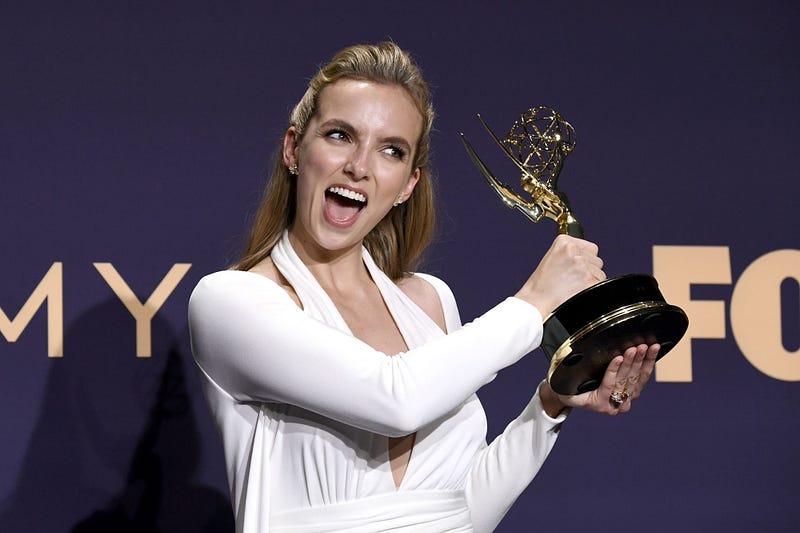
The 2nd season of Killing Eve defied the odds by nearly matching the 1st in terms of quality and finding its buzz growing even stronger. Accordingly, the Television Academy showered it with love (after scoring only 2 nominations for its 1st season, it broke into several other categories in its second, including Outstanding Drama Series). Unfortunately, it ends on a weak note, with another shameless cliffhanger (we know Eve is not dead!). However, the manipulative power plays Eve and Villanelle engage in during the final act shows that there is plenty of heat and drama left in their dynamic.
Best Episode: “I Hope You Like Missionary!” (Episode 14)
Best Performance: Jodie Comer, “I Hope You Like Missionary!” (Episode 14)
Season 3 (2020)
Many expected Killing Eve to have a sophomore slump to occur and breathed a deep sigh of relief when it did not. Unfortunately, it turned out that the show didn’t escape the slump but simply pushed it off a season. This is not to say that the 3rd season of Killing Eve is not good television. Rather, it is to say that it is more flawed and inconsistent than Seasons 1 and 2. The major issue with the 3rd season was it feeling overstuffed and lacking a clear through-line. When a show is only producing 8 40-minute episodes per season, adding numerous new characters and subplots is a risky proposition.
The season starts with Eve recovering from her stabbing, living as a recluse in a shabby apartment and working in the kitchen of a Korean restaurant in London. Meanwhile, Villanelle is living her best life in Barcelona where she has become engaged to an obscenely rich and beautiful woman and is reunited with her old handler Dasha (Harriet Walter, the one addition to the cast this season that works spectacularly). Dasha agrees to help Villanelle get the promotion that Villanelle believes will finally make her feel satisfied. Meanwhile, Konstantin is plotting to abscond with his daughter and escape the Twelve for a new life in the Caribbean and Carolyn is dealing with the return of her MI5 arch-nemesis Paul (Steve Pemberton) and domestic life with her whiny daughter Geraldine (Gemma Whelan). Neither Paul nor Geraldine are particularly strong additions to the ensemble. Then Kenny (Carolyn’s son and Eve’s partner) mysteriously dies and it is ruled a suicide. Eve and Carolyn are devastated and eager to discover the truth and get revenge. This sounds like a remarkably compelling setup for a season of a thriller, right? Well… Not so much.
The mystery regarding Kenny’s death never really generates much dramatic tension. The action at the journalism outlet he works for is never particularly intriguing, his research into the Twelve fails to produce much, and even the season-ending revelation that Konstantin was involved in his murder falls a bit flat. Despite Fiona Shaw’s undeniably brilliant work, Carolyn’s battles with Paul and Geraldine likewise fail to generate much heat and are sporadically sprinkled across the season in a manner that prevents them from gaining real dramatic traction. Eve slowly gets back into the action following Kenny’s death but is distracted by the slow recovery of her estranged husband Niko, following the horrors he was faced with in the prior season. Villanelle feels like she is in another universe for most of the season, although the scenes where she and Eve connect (either psychically or physically) remain chilling.
There are two truly notable episodes in the middle of the season. In “Still Got It,” the show massively switches up the narrative and rather than proceeding chronologically instead switches perspectives between its major characters. It is an ambitious (and occasionally confusing) patchwork that mostly works and builds up to the stunning climax where Dasha attempts to murder Niko in front of Eve in Poland while blaming it on Villanelle. The episode ends with Villanelle arriving in Russia to find her biological family, which Konstantin has been able to track down. The following episode, “Are You From Pinner?” features only Villanelle of the main cast and digs deep into her origin story. It’s a brilliant idea and Jodie Comer does award worthy work, but like most of the season it never truly electrifies.
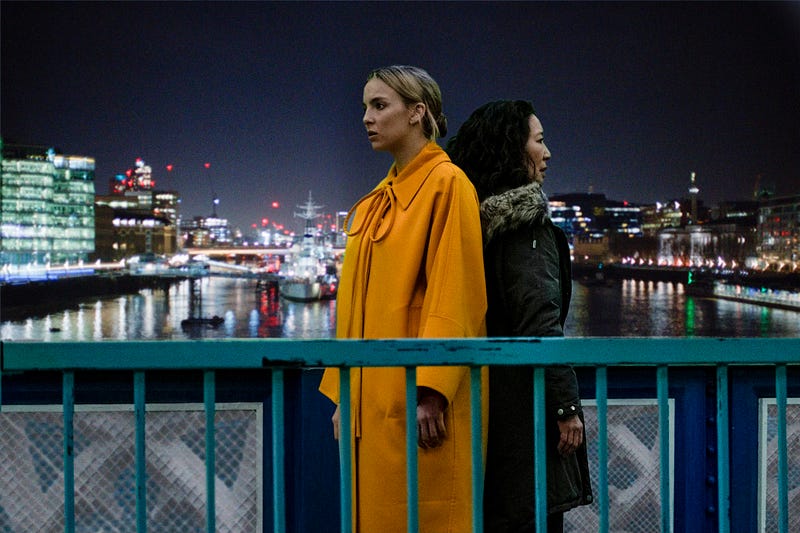
The final episode of the season finds Carolyn murdering Paul and Eve and Villanelle deciding to walk away from each other once and for all — before turning back to stare at each other. Is it one last look or is it a reigniting of their relationship that will fuel the inevitable fourth season? It’s unclear. But it is also harder to care by this point. Although Oh and especially Comer continue to do strong work, their dynamic doesn’t really evolve much this season, nor do the individual characters. In its third season, Killing Eve goes from a riveting, bold, and provocative show teetering on the edge of greatness to a muddled and quirky one that is consistently entertaining but with only occasional flashes of brilliance.
Best Episode: “Still Got It” (Episode 20)
Best Performance: Jodie Comer, “Are You From Pinner?” (Episode 21)
Season 4 (2022)
Just as was the case in the prior 3 seasons, a new female head writer took over the 4th and final season of Killing Eve. It was undoubtedly a boon for Laura Neal to be selected. She had written 3 episodes in Season 3 and now got the chance to shape not only how the show progressed, but also how it ended. Significant criticism has been lobbed on her for the show’s disappointing ending since the finale aired and while much of it was warranted, it is important to consider what a difficult task she had before before her. Before she took the reins of the 4th season, the show had already declined in quality and become spectacularly convoluted. She was not tasked with steering a top-notch ship into port, but rather to keep a sinking one afloat and getting it to shore with minimal damage. (Click here to read my in-depth piece on why crafting a satisfying series finale is such a difficult task.)
As has been the case with the prior 2 seasons, the 4th season begins with the characters scattered. The ambiguous glance between Eve and Villanelle that ended the prior season apparently did not mean too much, because they did in fact go their separate ways. Eve is hellbent on hunting down The Twelve, purportedly to avenge Kenny and the other loved ones they have killed but arguably more so to justify her descent into violence. Carolyn is also still hunting the Twelve, but doing so from her cushy role as a cultural attache in Mallorca. Konstantin is now the mayor of a small Russian town. And then there’s Villanelle, who is seeking to redeem herself by living in a rural English church and converting to Catholicism.
Villanelle’s plot line is by far the most problematic. Her bid for redemption and legitimacy never rings true and the eventual savagery with which she abandons it is all too predictable. (The less said about her hallucinations of Jesus — who is just herself in unconvincing drag — the better.) The result is that Villanelle, the most interesting character since the show’s inception, becomes the weight that drags things down for most of the season. Neal seems to have little idea what to do with her and although Comer continues to commit with an impressively nuanced performance, she can’t save it.
In contrast, Eve regains center stage after a couple seasons of taking a backseat to Villanelle. She is possessed with a ferocious determination that signals the completion of the transformation she began in the pilot. Her callous disregard for her devoted partner Yusuf (Robert Gilbert) and her take-no-prisoners approach to routing out the Twelve gives Oh meaty material to work with. However, Eve’s storyline also fails to come to a satisfying ending.
After having been stabbed in the hand by Eve in the season’s opening scene, Konstantin is revealed to still be under the thumb of the Twelve — Helene (Camille Cottin) in particular. Helene tasks Konstantin with training a new assassin Pam (Anjana Vasan), an awkward young Indian woman who works as a mortician. Although Konstantin has always been the least interesting of the show’s main quartet, Helene and Pam are both fascinating, well-acted characters that inject the season with a jolt of fresh energy. If only the Pam plot line was not so nakedly trying to add some sort of profound bookend to Konstantin’s training of Villanelle that began the series, it would have worked much better.
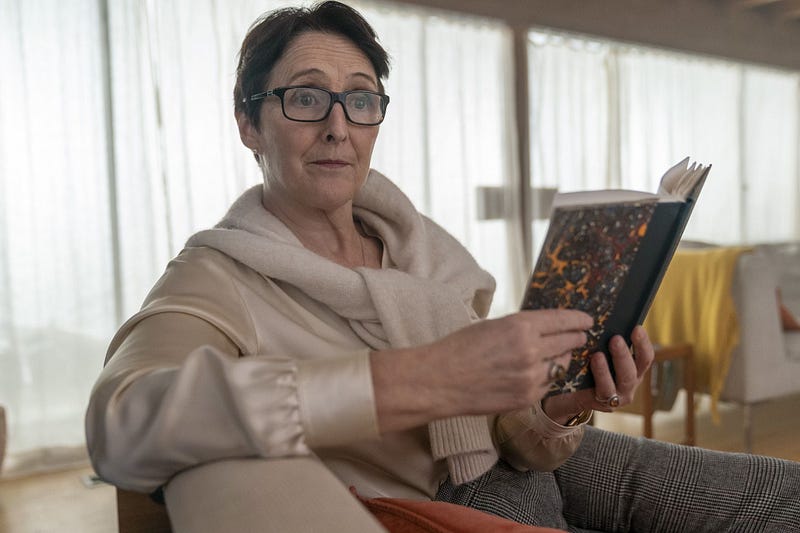
Interestingly, the most successful part of the show’s 4th season is the arc of Carolyn. Fiona Shaw brutally dominates every single scene from the initial shot of her contemptuously enduring her new role as a cultural attache to the chilling final scene where she…well, we’ll get into that in a minute. We find out that her father was a spy who was blackmailed for being gay and died by suicide. We find out that she was instrumental in the founding of the Twelve, ostensibly as a secret agent and not as a passionate devotee. But, even the season’s best plot line comes to a profoundly disappointing end in the series finale.
The animosity heaped onto the finale since it has aired has been staggering. It has an average rating of 2.7 out of 10 from nearly 5,000 reviews on IMDB. (For reference, no prior episode of the show had ever scored below a 6.6 out of 10 and the show itself has an average rating of 8.2 out of 10.) The episode begins compellingly enough, with Eve and Villanelle barely escaping the sadistic assassin Gunn and Carolyn returning to the UK to turn herself in. But things go spectacularly down hill in the second half.
First, we are subjected to a montage of Villanelle and Eve laughing and passionately kissing. It’s all too pat and trite given their tortured history and it is a painfully obvious harbinger of doom for the duo. Then, we get Villanelle and Eve getting convenient information about the location where the Twelve are gathered — a ship hosting a gay wedding. In an example of spectacularly cliched writing, Villanelle tells Eve she has to distract the wedding attendees and Eve gets mistaken for the officiant. Eve gives a trite speech that lamely echos some of the themes of the series while we see Villanelle savagely murdering the Twelve with comically little resistance. Finally, Eve and Villanelle escape only for Villanelle to be fatally shot. They jump from the boat and a lifeless Villanelle drifts away from Eve (just like Leo and Kate in Titanic) only for Eve to emerge from the water and let out a blood-curdling screen. Meanwhile, at the shore, Carolyn is revealed to have ordered Villanelle’s murder. The words “The End” then appear on the screen in the show’s signature font.
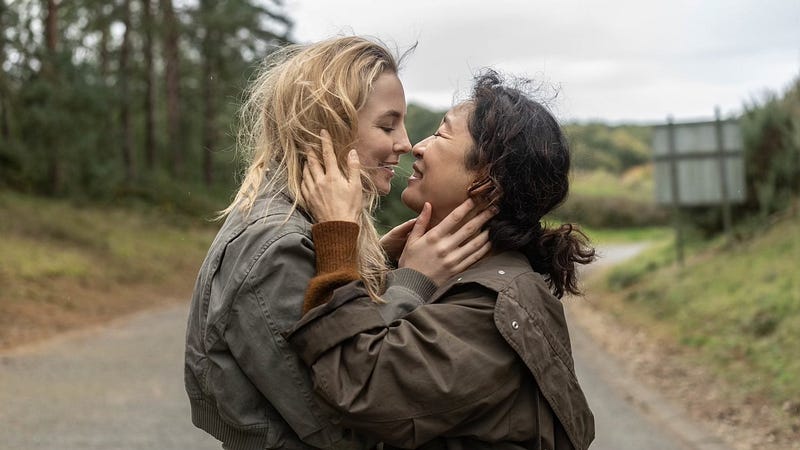
There are countless reasons why Neal ending the series as she did was so disappointing for viewers. At the most surface level, nothing was revealed. We gain no greater understanding of who the Twelve was and we don’t even know if they are really disbanded. We also gain no real insight into Carolyn’s role in it all. If the final shot of her sanctioning the hit on Villanelle was supposed to reveal something critical about her or the plot, it was lost on me. Far worse is the fact that the cliched plot mechanics of the climactic mission and the consummation of a forbidden passion just before one lover dies tragically are so profoundly conventional for a series that had thrived on being so unexpected and subversive.
I don’t really know how I wanted Killing Eve to end. But I’m certain that this wasn’t it. Perhaps Eve and Villanelle could have defied the odds and run off together, Eve’s transformation to evil being complete. Perhaps one of them could have killed the other, which would have been a fitting end to the profoundly dangerous dance they had been engaged in for 4 seasons. I would have even been fine with them agreeing to leave each other again, indicating that the cycle would repeat forever. At the very least I wanted to see the pursuit of the Twelve reveal some twists and turns and for Carolyn’s role in it to yield something interesting. Unfortunately, what we got is one that will go down in the annals of television’s most disappointing series finales.
Best Episode: “Oh Goodie, I’m the Winner” (Episode 30)
Best Performance: Fiona Shaw, “It’s Agony and I’m Ravenous” (Episode 28)
Summary
It seems likely that like Game of Thrones, Lost, and other series before it, Killing Eve’s legacy will be dominated by the outrage sparked by its finale. Although the vitriol leveraged at the finale is deserved, the show still deserved to be celebrated for the bold risks it took and hours of top-notch entertainment it provided for much of its run (particularly its first half). And, if nothing else, it gave 3 of our most fascinating working actresses spectacularly memorable roles.
Follow the author on Medium and Twitter.
Check out other articles by this author about television and streaming series:


