
Killing Envy
My Strategies for Defeating Jealousy
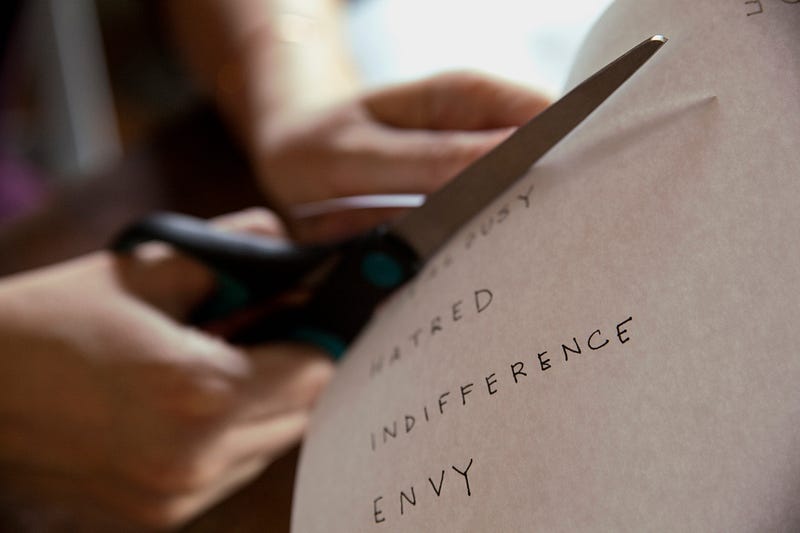
Envy is a vice I had to outwit at a very young age. Attending an elite private school with the daughters of the rich and famous, I quickly realized how much less I had than those around me — with regards to material wealth, at least. I was riding the subway for an hour from Crown Heights, Brooklyn to get to school; they were walking from Park Avenue or getting dropped off and picked up by a car service — even the occasional limo. I was sent to my grandparents for a month each summer (albeit on a beautiful Caribbean island); they travelled the world. I was happy to get a few dollars here and there on holidays and birthdays; they got consistent and generous allowances. I now know that some of my classmates and schoolmates weren’t as rich as I thought they were — some of them were on scholarships just like me, others were from families pretending to be wealthy, living stretched painfully far beyond their means. But I couldn’t see that then, my jealousy obscured my vision.
It wasn’t that I wanted their Park Avenue apartments. I liked that I lived in a house with a backyard (although I did wish I lived close enough to walk to school). I didn’t want all their clothes or toys, or any of their material things. I didn’t learn to covet stuff as a child — that’s a form of envy that found me later. What I was most envious of was their lack of worry — their (at least seemingly) carefree and nonchalant posture towards money. I wanted to be able to walk into a store and buy something without looking at, studying, and debating the price tag. I wanted to be frugal by choice, not necessity. I didn’t want to feel guilty whenever I had to ask my parents to buy something for me.
I wanted to be a kid that didn’t worry about money. And I didn’t just worry about money a little bit; I was consistently consumed by persistent and pervasive worry. I worried on behalf of myself and on behalf of my parents. I didn’t have (and couldn’t comprehend) all of the information regarding our family finances, but I knew enough to know that things were hard, and I worried about just how hard they really were — or might become. I always suspected that my parents were trying to insulate me from their financial stresses, but that only made my worry worse — let it run rampant and free without boundaries, growing as big as my imagination could hold. Every one of my financial fears weighed on my mind and tipped the scale in favor of jealousy.
But the older I got the more I understood — the more I learned what was really going on around me. One of the first things I discovered about jealousy is that much of its power is derived from a lack of information. Very few bouts of jealousy survive a close look into the life of the person being envied. And this realization came in tandem with another: it is futile and irresponsible to look at one part of a person’s life and envy it; you have to look at the whole picture — the good, the bad, and the unfortunate. Life is not a pick-and-choose buffet where you can put just those things you like most on your plate. Life is more like a sealed container of strawberries; you have to take all of what you get — every part. It might appear that someone else has gotten a perfect batch, but that’s just an illusion. Everyone gets a few sour or even rotten pieces of fruit in their life’s grocery bag. Everything might look sweet and wonderful from where you’re standing on line, but upon closer examination, you’ll see the imperfections. No one’s life is completely free of loss, sadness, pain, shortcomings, insecurities, or disappointments.
These realizations set me free from harboring jealousy. It was easy to look at the pieces and parts of another person’s life and feel envious, but now that I was looking at the whole, I found myself more satisfied. If life wasn’t a pick-and-choose buffet, if it was an all-or-nothing compendium of reality — good and bad, then I had a different question to ask. It wasn’t enough to wonder, “Why can’t I have her hair/figure/talents/money/intelligence?” I couldn’t just look at a part of a person — or a part of his/her life; I had to look at the whole. And so the question instead became this: Whose whole life would I take in lieu of mine — not just this part or that section of it, but the whole life?
Would I trade their faith (or lack thereof) for mine? No. Would I trade their parents and siblings for mine? No. And usually that’s as far as I needed to go before my jealousy would begin to abate. Because if I wanted any part of their life experience (their grades, self confidence, popularity, et cetera), I had to take everything else that came with it — be it a country house in the Hamptons, an eating disorder, great hair, or a suicidal parent. And whenever I looked at the sum total of a person’s life, I didn’t want to trade it for the sum total of mine. My reasons were diverse: I love my parents. I need God in my life. I love being strong and fast. I love the things I love, and I love the talents I have. Sure, I’d be tempted to give up some of the things that have made my life hard, or a few of my flaws, but I’d have to give up the good with the bad, and the good is good enough that I want to hold onto it — the people I love, the places I’ve been, the things I’ve done, the beauty I’ve seen — all worth it.
Realizing that jealousy thrives on a lack of information and that I can’t pick and choose the parts of another person’s life I’d like to trade for parts of my own, has helped me a great deal. Even when my mother died, and I was tempted to be jealous of anyone whose mother was still alive, I realized I wouldn’t trade their living mother for my own. I am sad that our time together wasn’t longer, but I wouldn’t want any other mother in her place. I wouldn’t trade all that she gave me simply by being who she was, just to have some other mother now.
I love my family — the one I was born into and the one I gained by marriage — so when jealousy knocks and I’m tempted to open the door, love for my family (not to mention my faith and friends) usually keeps that door securely closed — bolted shut with contentment.
But even when I’m satisfied, I’m still sometimes affected by envy — even when I’m happy with my life and wouldn’t trade it for another’s, I still really want this or that person’s salary/height/home/success/wardrobe/intelligence/hair/fill-in-the-blank. When the jealousy simply won’t die, I refocus. I allow myself to feel the yearning, but I don’t let it make me feel powerless. I ask myself if there is something I can do to pursue what I’m envying. That’s another question that is useful for killing envy: What am I willing to do to have what he/she has? If I envy his salary, am I willing to do the work or get the requisite degree to earn it? If I envy her figure, am I willing to exercise enough and restrict what I eat for it? If I envy something they own, am I willing to save up for long enough to buy it? If the answer is no, then the jealousy begins to evaporate. If the answer is yes, then my envy becomes the seed for a new dream and the motivation to tend to it.
Sometimes jealousy is a subtler infection. One of the sadder truths I’ve learned about myself is that I often confuse envying someone for disliking them. It’s something I’ve done since childhood. There was a girl in my grade school class that I disliked for the longest time. Everything she did irked me — every success she enjoyed inflamed my covetous anger. But as soon as I got a window into her suffering — as soon as I saw some of the imperfections in her life — I found her much easier to like. And that’s when I realized that I had never really disliked her; I’d simply been jealous of (and resented her for) the flawless life I’d thought she was living. I’d allowed her apparent perfection to fuel my own insecurities. But once I saw the true sum of her experiences, I could let her have it all without envy.
So now, whenever I come across someone I don’t like, I have to ask myself a few questions: Do I really not like this person, or am I just jealous? Am I allowing my jealousy to cloud my perception? Is something about him or her eliciting my feelings of inadequacy? Do I want what they have enough to do all they’ve done (or endure all they’ve endured) in order to have it?
Again, this process isn’t perfect, but it helps me to keep jealousy in her place. It helps me to not reduce people to what they do or do not have. And, perhaps more importantly, it helps me to not see myself that way. It keeps me humbled and grateful for what I have. And it reminds me that no one (no matter how perfect their life appears) gets through his or her earthly existence in a bubble of perfection and uninterrupted bliss. Every life will be touched by hardship and suffering. Every life will taste loss. Everyone has danced with insecurity or played with discontent. Flaws and fears — no one is without those.
And while it might seem morbid to focus on this, sometimes it’s the only dose of reality that cures my jealousy — killing envy before envy kills me. The antidote is simple: It is much harder for me to begrudge the blessings being poured into the lives of others while also considering the losses and struggles that weigh them down.
A version of this piece originally appeared on Write Away.


