
Killers of the Flower Moon is worth your time
Shedding light on an ugly period of US history
I recently had the pleasure of watching Killers of the Flower Moon in a local cinema. Despite having great admiration for director Martin Scorsese, I was a bit skeptical of the almost 3,5 hour runtime. As others might be too, I would like to share my thoughts on what I have seen.
In discussing the movie, there will inevitably be some spoilers for those who want to see it fresh. This goes particularly for those not already familiar with the Osage Indian murders, as the main characters and story beats are grounded in actual events.
Historical Background
In the early 20th century, oil was found in territory inhabited by Osage people (a Native American tribe), in what is today known as Oklahoma. This catapulted them into immense wealth, made all the more bittersweet by the fact that the US government had forced them to live there.
In 1921 Congress passed a law stating that the Osage would be required to have white legal guardians to manage their finances, deeming them too incompetent to do so themselves. This left the Osage tragically vulnerable to being exploited by the white “community” that flocked to them and their assets.
Several Osage women married white men, as then their guardian would at least be their own husband. This meant that their husbands stood to inherit their rights to the land in the case of their passing. The grim reality is that many of these men married for money and were quite willing to take part in killing their spouses.
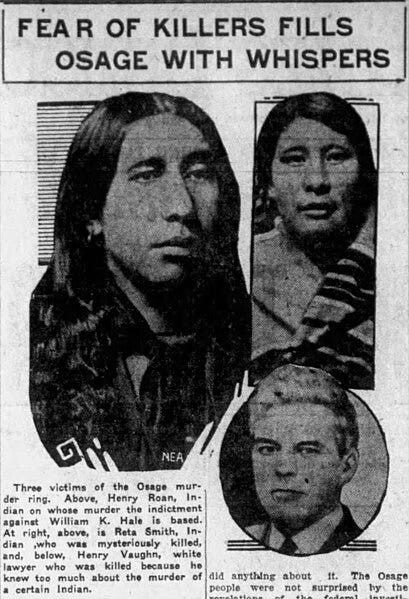
Though the exact numbers are unknown, dozens of suspicious deaths and outright murders occurred in the Osage tribe, primarily in the 1920s. Widespread corruption and blatant disregard for the wellbeing of the Osage people meant local law enforcement did little to investigate.
Central to the movie (and the non-fiction book it was based on, by David Grann) is the family of Mollie Burkhart. This native American woman lost her sisters and mother, and had to fear for her own life.
Though in these cases the truth was ultimately brought to light, many of the murders went unsolved, their perpetrators never brought to justice.

The Film
In an early scene, one of the main characters in the movie reads out a line from a children’s book: “Can you find the wolves in this picture?” Though a bit on the nose, it is abundantly clear who the wolves are in this picture.
Scorcese is no stranger to telling the tales of ruthless men drowning in their own darkness, with this particular tale having the sting of being non-fiction. He has collaborated before with both Robert De Niro and Leonardo DiCaprio, though not in the same movie (they did however star together in This Boy’s Life from 1993).
De Niro is perfectly cast as the mastermind of the crimes, posing as a considerate community leader and friend to the Osage. DiCaprio often plays suave and quick-witted characters, but this time around portrays an easily manipulated dimwit under the evil influence of his uncle (De Niro).
Despite the acting chops on display with these veteran actors, Lily Gladstone stood out to me with her portrayal of Mollie Burkhart. Her performance is subtle, emotions often shown through expressions rather than words. I would not be surprised to see her nominated for an Academy Award.
The score provides an interesting mixture of blues and tribal elements. Robbie Robertson, of The Band fame, acted as composer and has worked with Scorcese before. Of Native American descent himself, he unfortunately passed away a few months before the film’s release.
While you will have to see for yourself how it’s done, Scorcese seems to acknowledge the fact that the movie, too, could be seen as exploitative of the tragedy that befell the Osage people. I believe he sincerely wishes to tell their tale.
In conclusion, on the question this article started with: the film is well worth your time and you will likely learn something new about an overlooked part of history. It felt perhaps around 30 minutes too long overall (and you best go in with an empty bladder), but it went by quickly.
Hard recommend.