
Killer Caterpillars of the Côte D’Azur
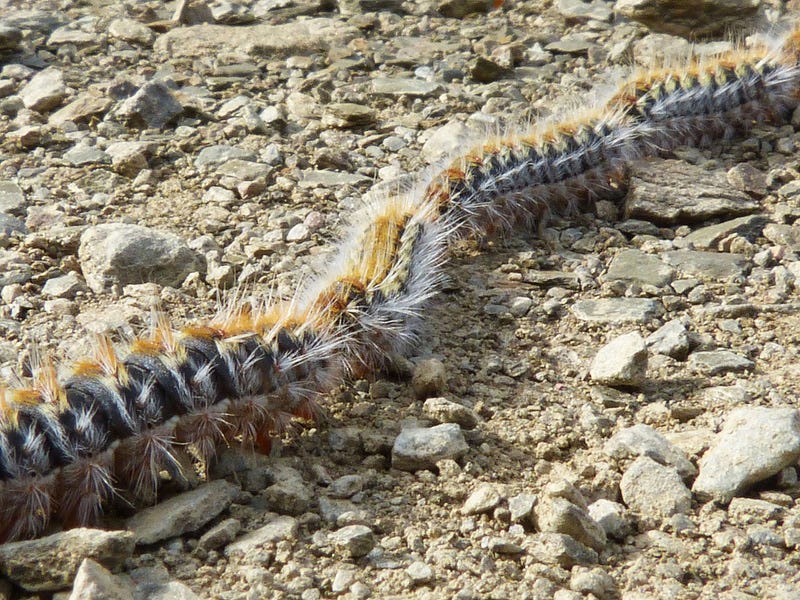
Alice in Wonderland featured a hookah-smoking caterpillar. The true-life caterpillars of the Côte D’Azur are far more evil. They can kill dogs and blind people, and no pills can protect you.
The first time I saw the killer caterpillars of the French Riviera, my reaction was curiosity, even amazement. The Chenilles Processionaires, ugly black caterpillars with white dots and evil orange fuzz, were crawling straight down one of our pine trees single-file, one after the other, tens and even hundreds at a time. They inched down the tree and began to make their way slowly across the upper-level terrace, not one of them deviating from the ramrod-straight formation. None of our neighbors had warned us about the chenilles, but they looked a little like the woolly caterpillars we used to find in New Jersey, so I let one crawl onto my finger and showed it to my sons. “See, a woolly caterpillar. Nothing to be frightened of, but don’t step on them. They squish and make an awful mess.”
It turns out, that mess would be nothing compared to what happened to my neck, arms, legs, and body for the next two weeks. I didn’t make the connection at first, even when the whole family began to sprout blotchy red bumps in unseemly places. It was our local doctor who explained the problem. “Don’t ever touch the chenilles. They are extremely poisonous. Even brushing your hand across any surface — the bark of a tree, the stones of a patio — where they have passed can give you a terrible rash.”
We called the local municipality to find out what to do. They gave us few alternatives: cut down the nests before the caterpillars emerged (it was already too late; we were in the midst of an unseasonably warm winter), trim the pines so their branches would present fewer breeding opportunities for the cocoons (also too late), treat the pines next September (too early), and burn every chenille we saw (bingo). We survived the chenille season armed with pills and creams in one hand, alcohol brulée and matches in the other.
I was away the following September and forgot to call the élager. Suddenly, after Christmas, all the pine trees on our property were sprouting ball-like pods of soft grey down. It looked like the Invasion of the Body Snatchers. All the terraces were littered with granules of masticated pine needles; chenille pollen, it’s called. We knew what was coming, as inevitably as the sun and the balmy temperatures of a premature spring.
And this time, we had a new dog. “What do I do in chenille season?,” I’d had the sense to ask the breeder when we picked up Homer, our Weimaraner puppy. Her face darkened immediately. “Oh, keep him away from them. Don’t let him eat them. His aunt bit into a cocoon when she was young, and she has had to spend the rest of her life with half a tongue.”
That was only the first of the terrible tales we were to hear in the following weeks, as the cocoons blossomed above our heads and the green granules spread like a tapestry on the terrace. We heard about dogs who died when their tongues swelled, or when their sensitive noses picked up the trace of the chenilles on the ground. The local vet talked about the number of dogs running around Provence with pieces of their tongues missing. He told us about similar cases in Spain, Italy, Corsica and Sardinia, in fact, the whole Southern Mediterranean region. He even told us about a man who was sleeping under a tree when some chenille pollen fell into his eye. “Got inflamed and lost the eye,” the vet concluded, with almost the same empathy he reserved for tongueless dogs.
Homer’s allergic reaction began at about the same time mine did. But his was worse. Blotches on his belly, secretions from his ears, a constant itching that had him tearing in frustration at his pink-rimmed eyes. Two days of antibiotics brought him back to health but left me drained and angry. How do you train a dog to stay outside when every tree bears evil tidings? How do you housebreak a puppy when the ground is littered with poisonous pellets?
All the other problems of handling a dog — their flatulence and snoring and turd-eating ways — pale in comparison to this. So I counted the days till the nid-cutters came. My sons turned into ruthless pyromaniacs. We wore gloves outside and walked only in the middle of the road. And Homer, an outdoor animal born and bred, was placed under house arrest till every ominous pod had erupted.
Meanwhile, I wonder why the regional government does so little to address the problem. The beautiful parasol pines that grace the Riviera are threatened with destruction. Many of France’s ten million dogs face death or mutilation. And normal human beings suffer allergic reactions so violent they can wind up in the hospital . . . or worse. All because of malevolent little creatures from a horror movie that no one talks about publicly. Buzz off, killer bees. Back to your caves, vampire bats. The real nightmare is crawling down the tree right now.


