Company</a>, working with this non-adapted material filled me with much confidence. So in the end, it ticked many boxes.</p><p id="d463">This is a summary of the most significant aspects my students were exposed to:</p><ul><li>A great variety of vocabulary connected to fear, loss, and grief</li><li>Present simple, past simple, routine in the past, modal verbs, irregular verbs, and conditionals</li><li>Detailed descriptions of landscape, weather, and places</li><li>Physical descriptions of the characters</li><li>Historical references such as the First World War</li><li>Dynamics that triggered their empathy thanks to the relationship between Howard and Oolu</li><li>The Cosmic Horror of H. P. Lovecraft</li><li>How “Fear Makes Monsters” (chapter 10)</li></ul><h2 id="ec95">Why should kids be introduced to horror?</h2><p id="be62">When Jim McLeod asked the question: When do we introduce our children to Horror? in his “<i>Blah, Blah, Blah, Introduction, For the Grown-Ups</i>” for <a href="https://www.amazon.es/Old-One-Sea-Lex-Jones/dp/1912578158"><i>The Old One And The Sea</i></a>, he was opening, without noticing, a can of worms. For me it is more: Why isn’t horror approached and taught in schools? and if it’s done: Why is it done so briefly and maybe only for Halloween? Why do we keep trying to protect our kids from developing their sense of fear? Why do we have this necessity of sugar-coating reality, when the reality is sometimes worse than fiction?</p><p id="4b24">I see many adults treating horror as something pornographic that kids shouldn’t be exposed to, intensifying their curiosity and making them hide in shame to read what could become their favourite Genre.</p><blockquote id="7c0e"><p>…in this “enlightened era” where everything has the potential to cause offence and outrage among the chattering classes, we are concerned that our love for the dark genre will be frowned upon by those who do not understand its worth as an art form. — Jim MacLeod.</p></blockquote><p id="7547">Another author who talks about the benefits of reading scary stories is <a href="undefined">Joe Ballarini</a>. In his article <a href="https://readmedium.com/heres-why-your-kids-need-scary-stories-28dde90e1cd2"><i>Should Kids Read Scary Stories?</i></a><i> </i>he<i> </i>writes:</p><blockquote id="1711"><p>It’s a chance to face their fears. Because, it’s a scary world out there, especially for children. They see stuff we never see. And I think scary stories help them understand that it’s okay to be afraid of the dark as long as they are brave enough to turn on the lights.</p></blockquote><h2 id="0af9">What happens to the brain when exposed to horror</h2><p id="b687">In her article <a href="https://www.thenationalnews.com/lifestyle/the-science-of-being-scared-why-we-chase-the-fear-high-1.1101666"><i>The science of being scared: why we chase the fear high</i></a>, Gemma White refers to Johanna Richmond, a psychologist at Cognitive Behaviour Therapy in Dubai, to talk about what she calls the “dopamine high”.</p><p id="62b9">For those who are not familiarised with this neuromodulatory molecule, dopamine triggers ‘euphoria’ activating “ the parasympathetic nervous system, sending a message to the brain to say: ‘ This is exciting. Scary but exciting.’”</p><p id="af90">So exposure in the right balance is positive for kids and the development of their neural pathways.</p><h2 id="1b00">So When Should Kids Be Introduced to Horror at Home?</h2><p id="d49e">Personally, I think kids should be introduced to horror as soon as they become afraid of the monsters under their beds, that is between the ages of three and five.</p><p id="b35f">If they get dressed as cute monsters from the age of six months old, and we expose them to other kids with scary makeup, gross sweets and decorations, because it’s Halloween, why can’t we expose them to films and even buy them horror books at the same time?</p><p id="46cf">Make it part of your TV routine to watch suitable horror with your kids and talk about it like you would do with other things they watch.</p><p id="0817">Give them the tools to help them differentiate between reality and fiction, but also to go over the whys and why nots, make them elaborate their own theories and stimulate their imaginations.</p><h2 id="c88b">What about schools?</h2><p id="4957">Schools should introduce students to all different literary genres in a balanced way. I don’t remember really working on ghost stories or horror in my
Options
student life, and at university, this exposure was very limited.</p><p id="7f23">Are we creating monsters by protecting our kids from what it’s so intrinsically part of what makes us human? I’m not a psychologist, but I’m inclined to think so.</p><p id="9578">At the end of the day a balanced curriculum to prepare our kids for the real world is what education should be all about, don’t you think?</p><p id="326b">If you want to watch my video podcast regarding this subject you can click on the following link:</p>
<figure id="947c">
<div>
<div>
<img class="ratio" src="http://placehold.it/16x9">
<iframe class="" src="https://cdn.embedly.com/widgets/media.html?src=https%3A%2F%2Fwww.youtube.com%2Fembed%2FxE99-4d2gSk%3Ffeature%3Doembed&display_name=YouTube&url=https%3A%2F%2Fwww.youtube.com%2Fwatch%3Fv%3DxE99-4d2gSk&image=https%3A%2F%2Fi.ytimg.com%2Fvi%2FxE99-4d2gSk%2Fhqdefault.jpg&key=a19fcc184b9711e1b4764040d3dc5c07&type=text%2Fhtml&schema=youtube" allowfullscreen="" frameborder="0" height="480" width="854">
</div>
</div>
</figure></iframe></div></div></figure><h2 id="3b83">Takeaways</h2><ul><li>Horror can be a fun activity to embrace at home and in class</li><li>Reading horror and ghost stories allows kids to work on their fears in a healthy and friendly way</li><li>Kids develop their Critical Thinking when they are confronted with different scenarios in horror books</li><li>Horror can help them see the stories from different angles and develop their empathy through the characters</li><li>Kids who don’t like reading other genres may take a fancy to horror, helping them develop their reading skills</li><li>Reading horror helps students work on vocabulary connected to grief, fear and loss in ways that other books don’t</li><li>Exposure to fear allows kids to confront their own monsters and therefore grow psychologically healthier</li></ul><h2 id="dafb">Question for you</h2><p id="c7ea">Were you exposed to horror and ghost stories as a child? What was your experience? Do you think horror should be part of the school’s curriculum? I’m curious to know your thoughts.</p><h2 id="672b">If you liked this article you may also want to read:</h2><div id="625f" class="link-block">
<a href="https://readmedium.com/all-the-benefits-from-a-christmas-horror-reading-group-cde87594000b">
<div>
<div>
<h2>All The Benefits From A Christmas Horror Reading Group</h2>
<div><h3>Despite what most people think, horror groups are amazingly healthy</h3></div>
<div><p>medium.com</p></div>
</div>
<div>
<div style="background-image: url(https://miro.readmedium.com/v2/resize:fit:320/1*D08Job2o86GHRV9VuWBf2A.png)"></div>
</div>
</div>
</a>
</div><div id="f9d1" class="link-block">
<a href="https://alicegothicland.medium.com/fiction-your-best-ally-to-overcome-your-fears-573465670b72">
<div>
<div>
<h2>Fiction: Your Best Ally To Overcome Your Fears</h2>
<div><h3>People go to Fiction films and books to disconnect from their daily problems. However, watching Horror films or reading…</h3></div>
<div><p>alicegothicland.medium.com</p></div>
</div>
<div>
<div style="background-image: url(https://miro.readmedium.com/v2/resize:fit:320/1*4hqrDZzVb7TDwRkHV9jAPw.png)"></div>
</div>
</div>
</a>
</div><div id="c0a5" class="link-block">
<a href="https://alicegothicland.medium.com/as-well-as-entertain-you-the-gothic-can-help-you-develop-your-critical-thinking-and-overcome-many-fba97a035755">
<div>
<div>
<h2>As Well As Entertain You, The Gothic Can Help You Develop Your Critical Thinking And Overcome Many…</h2>
<div><h3>The Gothic is still a big unknown and yet is a powerful tool of education that most miss.</h3></div>
<div><p>alicegothicland.medium.com</p></div>
</div>
<div>
<div style="background-image: url(https://miro.readmedium.com/v2/resize:fit:320/1*M5MaPc7Dgq2LslzxZFpibw.png)"></div>
</div>
</div>
</a>
</div></article></body>
Following my video and my article on Books that boosted my Critical Thinking in 2021 a couple of weeks ago, today I want to talk about Horror, Critical Thinking, and kids.
In order to do that I am going to refer back to a book, I read in class last year with my group of young learners of English as a second language: The Old One And The Seawritten by Lex H Jones and illustrated by Liam ‘Pais’ Hill.
I already talked about this book in my blog after having interviewed both Lex and Liam. These are my thoughts on the book and the interview if you are interested:
I interviewed Lex and Liam back on 17th July 2021. Lex, who is also the author of various short horror stories and books, is the same author who got a bunch of other horror writers reading each other’s stories last Christmas; a great experience I’m hoping to repeat again.
If you want to watch the whole interview with Lex and Liam here is the link:
Although The Old One And The Sea mightmake us think of Ernest Hemingway’s novel with a similar name The Old Man And The Sea, and has the element of the sea and of a strange and scary creature in it, the book in Jim Mcleod’s introductory note to the book, is “an accomplished story” in which:
…Lex’s use of a young H. P. Lovecraft, and how he becomes a writer is inspired, a bittersweet story, full of joy and wonder and probably the nicest depiction of Cthulhu ever committed to the page.
How this book benefited my students
I was unaware of the fact that this book had been used in English classes in other parts of the world. But when you take a closer look you can see why. It is a beautiful book, not too long not too short, with a clean image and lovely drawings.
Also, since I am a supporter, follower, reader, and reviewer of the Sinister Horror Company, working with this non-adapted material filled me with much confidence. So in the end, it ticked many boxes.
This is a summary of the most significant aspects my students were exposed to:
A great variety of vocabulary connected to fear, loss, and grief
Present simple, past simple, routine in the past, modal verbs, irregular verbs, and conditionals
Detailed descriptions of landscape, weather, and places
Physical descriptions of the characters
Historical references such as the First World War
Dynamics that triggered their empathy thanks to the relationship between Howard and Oolu
The Cosmic Horror of H. P. Lovecraft
How “Fear Makes Monsters” (chapter 10)
Why should kids be introduced to horror?
When Jim McLeod asked the question: When do we introduce our children to Horror? in his “Blah, Blah, Blah, Introduction, For the Grown-Ups” for The Old One And The Sea, he was opening, without noticing, a can of worms. For me it is more: Why isn’t horror approached and taught in schools? and if it’s done: Why is it done so briefly and maybe only for Halloween? Why do we keep trying to protect our kids from developing their sense of fear? Why do we have this necessity of sugar-coating reality, when the reality is sometimes worse than fiction?
I see many adults treating horror as something pornographic that kids shouldn’t be exposed to, intensifying their curiosity and making them hide in shame to read what could become their favourite Genre.
…in this “enlightened era” where everything has the potential to cause offence and outrage among the chattering classes, we are concerned that our love for the dark genre will be frowned upon by those who do not understand its worth as an art form. — Jim MacLeod.
It’s a chance to face their fears. Because, it’s a scary world out there, especially for children. They see stuff we never see. And I think scary stories help them understand that it’s okay to be afraid of the dark as long as they are brave enough to turn on the lights.
For those who are not familiarised with this neuromodulatory molecule, dopamine triggers ‘euphoria’ activating “ the parasympathetic nervous system, sending a message to the brain to say: ‘ This is exciting. Scary but exciting.’”
So exposure in the right balance is positive for kids and the development of their neural pathways.
So When Should Kids Be Introduced to Horror at Home?
Personally, I think kids should be introduced to horror as soon as they become afraid of the monsters under their beds, that is between the ages of three and five.
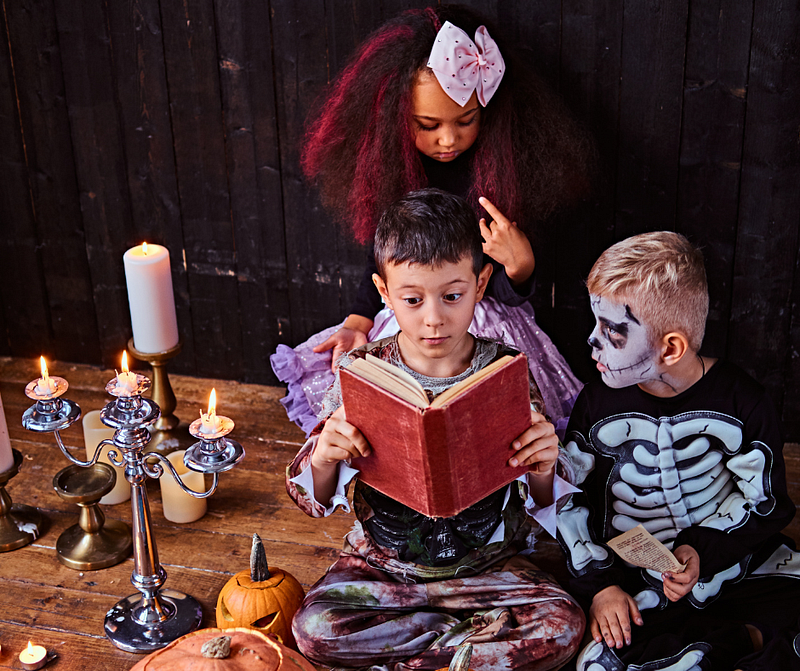
If they get dressed as cute monsters from the age of six months old, and we expose them to other kids with scary makeup, gross sweets and decorations, because it’s Halloween, why can’t we expose them to films and even buy them horror books at the same time?
Make it part of your TV routine to watch suitable horror with your kids and talk about it like you would do with other things they watch.
Give them the tools to help them differentiate between reality and fiction, but also to go over the whys and why nots, make them elaborate their own theories and stimulate their imaginations.
What about schools?
Schools should introduce students to all different literary genres in a balanced way. I don’t remember really working on ghost stories or horror in my student life, and at university, this exposure was very limited.
Are we creating monsters by protecting our kids from what it’s so intrinsically part of what makes us human? I’m not a psychologist, but I’m inclined to think so.
At the end of the day a balanced curriculum to prepare our kids for the real world is what education should be all about, don’t you think?
If you want to watch my video podcast regarding this subject you can click on the following link:
Takeaways
Horror can be a fun activity to embrace at home and in class
Reading horror and ghost stories allows kids to work on their fears in a healthy and friendly way
Kids develop their Critical Thinking when they are confronted with different scenarios in horror books
Horror can help them see the stories from different angles and develop their empathy through the characters
Kids who don’t like reading other genres may take a fancy to horror, helping them develop their reading skills
Reading horror helps students work on vocabulary connected to grief, fear and loss in ways that other books don’t
Exposure to fear allows kids to confront their own monsters and therefore grow psychologically healthier
Question for you
Were you exposed to horror and ghost stories as a child? What was your experience? Do you think horror should be part of the school’s curriculum? I’m curious to know your thoughts.
If you liked this article you may also want to read: