
Kickstarting a book to end enshittification, because Amazon will not carry it
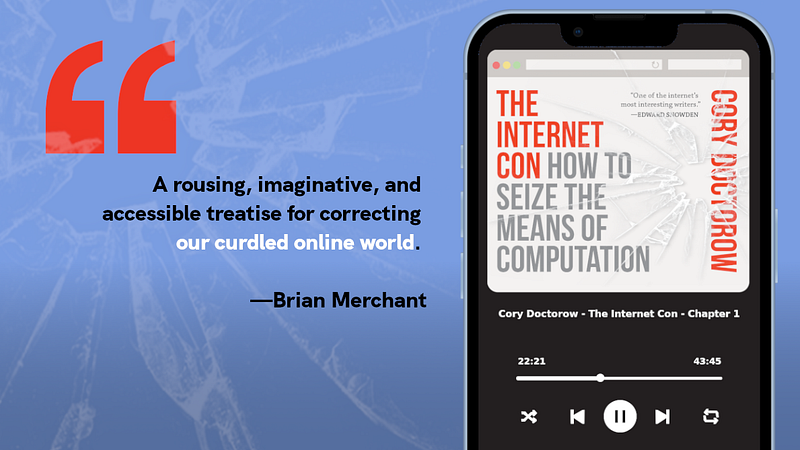
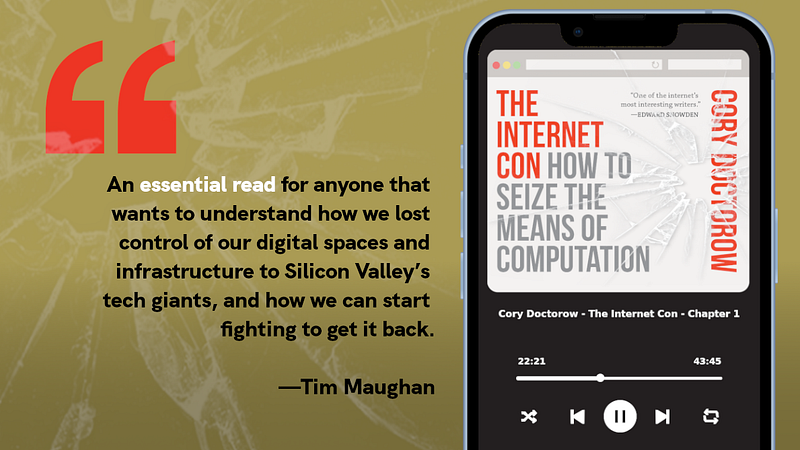
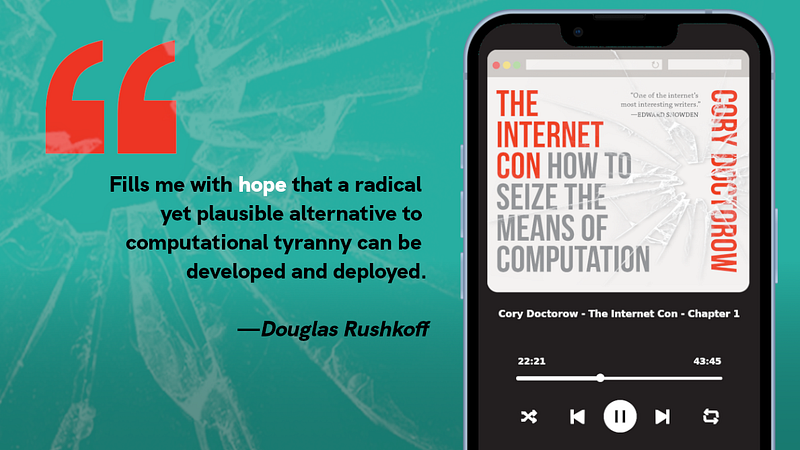
“The Internet Con: How to Seize the Means of Computation” comes out from Verso on Sept 5.
Next weekend (Aug 4–6), I’ll be in Austin for Armadillocon, a science fiction convention, where I’m the Guest of Honor:
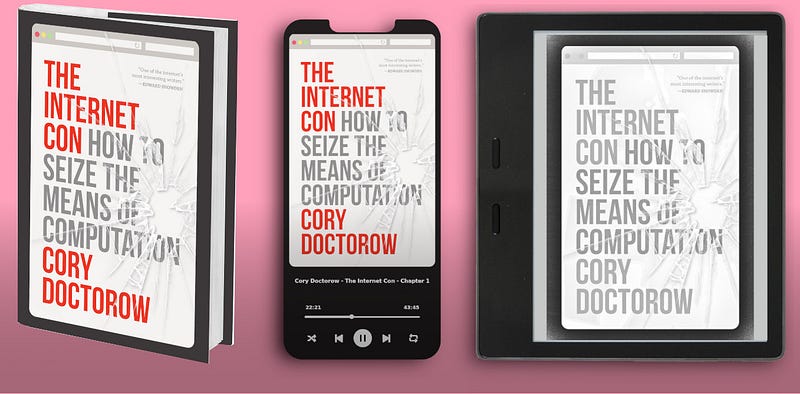
My next book is The Internet Con: How to Seize the Means of Computation: it’s a Big Tech disassembly manual that explains how to disenshittify the web and bring back the old good internet. The hardcover comes from Verso on Sept 5, but the audiobook comes from me — because Amazon refuses to sell my audio:
https://www.kickstarter.com/projects/doctorow/the-internet-con-how-to-seize-the-means-of-computation
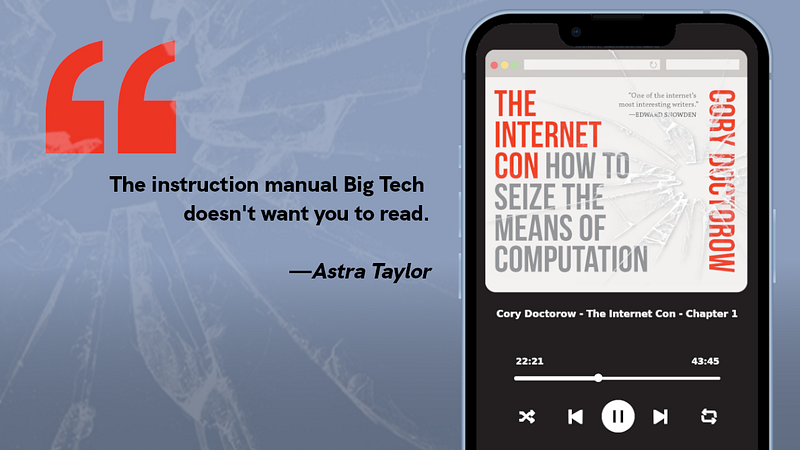
Amazon owns Audible, the monopoly audiobook platform that controls >90% of the audio market. They require mandatory DRM for every book sold, locking those books forever to Amazon’s monopoly platform. If you break up with Amazon, you have to throw away your entire audiobook library.
That’s a hell of a lot of leverage to hand to any company, let alone a rapacious monopoly that ran a program targeting small publishers called “Project Gazelle,” where execs were ordered to attack indie publishers “the way a cheetah would pursue a sickly gazelle”:
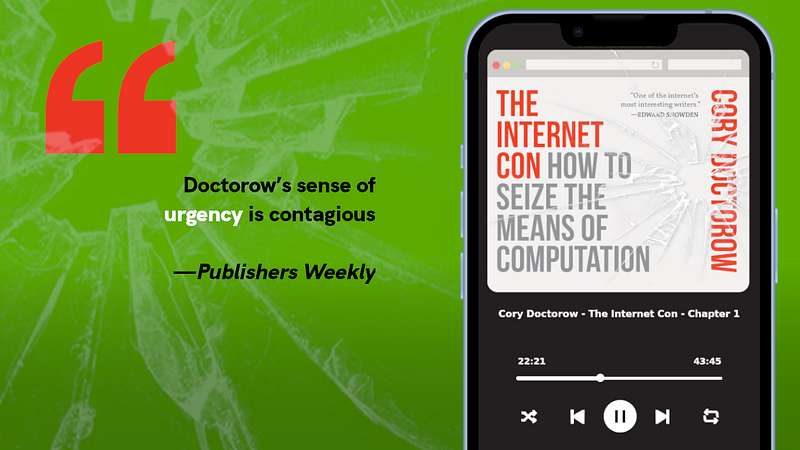
I won’t sell my work with DRM, because DRM is key to the enshittification of the internet. Enshittification is why the old, good internet died and became “five giant websites filled with screenshots of the other four” (h/t Tom Eastman). When a tech company can lock in its users and suppliers, it can drain value from both sides, using DRM and other lock-in gimmicks to keep their business even as they grow ever more miserable on the platform.
Here is how platforms die: first, they are good to their users; then they abuse their users to make things better for their business customers; finally, they abuse those business customers to claw back all the value for themselves. Then, they die:
https://pluralistic.net/2023/01/21/potemkin-ai/#hey-guys
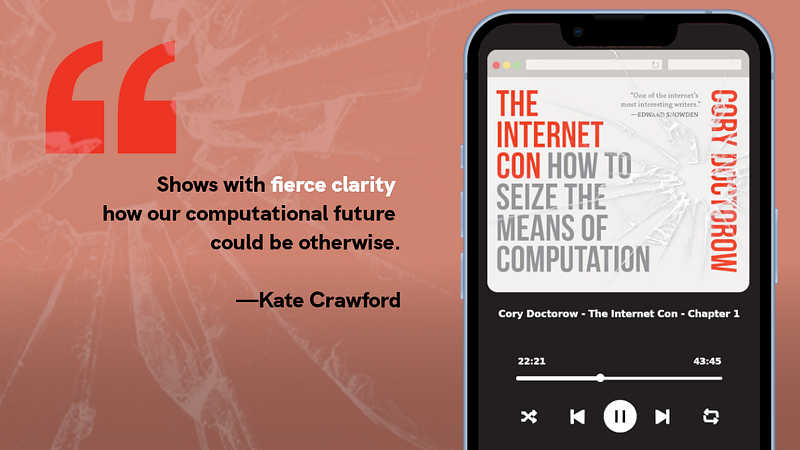
The Internet Con isn’t just an analysis of where enshittification comes from: it’s a detailed, shovel-ready policy prescription for halting enshittification, throwing it into reverse and bringing back the old, good internet.
How do we do that? With interoperability: the ability to plug new technology into those crapulent, decaying platform. Interop lets you choose which parts of the service you want and block the parts you don’t (think of how an adblocker lets you take the take-it-or-leave “offer” from a website and reply with “How about nah?”):
https://www.eff.org/deeplinks/2019/07/adblocking-how-about-nah
But interop isn’t just about making platforms less terrible — it’s an explosive charge that demolishes walled gardens. With interop, you can leave a social media service, but keep talking to the people who stay. With interop, you can leave your mobile platform, but bring your apps and media with you to a rival’s service. With interop, you can break up with Amazon, and still keep your audiobooks.
So, if interop is so great, why isn’t it everywhere?
Well, it used to be. Interop is how Microsoft became the dominant operating system:
It’s how Apple saved itself from Microsoft’s vicious campaign to destroy it:
Every tech giant used interop to grow, and then every tech giant promptly turned around and attacked interoperators. Every pirate wants to be an admiral. When Big Tech did it, that was progress; when you do it back to Big Tech, that’s piracy. The tech giants used their monopoly power to make interop without permission illegal, creating a kind of “felony contempt of business model” (h/t Jay Freeman).
The Internet Con describes how this came to pass, but, more importantly, it tells us how to fix it. It lays out how we can combine different kinds of interop requirements (like the EU’s Digital Markets Act and Massachusetts’s Right to Repair law) with protections for reverse-engineering and other guerrilla tactics to create a system that is strong without being brittle, hard to cheat on and easy to enforce.
What’s more, this book explains how to get these policies: what existing legislative, regulatory and judicial powers can be invoked to make them a reality. Because we are living through the Great Enshittification, and crises erupt every ten seconds, and when those crises occur, the “good ideas lying around” can move from the fringes to the center in an eyeblink:
https://pluralistic.net/2023/06/12/only-a-crisis/#lets-gooooo
After all, we’ve known Big Tech was rotten for years, but we had no idea what to do about it. Every time a Big Tech colossus did something ghastly to millions or billions of people, we tried to fix the tech company. There’s no fixing the tech companies. They need to burn. The way to make users safe from Big Tech predators isn’t to make those predators behave better — it’s to evacuate those users:
https://pluralistic.net/2023/07/18/urban-wildlife-interface/#combustible-walled-gardens
I’ve been campaigning for human rights in the digital world for more than 20 years; I’ve been EFF’s European Director, representing the public interest at the EU, the UN, Westminster, Ottawa and DC. This is the subject I’ve devoted my life to, and I live my principles. I won’t let my books be sold with DRM, which means that Audible won’t carry my audiobooks. My agent tells me that this decision has cost me enough money to pay off my mortgage and put my kid through college. That’s a price I’m willing to pay if it means that my books aren’t enshittification bait.
But not selling on Audible has another cost, one that’s more important to me: a lot of readers prefer audiobooks and 9 out of 10 of those readers start and end their searches on Audible. When they don’t find an author there, they assume no audiobook exists, period. It got so bad I put up an audiobook on Amazon — me, reading an essay, explaining how Audible rips off writers and readers. It’s called “Why None of My Audiobooks Are For Sale on Audible”:
https://pluralistic.net/2022/07/25/can-you-hear-me-now/#acx-ripoff
To get my audiobooks into readers’ ears, I pre-sell them on Kickstarter. This has been wildly successful, both financially and as a means of getting other prominent authors to break up with Amazon and use crowdfunding to fill the gap. Writers like Brandon Sanderson are doing heroic work, smashing Amazon’s monopoly:
And to be frank, I love audiobooks, too. I swim every day as physio for a chronic pain condition, and I listen to 2–3 books/month on my underwater MP3 player, disappearing into an imaginary world as I scull back and forth in my public pool. I’m able to get those audiobooks on my MP3 player thanks to Libro.fm, a DRM-free store that supports indie booksellers all over the world:
https://blog.libro.fm/a-qa-with-mark-pearson-libro-fm-ceo-and-co-founder/
Producing my own audiobooks has been a dream. Working with Skyboat Media, I’ve gotten narrators like Wil Wheaton, Amber Benson, Neil Gaiman and Stefan Rudnicki for my work:
But for this title, I decided that I would read it myself. After all, I’ve been podcasting since 2006, reading my own work aloud every week or so, even as I traveled the world and gave thousands of speeches about the subject of this book. I was excited (and a little trepedatious) at the prospect, but how could I pass up a chance to work with director Gabrielle de Cuir, who has directed everyone from Anne Hathaway to LeVar Burton to Eric Idle?
Reader, I fucking nailed it. I went back to those daily recordings fully prepared to hate them, but they were good — even great (especially after my engineer John Taylor Williams mastered them). Listen for yourself!
https://archive.org/details/cory_doctorow_internet_con_chapter_01
I hope you’ll consider backing this Kickstarter. If you’ve ever read my free, open access, CC-licensed blog posts and novels, or listened to my podcasts, or come to one of my talks and wished there was a way to say thank you, this is it. These crowdfunders make my DRM-free publishing program viable, even as audiobooks grow more central to a writer’s income and even as a single company takes over nearly the entire audiobook market.
Backers can choose from the DRM-free audiobook, DRM-free ebook (EPUB and MOBI) and a hardcover — including a signed, personalized option, fulfilled through the great LA indie bookstore Book Soup:
https://www.kickstarter.com/projects/doctorow/the-internet-con-how-to-seize-the-means-of-computation
What’s more, these ebooks and audiobooks are unlike any you’ll get anywhere else because they are sold without any terms of service or license agreements. As has been the case since time immemorial, when you buy these books, they’re yours, and you are allowed to do anything with them that copyright law permits — give them away, lend them to friends, or simply read them with any technology you choose.
As with my previous Kickstarters, backers can get their audiobooks delivered with an app (from libro.fm) or as a folder of MP3s. That helps people who struggle with “sideloading,” a process that Apple and Google have made progressively harder, even as they force audiobook and ebook sellers to hand over a 30% app tax on every dollar they make:
Enshittification is rotting every layer of the tech stack: mobile, payments, hosting, social, delivery, playback. Every tech company is pulling the rug out from under us, using the chokepoints they built between audiences and speakers, artists and fans, to pick all of our pockets.
The Internet Con isn’t just a lament for the internet we lost — it’s a plan to get it back. I hope you’ll get a copy and share it with the people you love, even as the tech platforms choke off your communities to pad their quarterly numbers.
If you’d like an essay-formatted version of this post to read or share, here’s a link to it on pluralistic.net, my surveillance-free, ad-free, tracker-free blog:
https://pluralistic.net/2023/07/31/seize-the-means-of-computation/#the-internet-con
Cory Doctorow (craphound.com) is a science fiction author, activist, and blogger. He has a podcast, a newsletter, a Twitter feed, a Mastodon feed, and a Tumblr feed. He was born in Canada, became a British citizen and now lives in Burbank, California. His latest nonfiction book is Chokepoint Capitalism (with Rebecca Giblin), a book about artistic labor market and excessive buyer power. His latest novel for adults is Red Team Blues. His latest short story collection is Radicalized. His latest picture book is Poesy the Monster Slayer. His latest YA novel is Pirate Cinema. His latest graphic novel is In Real Life. His forthcoming books include The Internet Con: How To Seize the Means of Computation, a detailed policy plan for dismantling Big Tech (Verso, 2023); and The Lost Cause, a utopian post-GND novel about truth and reconciliation with white nationalist militias (Tor, 2023).


