
Kiang
You bet your ass this word is real
Today’s New York Times Spelling Bee letters:
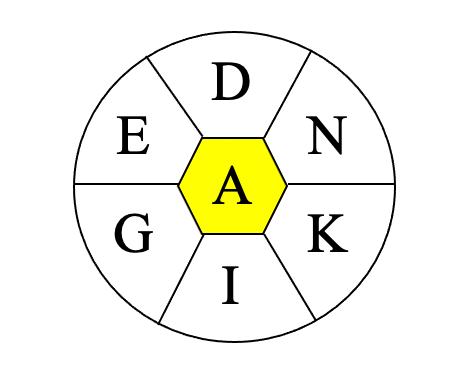
D, E, G, I, K, N, and center A (all words must include A).
Merriam-Webster says…

Silly little dictionary! Don’t you know kiang can’t possibly be a word if the New York Times says it ain’t?
For further fascinating facts, check out the Spelling Bee Master.
What’s your favorite dord* from today’s puzzle?
My Two Cents
The kiang is not just any wild ass, it’s the biggest — and maybe baddest — of the wild asses. Now, I haven’t actually met any wild asses; most of the ones I know are the subdued, intellectual type. But I’ve heard the kiang gets pretty crazy and wasted during parties, especially at colleges of the Big Ten Conference.
Equus Asinus
The wild ass is a subgenus of the Equus genus, which is best know for including horses and zebras. Basically what this means is that asses are a subdivision of horses. The shorter, chubbier, less attractive subdivision, the one that is more likely to end up going home alone Saturday night after last call at the club.
You may be asking yourself what the difference between an ass, a donkey, and a mule is. Lucky for you, I ripped out the page from the Denny’s menu that explains this with photos:
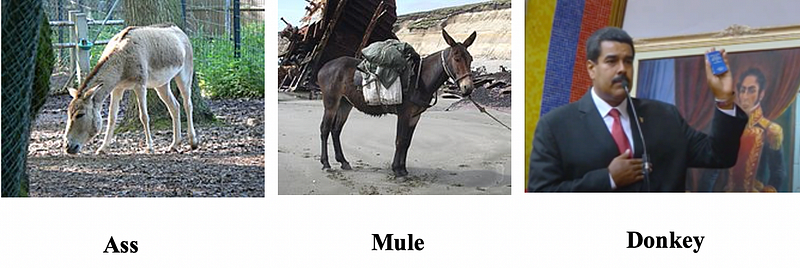
Venezuelans reading this are nodding in approval. For those who are not from Venezuela or don’t follow international politics, the guy on the right is Nicolás Maduro, current dictator of that country. One of the many creative nicknames bestowed upon him is Maburro or Masburro, burro having the same meaning in Spanish as it does in English: donkey.
Actually, asses and donkey are basically the same creatures, except the former are wild and the latter domesticated. More or less the equivalent of a mustang and a horse. The ancestor of the donkey is thought to be the African wild ass.
Now, a mule is a cross between a male donkey and a female horse. When the opposite combo happens — a female donkey and a male horse — you get a hinny. Hinnies are much rarer than mules because that particular species crossing is harder to get. Hinnies are smaller and have shorter ears than mules, but their legs are stronger and their mane is thicker. Although that last trait has more to do with the shampoo they use than genetics.
A male hinny is termed a horse hinny, while a female hinny is called a mare hinny. In Britain, however, female hinnies and female donkeys are both called jennets. But not always. Why? I have no idea.
Both male and female hinnies, and male mules, are sterile, while female mules have been known to produce offspring, even in natural circumstances.
Equus kiang
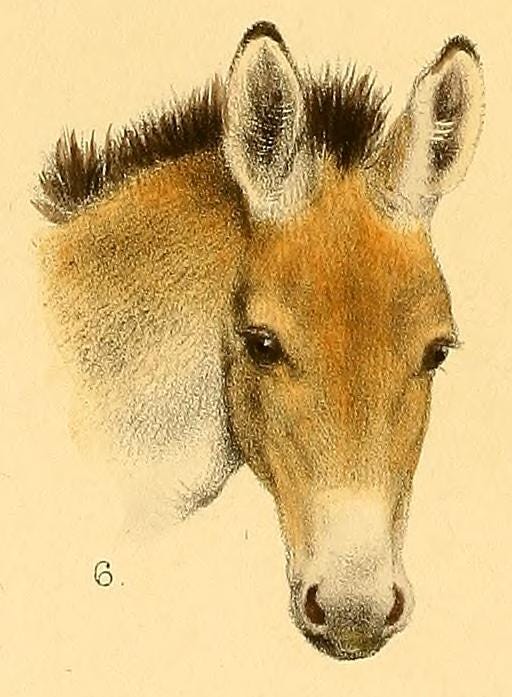
The photo at the top is from the book The Great and Small Game of India, Burma, and Tibet, written by Richard Lydekker and published in 1900. I’m not 100% sure if he actually sketched that kiang, but it seemed more reasonable to credit him than 6, whose signature appears on the picture.
Here is a photo of a kiang, so you can judge for yourself how good an artist Lydekker (or 6) is:
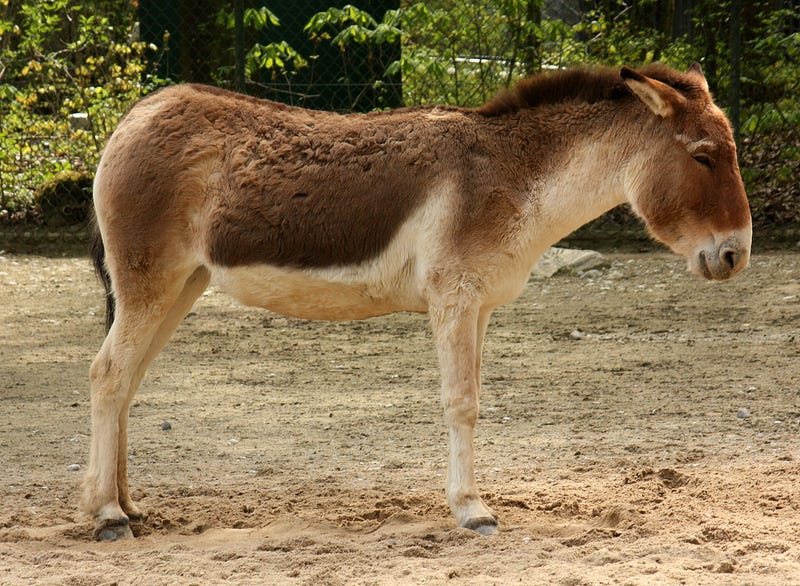
The photo I’m 100% sure was taken by a human being and not a digit.
The kiang has a few street cred aliases: Tibetan wild ass, khyang, and gorkhar. It’s native to the Tibetan Plateau, where it roams around the grasslands and plains of the Tibet; Ladakh, India; and northern Nepal along the border with Tibet.
Three subspecies of kiangs have been officially categorized:
- E. k. kiang — western kiang (Tibet, Ladakh, southwestern Xinjiang)
- E. k. holdereri — eastern kiang (Qinghai, southeastern Xinjiang)
- E. k. polyodon — southern kiang (southern Tibet, Nepalese border)
There used to be a northern kiang, but he disappeared mysteriously after a guy named Sant A. Claus visited Tibet decades ago. So if you hear some weird braying in the skies on Christmas Eve, you’ll know the kidnapping rumors are true.
The only real predator of the kiang — other than humans, of course — is the Himalayan wolf. Kiangs defend themselves by forming a circle and, with their heads down, engage in some violent kicking of the wolves. In other words, the asses kick the wolves’ asses. Hmmm… words are a beautiful thing indeed.
Because of this, wolves usually attack single kiangs that have strayed from the group.
Lesson learned. If you ever visit Tibet, don’t go strolling by yourself in the plains or grasslands. And if you do plan to do that, at least join a kiang dojo before your trip and take some violent kicking classes.
Then, when you return from your spiritual retreat in Tibet (without straying), please tell us all about it. We’d love to hear your stories and see the hundreds of selfies you took. You can even regale us with the tale of that ride you took on a bareback donkey. And I am forced to say donkey and not kiang… because the editors of the Spelling Bee puzzle have decreed that kiang is a dord.*
You can check out my previous entry on another dord* here:
*What the heck is a dord, you ask? Here’s the answer: