
Keyword Research Done RIGHT(+ Free Keyword Research Tool)
You know what… Many people shoot themselves in the foot.
They put an incredible amount of time into producing super helpful content but forget one thing…
They forget to check if people are actually searching Google for that content. In other words, is there a demand for that subject?
What do visitors type in Google exactly, and how do they express their interest in a certain subject (in words)?
Do not make the same mistake. Before you write down your post title, you should know the relevant keywords.
This is called keyword research.
I know that The Internet is full of sci-fiction-like videos taking this subject to extreme levels.
But you and I are not going to do this here.
We are evidence-based, of course, and want to get some statistics to make sure that the post is actually worth writing (and to ensure that others will find it).
Still, I do not want you to “overdo it” and spend time & energy when not necessary.
The tool I will use comes straight from Google. It’s called Google Ads.
Note again that thousands of different tools offer keyword research services, but you do not need anything else than what I mentioned here.
Google has all you need (and even more than that, plus it is free).
With this tool, you can buy ads at Google (and many other things), but we will discuss that bit later.
Now, we will stick only to the keyword research functionality.
Let’s get an idea about three things (no more, no less).
- How many people search for a specific keyword (search volume)?
- What’s the competition level for that keyword?
- What other keywords relate to that subject?
Watch the video below to see how I used the tool to find the keywords for this post. (You can also see how to create an account if you haven’t done so.)
Finished watching? Then go to Google Ads Keyword Planner and find the primary keyword for your next post. Also, note down other relevant keywords (together with the search volumes).
To begin your search, just type one word (e.g., travel), and Google will generate keyword ideas for you.
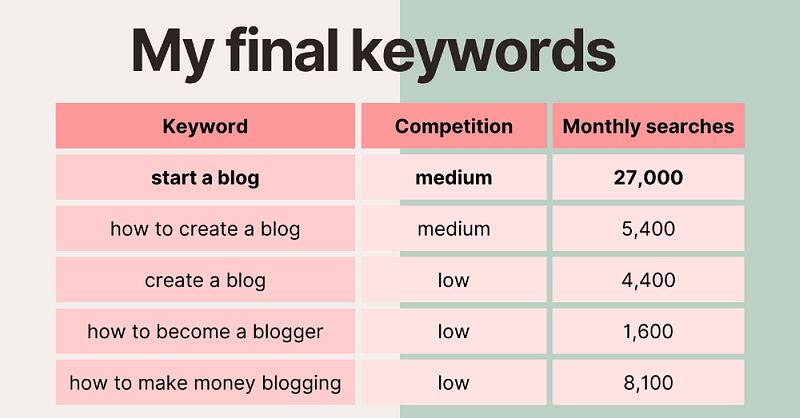
Here is my final keyword list for this post (and you should have something similar for your topic).
Note: the keyword in the strong typeface is my primary keyword.
BONUS TIP
Try finding so-called long-tail keywords (less competitive keywords).
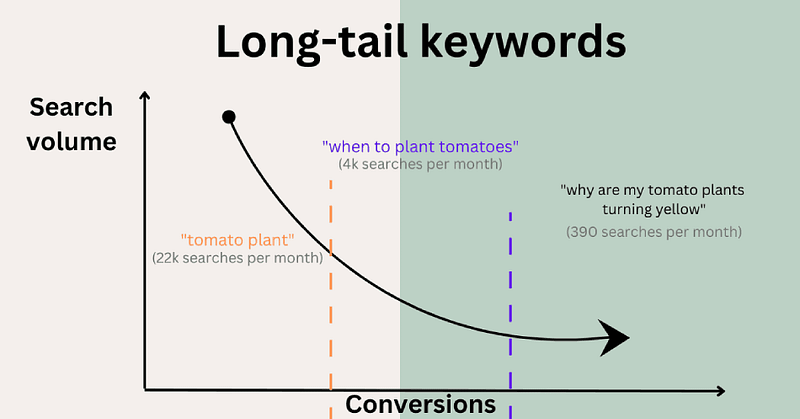
Long-tail keywords are usually very specific sentences of three or more words. True, these keywords are not as popular as the prime ones (e.g., “losing weight”), but ranking well for them is much easier.
See the example below. The “tomato plant” keyword is the prime one and is widely searched. As the keyword becomes more and more specific, there are fewer searches but more conversions. The more specific the keyword is, the easier to rank and the greater the conversions.
FAQs
What is Google Ads?
It’s a platform offered by Google. You can use it for advertising on numerous Google networks, including Google Search, and on all third-party websites that use Google Adsense.
What is keyword research?
Keyword research is a process of finding the keywords (phrases) people type in Google to get to the relevant content.
Can I do this for free?
Yes. You can use the Google Keyword tool that offers the functionality free of charge.
What is the minimum search volume I should look for?
I usually limit the selection to the US region only. If a keyword has less than 1,000 searches per month, I look further. The sweet spot is between 1,000 to 25,000 monthly searches with Low to Medium competition. You can use the same rule of thumb.
What are the long-tail keywords?
These are very specific keywords that consist of three or more words. For instance, “diabetic recipes” is a keyword with many searches but also a huge competition. On the other hand, “diabetic recipes for pregnant women” is much more specific (with fewer searches) but the competition is lower. This is one example of a long-tail keyword.
Can I use the keywords with High competition?
I do not recommend this. In most cases, those keywords are dominated by big corporates such as Amazon (for online shopping for instance) and others. Stick to what is more real and where you can see the results in the near future. It is not impossible to win Amazon but it is very difficult and takes time & effort.
Struggling to set up a blog that sells? Most people working a 9–5 fail to get their side project off the ground.
Subscribe to DDIntel Here.
Have a unique story to share? Submit to DDIntel here.
Join our creator ecosystem here.
DDIntel captures the more notable pieces from our main site and our popular DDI Medium publication. Check us out for more insightful work from our community.
DDI Official Telegram Channel: https://t.me/+tafUp6ecEys4YjQ1