
Key to Successful Communication in Project Management

“The most important thing in communication is hearing what isn’t said.” Peter Drucker
As per PMI research ineffective communication has a negative impact on successful project execution. Companies risk $135 million for every $1 billion spent on a project and $75 million of that $135 million (56%) is put at risk by ineffective communications, indicating a critical need for organizations to address communications deficiencies at the enterprise level.
According to a Web poll released by the Computing Technology Industry Association (CompTIA) poor communication is the number one cause of project failure, insufficient resource planning is in the second place, while Unrealistic deadlines is the third most frequent cause of project failure.
Key issues in communication client-development
If you know the fact that one out of five projects fail due to ineffective communication, then you are aware of the importance of a communication. Project Manager is a person that spends 90% of their time in communication. They are the key roles in project development and those who have the biggest responsibility in communication part of project development.
The first issue that can come up during the execution phase of your development process is incomplete information. One member of your team knows all the information but didn’t share it with the whole team. They don’t have all the information and maybe won’t include one important feature since they don’t have complete information. Another possibility is that the client gave all information, but the project manager failed to share it with the whole team. That for, a project manager must deliver all information to every member and make sure that they have full information in every phase of execution. Project Manager is talking with 1–3 person from the client side and it is important that they communicate well with each other so that they can transfer all information to Project Managers and them to the whole team.
Another thing that slows the team down or causes issues is a request for a change. The client can realize that he/she wants to include some feature or change the existing one. They must be aware that those changes can cause delays in delivering the final process. Another thing is that Project Manager must communicate this with both developers and testers. If it is some of the structural changes there is a lot to be changed and a lot of communication between team members and due to those possibilities of mistakes.
It is not rare that the client is not completely sure what he/she wants to implement. They know that they want some changes or features but they are not completely sure how it should look like or they are unaware that feature like that is already implemented- putting two similar features would be useless. It is up to a Project Manager to ensure that clients’ wishes are fulfilled and that there are no insufficient steps.
Last but not least is clients’ feedback. Sometimes they just don’t ask end users for a feedback and don’t deliver it to a development team or they need too much time to deliver it. This can create miscommunication and cause bigger costs due to redevelopment.
Communication within the team
Communication client- the development team is not the only one that can be inefficient, communication between team members can be, too. A relation between the Project Manager and the team is the most important one- he/she must understand and transfer all information to the whole team. All steps must be clear and everyone must know what is his/her duty. The whole team must be able to visualize the end result in order to work towards the same goal. Regular reporting of the project status is crucial to the success of the project.
Miscommunication can happen between developers and testers and mostly the reason is bad documentation. Testers verify functionality according to specifications and if there’s something omitted or not considered each tester will figure out what he/she thinks is correct. Using scrum technology in communication between developers and testers can solve this problem- each feature is developed and tested right away.
While we’re talking about tools it is great that the team is using project management tools and communicate there but they must be consistent. Using too many tools will cause a problem since one will be documented in Jira and other in Trello for example. This way you won’t have all the information in one place. Also, avoid communicating along the way and not writing it down. It can happen that you solve some issue very fast, didn’t put down in your Project Management tool (PMT) and lost track about it. Put all information in your PMT, that’s the only way to track everything.
If you are working in a small team and with a small number of experts in some field unexpected situations such as sick leave can cause you big issues. When the key developer is ill and can’t work on a project whole process must stop. For this reason, avoid small teams of developers since they are too dependent on each team member and can’t replace anyone fast.
Project development is a lasting process and you probably don’t work on only one project but on a few at the same time. It will often happen that while working on one other pop up and takes your attention. Good Project Manager must handle these situations and dedicate the same attention to each and every project developers work on.

How to diminish a number of communication channels?
When you are communicating with a small team of people miscommunication is possible. But when you’re communicating with a larger team of people it is almost inevitable. As a project grows in size, it will involve more team members and communication complexity will increase geometrically.
In these situations, a key solution is to divide the team into subgroups. This way you will narrow a number of communication lines and with it possibility for miscommunication. Let’s take for example a team of 20 people that are on the project.
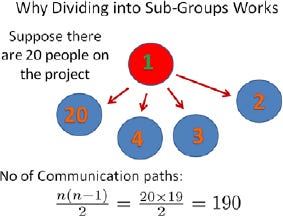
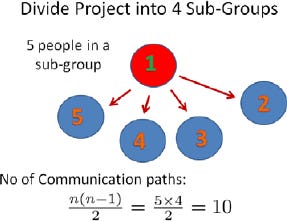
As you can see in the picture above number of a communication channels that you have in this case is 190. If you divide the team into 4 sub-groups you will have 10 communication paths:
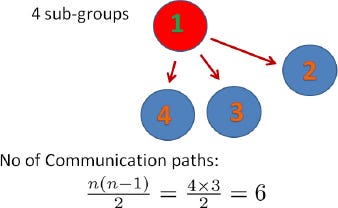
If you have four sub-groups, the number of communication paths that a project manager has to take care of is only six.
In summary, the total number of communication paths:
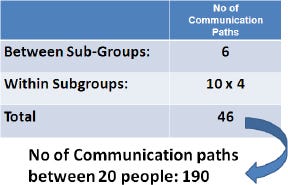
As you can see this way a number of communication paths is much smaller and a possibility for mistakes is much lower. Dividing your team into sub-groups will ensure that you will have constant flow in your communication.
Tools for successful communication
- Team communication tools
You should be in constant communication with your remote team. Your work is in progress and you must be informed about its stage. Additionally, your product is changing during a development phase and each change must be communicated between you and your team. The fastest way is to use software that will allow you to stay in the loop. You can choose tools such as Slack or Chanty for your real-time communication.
2. Video conferencing tools
Since communication is a key element for successful remote teams video calls are inevitable. If you want to get a daily report from your team Manager or solve some of the issues that pop out along the way you can use tools such as Skype, Google Hangouts or Zoom to stay in touch. Your team can also share the screen with you so that you have a visual presentation of a work done.
3. Project Management Tools
If you run an agile remote team it is all about project management. Project Management tools such as Jira, Trello or ActiveCollab allow you to organize and track the work. They let you run and monitor team, see their progress, get informed via email about updates and assign tasks to different team members. With these tools, you will always have all the information and track of your team work .
4. Software development and design tools
Software developers and designers are a vital part of every organization, no matter if it is a large enterprise or a startup. You can use great tools to make your remote developers more productive. Bitbucket is a project management for your code. It gives your team one place to plan projects, collaborate on code, test and deploy. The remote development team can easily collaborate on features, perform code review, and push software updates out on a regular basis.
InVision is a product design collaboration platform. It is incredible for building UX prototypes, work together on a Freehand whiteboard, sharing them with a team and gathering a feedback.
Conclusion
Every project that we do is based on how effectively we communicate both with clients and within our team. This is often still regarded by management as something that just ‘happens’ as part of regular project management tasks. However, without a well thought out communication strategy and right tools, as well as, detailed information your project will be doomed.