
Photography
Kevin Carter
Manic Street Preachers & The Bang-Bang Club.

* This article contains disturbing images.
If you've ever had a conversation with me about music, it's a safe bet that I've prattled on about either The Replacements or Manic Street Preachers. Depending on your perspective on luck, maybe both.
I'll skip the preamble on Manic Street Preachers, but after becoming besotted with them after hearing The Holy Bible, I purchased their 1996 album Everything Must Go.
The album, recorded after the disappearance of rhythm guitarist and lyricist Richey Edwards, Everything Must Go would prove the band's breakthrough (not here in America — that never happened.) It would win many British music awards that won't mean anything to Americans (but the awards were a big deal.)
Interestingly, EMG gives shout-outs to two particular people. One is "Kevin Carter," and the other is "Interiors (Song for Willem de Kooning)." Now I know who de Kooning was, or at least had a very rudimentary knowledge of his work.
But I thought:
“Who the fuck is Kevin Carter?”
While poking around, I learned that "Kevin Carter" was the third single from EMG and peaked at #9 on the UK Singles Chart. The lyrics are solely credited to Richey Edwards and were written a few months before he disappeared.
It took a little more digging before I found out who the inspiration for the song was. When I discovered who Kevin Carter was, I thought: "Ohhh yeah, I remember that picture."
Hi, Time magazine, hi, Pulitzer Prize Tribal scars in Technicolor Bang-bang club, AK-47 hour Kevin Carter
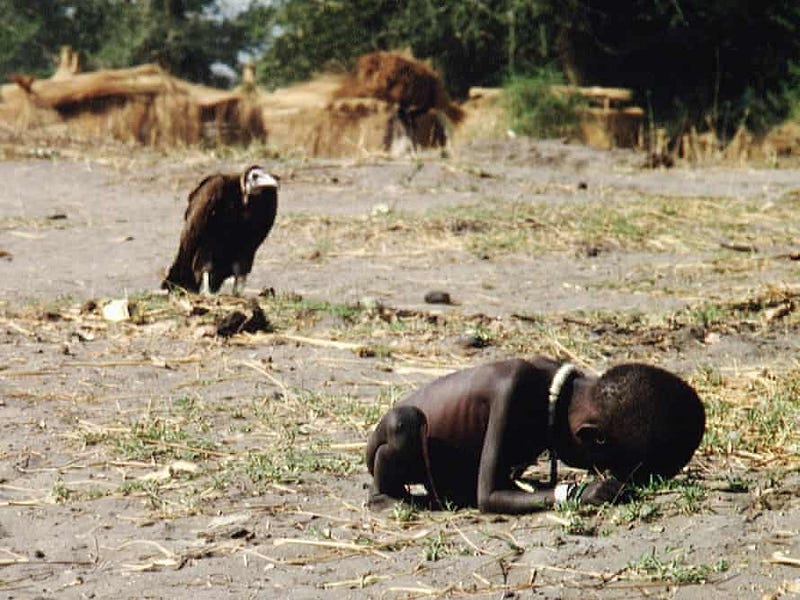
Kevin Carter was the South African photographer who won the Pulitzer Prize for capturing the singular image of the famine in Sudan — arguably the singular picture of famine.
In March of 1993, Carter snapped the picture of a vulture skulking behind a young boy:
That’s a powerful photograph. Still.
The boy was reportedly attempting to reach a United Nations feeding center about a half-mile away in Ayod, Sudan (now South Sudan). *
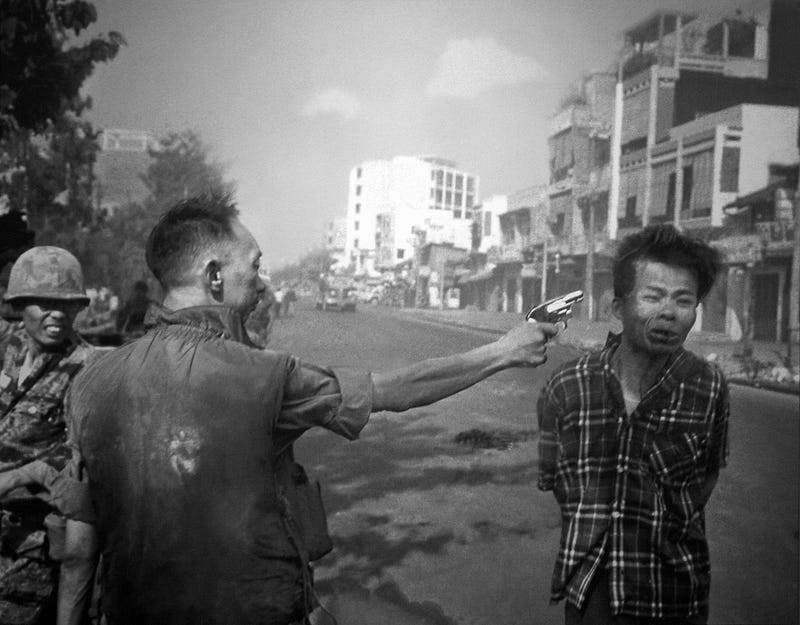
Carter's picture above is almost as powerful as photographer Eddie Adams' picture from the Vietnam War. Now getting an image from the clusterfuck of the Vietnam War — a war with no shortage of horrific photographs — that remains seared in history is a lot harder than it seems. And Adams accomplished that:
Carter's picture of the vulture and starving child was first published in The New York Times on March 23, 1993. Instantly, the photo had a two-fold effect:
- It helped raise awareness on the war in Sudan (and accordingly, money.)
- It raised (again) the issue of ethical photojournalism.
I won't pretend to have the answer on the ethical responsibility of photojournalists. I will say that I agree with Susan Sontag, who wrote in her 2003 essay Regarding the pain of others:
“To catch a death actually happening and embalm it for all time is something only cameras can do, and pictures taken out in the field of the moment of (or just before) death are among the most celebrated and often reproduced of war photographs…There is shame as well as shock in looking at the close-up of a real horror.”
Like I had with Manic Street Preachers, I went down a rabbit hole, finding out as much as I could about Kevin Carter.
Growing up in South Africa, Carter was "lackadaisical" about fighting against apartheid by his admission.
After dropping out of college, Carter was drafted, and to avoid combat, he enlisted in the Air Force (I don't know why, but I was surprised to learn South Africa had an Air Force.) While in the Air Force, Carter defended a black waiter and received an ass-kicking from fellow soldiers. Spiritually defeated and in physical pain, he decided to go AWOL from the Air Force after the beating.
While AWOL, he attempted to start a life as a disc-jockey named "Dave (apparently that's it, just "Dave.”) It will shock no one to read that the whole DJ thing didn't pan out, and Carter returned to the Air Force to complete his military service.
Witnessing a car bomb attack (the famous Church Street bombing) in 1983 cemented Kevin Carter's path to journalism.
FROM VOYEUR TO VICTIM
Carter cut his chops covering sports on the weekend before making a radical change. The change coincided with the political shift taking place in South Africa.
Using his camera, Carter began to document the conflict in South Africa as the country started breaking the chains of apartheid and taking aggressively reluctant steps toward democracy. It would be these photographs that would come to define his career.
It wasn't long before Kevin Carter became one of the more prominent "conflict journalists." Between 1990 and 1884, Carter and fellow "conflict" photographers Greg Marinovich, Ken Oosterbroek, and João Silva became the go-to guys in the South Africa townships in turmoil.
Africa is a continent never short of political, military, and economic strife and turmoil, and soon these guys began going outside of South Africa.
They even had a name — The Bang-Bang Club.
But in the early 90s, the political violence in South Africa was fertile ground for conflict journalists worldwide. As a photographer for the Johannesburg Star, Carter had a keen eye; and depending on your perspective on luck, he happened to be in the right place at the right time.
Kevin Carter was the first to photograph a public "necklacing" execution in the mid-1980s. It was this photo that put him on the international journalistic radar. Now murder and torture, even during wartime, is horrible, but "necklacing" is something entirely different; I won't define it or provide a link — you're on your own there.
Sure, these days, a quick Google search will yield all sorts of horrific pictures — the internet is a strange kind of global amorphic snuff film. But in the early 90s, it was different. And it was this picture of the vulture and child that brought him a certain level of "celebrity." And it seems a strange word to use given the content of his photos.
Carter would later reflect on the images that helped build his career, saying: "I was appalled at what they were doing. But then people started talking about those pictures… then I felt that maybe my actions hadn't been at all bad. Being a witness to something this horrible wasn't necessarily such a bad thing to do."
In March 1994, Carter took a photograph of three Afrikaner neo-nazi nationalists from the AWB (Afrikaner Weerstandsbeweging) as they were shot:
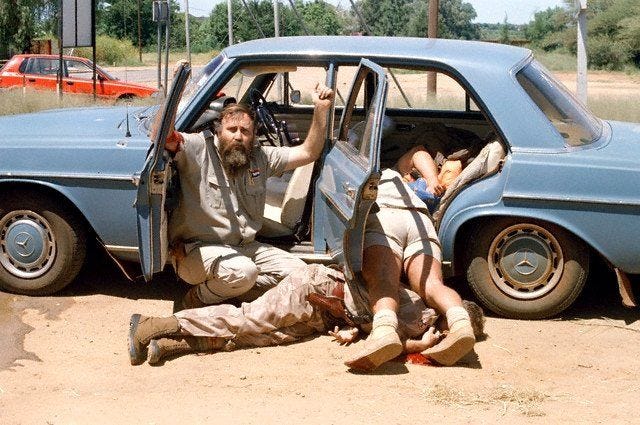
Even though Carter ran out of film halfway through, he managed to snap enough pictures to make "nearly every front page in the world," according to The Guardian's Eamonn McCabe.
In 2000, Carter's fellow conflict photographers, Greg Marinovich and João Silva wrote The Bang-Bang Club: Snapshots from a Hidden War. In it, they contemplated the virtue of their profession. Marinovich wrote that he and fellow Bang-Bang members: "… discovered that one of the strongest links among us was questions about the morality of what we do: when do you press the shutter release and when do you cease being a photographer?"
Kevin Carter wrestled with that. All of it. The murder and horror that he witnessed and photographed that led to his success came at a very high price.
There would be one more death for Kevin Carter to encounter. Except he wasn't there to photograph it.
On July 27, 1994, Kevin Carter committed suicide.
He was 33 years old.
Portions of his suicide note read:
“I’m really, really sorry. The pain of life overrides the joy to the point that joy does not exist. … I am haunted by the vivid memories of killings & corpses & anger & pain … of starving or wounded children, of trigger-happy madmen, often police, of killer executioners …”
Hi, Time magazine, hi, Pulitzer Prize Vulture stalked white piped lie forever Wasted your life in black and …
Click, click, click, click, click, click himself under Kevin Carter Kevin Carter Kevin Carter Kevin Carter
*The young boy from Kevin Carter's Pulitzer prize-winning photograph is reported to have survived.
If you or someone you know has thoughts of suicide, please call the National Suicide Prevention Hotline at 1–800–273–8255.