
Kettlebell Training for Beginners — The Ultimate Guide
Do you even swing?
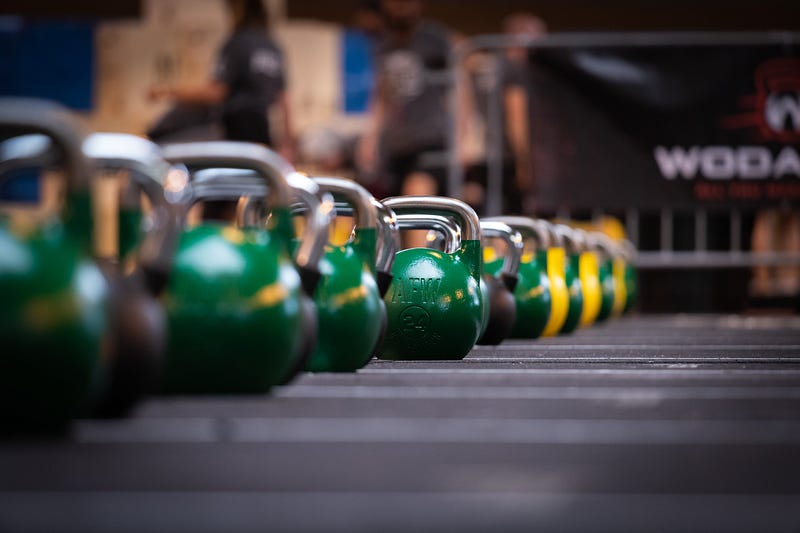
The kettlebell is one of the most underrated yet one of the most beneficial training tools for the average fitness enthusiast. If you are one of those who doesn’t aspire to be a world-class athlete but instead just wants to be a little bit stronger, a little bit more muscular, and have a little bit more endurance, then kettlebell training is for you.
Through kettlebell training, I built muscle and strength and improved my mobility. I went back to running and remained injury-free.
But kettlebell training not only injury-proofed my body. It also completely transformed my relationship with it.
And while I am convinced that kettlebell training is one of the best ways to train your body, I am also aware that starting your kettlebell journey can be confusing and painful.
As a beginner, you may ask yourself questions like:
- What weights should I use?
- How many kettlebells should I buy?
- What type of kettlebell do I need?
- Why does the skin on my hands tear, and how can I avoid it?
- What are the best exercises for [your goal]?
- What is the best training program for [your goal]?
If you try to answer these questions by ordering a stack of books or going online, you might spend weeks trying to find knowledge that helps you.
And you may be left with more confusion than answers.
Luckily, I have decided to write the guide I wish I had 11 years ago when I started my kettlebell journey.
So grab your favorite hot drink and get comfy 😎.
This guide will teach you everything you need to know as a kettlebell training noob.
What are kettlebells, and why should you train with them?
Kettlebells likely originated around 350 years ago in Russia. The term “girya” first appeared in a Russian dictionary in 1704.
Initially, people used those cannonballs with a handle as a counterweight when weighing goods at the market. Over time kettlebells were used in weight lifting, and in 1948 kettlebell lifting became a national sport in the Soviet Union.
In the Western world, kettlebell training started to take off with the publishing of Pavel Tsatsouline’s book “The Russian Kettlebell Challenge.”
Today, kettlebells are a staple in gyms worldwide and have made their way into countless homes as a versatile fitness tool that requires only little space.
The unique advantage of the kettlebell is that you can train the various components of fitness with just one tool.
Whether you want to get stronger, build muscle or improve your mobility or cardiorespiratory fitness — kettlebell training will get you there. And since you can train all aspects of fitness with just one tool in one training session, kettlebell training is highly efficient.
Another factor often overlooked when people try to find “the best” training program for them is fun.
Yes, training should be fun.
Why? Because most people will only stick to a long-term training program if they enjoy it. And kettlebell training is a lot of fun and never gets boring.
You have numerous exercises that you can link together in a flow.
You can learn how to juggle kettlebells or dip your toes into kettlebell sports training.
Besides, due to its small size, you can take your kettlebell outside, train in your garden or a park or office, and even travel with it.
You can train with kettlebells almost everywhere.
Training principles you must adhere to when training with kettlebells.
My coaches and mentors taught me how to use the kettlebell correctly and safely.
But I have also learned to look at training in a new and more holistic way.
I have learned to value long-term progress and sustainable workloads over short-term feelings of “crushing the workout.” I have also developed a deeper understanding of the mind-body relationship when developing physical fitness.
The following training principles have contributed significantly to my progress over the past ten years. I recommend that you follow them too.
1. Train movement over muscle.
When I started entertaining the idea of strength training, I turned to fitness and bodybuilding blogs. And what did I find there? An absurd amount of confusing information about the best exercises for specific muscles and muscle groups.
So I dug in. And the more I read, the more I wanted to learn.
There was so much to learn!
Which exercises are best for developing my quads? How can I grow my triceps? Are woodchoppers the best exercise for the serratus anterior?
It’s pretty comical that I spent my free time reading about bodybuilding style training when I didn’t even have a gym membership because of intense gym anxiety 😅.
However, I vowed to start going to the gym once I had acquired enough knowledge on which exercises to do and how to do them.
But as luck would have it, I stumbled upon kettlebell training before I ever set foot into a gym.
And this fundamentally changed my idea of how to build muscle and strength.
When designing a training program, think, “Which movement pattern does this exercise target” instead of thinking, “Which muscle does this exercise work”?
The basic human movement patterns are the squat, hip hinge, pull, push, and carry. Your training program must include all of those. Add some rotation, and you have a well-rounded program that helps you develop full body strength and muscle in all the right places.
If you are like most of us, you don’t want to be a professional bodybuilder. And if you don’t want to be a bodybuilder, why train like one?
You don’t only want to look better. You want to feel and move better too!
And “training movements instead of muscles” gives you these benefits.
2. Approach your training sessions as a movement practice instead of a workout.
I used to train myself to the ground. I ran through inflamed ankles when I had a fever and on 4 hours of sleep.
I approached my kettlebell training with the same “go hard or go home” mentality.
Until I got serious about being a coach and took various courses to prepare.
Through education from kettlebell masters, I learned to respect my body more. I learned to focus on the journey of mastering movement.
Instead of chasing fatigue or “the burn,” I pursued perfection in my technique. No matter what kind of training you do, you should always approach it with the mindset of “practice.”
Just like a piano player practices playing the piano, you are practicing movement.
The goal is to improve, not tire yourself out so much that you need days to recover or injure yourself.
I also applied this mindset to my running, greatly benefiting my performance. I no longer measure the quality of my runs solely by the time I ran or the level of exhaustion I feel, but also by how smooth I ran and how aware I was of my body during the run.
3. Safety first.
I shouldn’t have to write this paragraph, really. But I often see women in my gym doing dangerous things with weights in their hands, so I decided to include a short section on safety.
First of all, you don’t want to wear any jewelry on your hands when training with kettlebells. No rings, no armbands, no watches. Even small fabric wristbands can feel very uncomfortable when a kettlebell lands on them.
I’m speaking from personal experience, so trust me on this one 😉.
Secondly, you want to train somewhere where you can drop your kettlebell without issues. If a lift goes wrong, you must get out of your way and let the kettlebell go without worrying about broken floors or windows.
Always be aware of your surroundings, especially if you’re training where other people are nearby, like in a gym or a park.
And lastly, train barefoot, in socks, or in minimalist shoes that don’t have a cushion or an elevated heel. When you train barefoot, you have more stability and mobility.
Besides, you train your feet to become stronger. And since your feet are the foundation for your entire body, you want them to be mobile and strong.
Which kettlebells should you use, and how many do you need?
Shopping around for kettlebells today is much more confusing than it was just 10 years ago when I first started using them. Back then, you had few suppliers, and I could find only cast iron and competition kettlebells.
Today, you have a much more varied selection and can also buy vinyl, sand-filled, rubber-coated, and more.
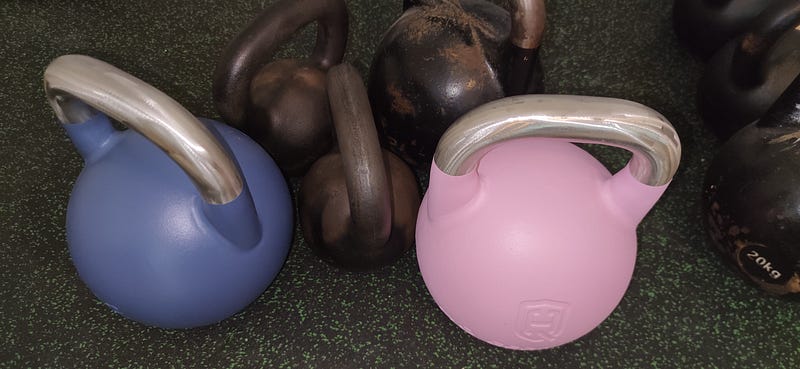
However, the only choice you should make is whether you want to use cast iron or competition-style bells.
There is no right or wrong here. I have both types, and both have their advantages and disadvantages.
Let’s start with competition kettlebells.
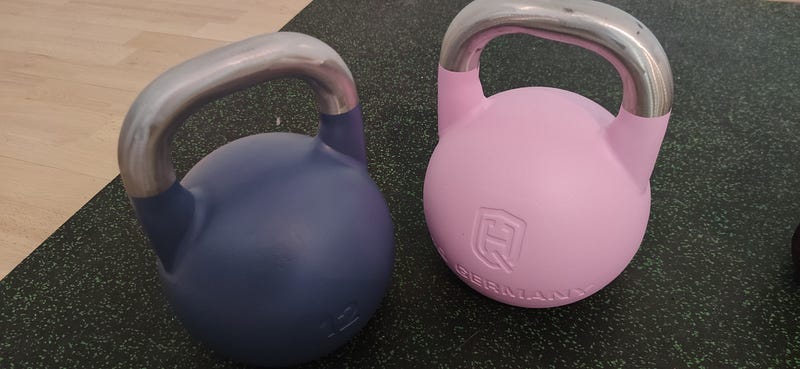
Competition kettlebells are used in kettlebell sport. Each weight is the same size and dimension, so you always train with the same shape. This is an advantage when perfecting your technique since every weight class has the same form.
And when you do 100 or more repetitions for an exercise, you want to perfect your technique as much as possible. For petite women, however, the size of the competition bells can make double kettlebell work a bit awkward.
If you are small and do not want to compete in kettlebell sport, cast-iron kettlebells may be your bells of choice.
Cast-iron kettlebells come in various sizes. The heavier the kettlebell, the larger it is. Usually, cast-iron kettlebells are a bit cheaper than competition kettlebells.
I prefer cast-iron kettlebells when my training focuses on strength and muscle building. I am a relatively small woman. Because I am cautious about hitting my breasts when doing double kettlebell work, I prefer balancing a pair of cast-iron 16 kg bells over two more giant competition bells.
I also find double swings less awkward when using cast-iron bells.
Avoid vinyl and plastic kettlebells. The only quality they share with the other two types described above is the name. Their design does not allow for the mechanics of proper kettlebell training. So while they are cheaper, they are of little use if you want to learn how to lift kettlebells correctly.
Different kettlebell training styles — hardstyle and softstyle.
I started my kettlebell journey in 2012 with Pavel Tstatsouline’s book “Enter The Kettlebell.” The technique he teaches and many of his students and followers use is called “hardstyle.”
The focus in hardstyle kettlebell training is on building strength and power. You use short bursts of energy and develop maximum tension in your muscle.
On the other hand, the “soft style” technique allows for more extended sets and focuses on strength endurance. The movements are more fluid, and you aim to move as efficiently as possible.
This style is also used in kettlebell sports, where athletes try to complete as many repetitions as possible during a timed set of 10 minutes or more.
I use both styles in my training.
I love the hardstyle approach for building strength and muscle. And I love the high-rep strength-endurance challenges as well. I also plan to participate in a kettlebell competition next year, so I have recently included more “soft style” training.
You don’t have to understand the ins and outs of these different styles in the beginning. However, you must know these two styles exist, so you can choose what to focus on first.
And most importantly, to arm yourself against misinformation and know when to spot people who are only aware of their preferred style of kettlebell training 😁.
Which weight should you use as a beginner in kettlebell training, and how many bells do you need?
Various factors will influence which starting weights you should use. Your age, gender, height, weight, and previous training experience all influence which kettlebell you can use when starting out.
If you are a woman without any strength training experience, you should use an 8kg or 12kg. You may even start with a 6kg if you are small or older.
If you are a man who has been sedentary for most of his life, you should begin with 16kg or even a 12kg bell.
If you are unsure, opt for the lighter weight.
If you have the money to invest, get two kettlebells — one with the lower weight and one with the next weight class.
I started with an 8kg and a 12kg kettlebell, which is what I recommend for most women. Similarly, you could start with 16kg and 20kg if you are a man.
These are only recommendations, though. If you have the option, go to the gym and try the various sizes to determine your starting weight.
Fundamental kettlebell exercises for beginners.
As a beginner, kettlebell training can be confusing. Kettlebell wizards on social media can make your head spin with their varied exercise routines, different styles, and creative kettlebell flows.
However, kettlebell training is surprisingly simple. That’s why I love it so much.
You can rely on a few basic exercises and weave them into endless kettlebell flows, complexes, and workouts. To start your kettlebell journey, you want to focus on these fundamental exercises first:
The kettlebell swing.
Most kettlebell enthusiasts started out swinging a kettlebell, myself included. In fact, the kettlebell swing was the only movement I did with a kettlebell for several months before I got bored and started to learn other exercises 😂.
The video below gives a demonstration of the one-arm swing. Please note that this is the pendulum swing used when training soft style.
The kettlebell clean.
The kettlebell clean is a critical yet very underrated exercise. The clean gets the kettlebell in the rack position — the starting point for overhead movements, like the press or push press.
Even though many see it as a means to an end, the clean is a terrific exercise in and of itself. It is a pulling movement and teaches you how to direct force.
The video below gives a demonstration of the kettlebell single arm clean.
The kettlebell press.
The kettlebell press is a great strength builder for the shoulders, the upper back, and the arms. It is one of the most functional movements you can do for the upper body.
It is also one of the most shoulder-friendly presses.
Because of the kettlebell’s unique shape, you hold the weight in a neutral grip. And when you press with a neutral grip, you put less strain on your shoulder joint because your upper arm bone can glide through the shoulder joint more smoothly.
The video below gives a demonstration of the kettlebell press.
The kettlebell squat.
The squat is a fundamental human movement pattern that, sadly, many adults in our modern society can not perform correctly anymore.
After years of sitting most of the day, many don’t have the mobility and strength to get into a deep squat position, let alone remain there for several minutes.
If you are one of those, who have problems squatting, start with the goblet squat.
Holding the weight in front of your body is easier on your back, promotes upright posture, and strengthens your core.
The video below shows three variations of the goblet squat. However, you can also do a kettlebell front squat, my favorite squat variation. At the end of the video, you will see a demonstration of the double kettlebell front squat.
Loaded carries.
Everyone should do loaded carries. It is one of the simplest yet most underrated ways to develop strength and mental toughness.
You train your whole body and teach your muscles to work together by doing loaded carries.
Additionally, you promote stability in your hips, core, and spine.
The idea is simple. For a farmer’s walk, grab two kettlebells and go for a walk. And when you can not hold the weight any longer, drop it. For an added challenge, use just one kettlebell and do a suitcase carry. Because you have the load on only one side, your core must work extra hard to keep you upright.
Kettlebell training variables and methods.
Training with rep and set schemes.
The kettlebell is a tool that you can use to pursue various fitness goals. And if your goal is to build strength and muscle, you can use them similar to barbells and dumbells.
That means you can program your training with the variables, weight (the weight of the kettlebell you use), sets (how many sets per exercise you are doing), reps (how many repetitions of each exercise you are doing), and rest (how long you rest between each set and between each exercise).
I have used this method to build muscle and strength with kettlebells. Many kettlebell programs that focus on building either use this method.
Timed sets.
The kettlebell is uniquely suited for timed sets. In fact, kettlebell sport is based on timed sets.
Traditionally kettlebell lifters perform one exercise for 10 minutes without setting the bell down. The athlete who completes the most repetitions within 10 minutes wins.
When using timed sets in training, you have various options.
You could do a timed set of only one exercise or combine several exercises. For example, I have completed 20-minute sets of kettlebell swings or 6-minute sets of goblet squats.
However, I also have done 5-minute sets consisting of various movements, like the clean, press, and snatch.
These are “AMRAP sets,” meaning you try to get in As Many Reps As Possible.
Another type of times sets are “EMOM sets.”
When you train using this style, you try to perform a fixed amount of repetitions at the top of every minute.
An example of this training style would be doing ten kettlebell swings at the top of every minute for 10 minutes.
Play around with those and find a training style that you enjoy and that makes sense for your goals 😁.
What to do next.
I hope this article answered some of your questions about kettlebell training and that you feel better prepared now to jump into your kettlebell training journey.
If you have questions about kettlebell training I haven’t answered in this article, please message me or hit me up on Instagram.
The kettlebell is undoubtedly one of the best training tools for everyday athletes with limited time and funds.
And it even has the power to change your life 💪.


