
Keeping His Name
A Post-Divorce Reflection

Mama Gladys asked me, “Are you going back to your maiden name?” It’s a good question. After all, when I married the second time (after widowhood) I adopted my husband’s first and last names — in the African tradition — and every time I sign a full signature, there he is. The name change reversal (for some) is a rite of passage, a declaration to the world that what once was has forever ended. But for me, it is an unnecessary and fruitless attempt to erase a very necessary, not always bad part of my personal history. Keeping his name — unless I remarry, which is certainly a possibility — is reasonable and cathartic for me for several reasons.

1- He Arrived at the Right Time.
Though my ex-husband is gone now, he certainly arrived at the right time. When I met him, I was saturated in compounding levels of grief.
- It was four months since the love of my life had died. The ramifications of that require a separate article. Some insights can be found in “Caretaking and the Grief of Gradual Loss.”
- The caretaking role — and my inability to keep my husband alive (which was an unrealistic expectation) — left me feeling like a failure.
- Single parenthood — especially to a preteen who had just lost “the fun parent” — was terrifying.
- My own health was on a spiraling decline.
This is the short list. Timothy’s arrival meant that instead of drowning in worry over hot flashes and chills, carpal tunnel in both hands, joint pain and changes in my posture… instead of being in the constant shade of the shadow of death (my first husband’s and perhaps my own) … instead of panicking through the delicate nature of navigating my child’s grief structure… I was laughing for a part of the day. This laughter, and the friendship that came with it, lifted me out of the weight of my struggle and kept me out of a dark place.
Instead of endlessly worrying, fretting over death, and panicking, I was laughing for a part of the day.
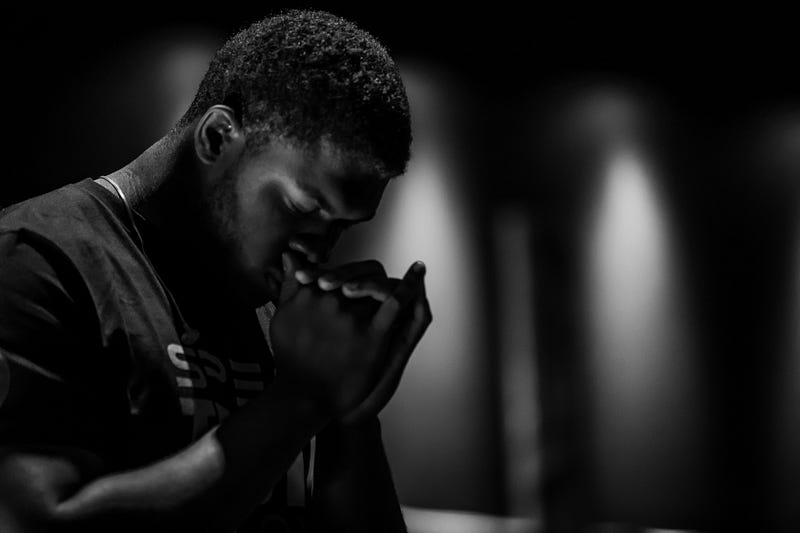
2- He Loaned Me His Faith.
Unbeknownst to us, my health issues would come to a head just 60 days after we’d met. A cardiac incident left me hospitalized in Phoenix — just three days before my 10-points defense for my PhD — and the petrifying prognoses began. As the medical tests were being run, I recommended to Timothy that we end things. “It looks bad,” I told him. “It looks very bad, and I just think you should find someone else.” His response — “You will not die. You cannot die because I just met you. You will live and declare the glory of the Lord in the land of the living” — was exactly what I would have said to myself when I could! But at this point, I was so entangled in my circumstances that I couldn’t see the possibility of victory. I had accepted death as — perhaps — the only logical ending to years of suffering.
I know that some readers will want to believe that divorce can only happen when one spouse is a villain to the core, but this is who he was — a man who could loan me his faith while mine was down to almost empty. Over three days of x-rays, blood tests, and consultations, he poured hours of prayer, encouragement, and diversion into my life. When the right doctor came in and announced that he had found the likely culprit — Lupus — the truth was not without its own set of frightening and disappointing likelihoods.
Over three days of x-rays, blood tests, and consultations, he poured hours of prayer, encouragement, and diversion into my life.
“This Lupus,” I explained to him, “has no cure. I might lose my organs, and maybe even my face. So, maybe it’s best if we go our separate ways.”
“What is Lupus to God,” he asked. “Let us wait and see what God will do.”

3- He Gave Me Something to Fight For
After those 72 hours in Abrazo Central, I deemed this man worthy of a lifetime investment… a man born in and living in a foreign country. If you’ve never navigated the waters of legal immigration to the United States, I can tell you it is a formidable process. This was particularly true during the Trump presidency when USCIS was stripped of some of its most effective parts: live phone support, regional in-person field offices, and staffing. When Timothy and I decided to get married, it meant navigating a wedding between two immigrants in a third country — Italy — and a 2-year spar with the immigration process.
I suppose you could look back on that and say, “Look at all that time you wasted.” You could. Or, you could see that during the time that I was navigating a very difficult recovery in every aspect of life, I had a HUGE, invigorating distraction to keep my mind focused on something outside of me. It was a fight that got me out of bed, that woke me up in the morning, that kept my mind churning at night. Sometimes it meant rage that fueled my ability to coach my son through his hard times. Sometimes it meant celebration that sent a rush of positive energy into my week. Sometimes it meant disappointment that renewed my drive to never give up.
You could look back on that and say, “Look at all that time you wasted,” or, you could see that during a very difficult recovery I had a HUGE, invigorating distraction to keep my mind focused outside of me.
We easily overlook the power of a righteous fight. While I was warring for my family — my marriage to this man of faith and our right to live together — I was flexing my battle muscles, which inevitably gave me the power to fight for myself.

Why Am I Telling You This?
As a divorcee, I have chosen to dwell in the truth, not in the emotional turmoil of bitterness. Regardless of how things soured over the past two years, the good times I shared with Timothy were certainly good enough to merit the love that I committed to him when I did. His name, the evidence of not just the bad but also the good that we lived together, does not exist as a brand in my skin. It does not invoke a hot, boiling anger. It isn’t a mockery of the relationship we couldn’t make work.
His name remains here as a part of me, like the early investments he made.
I will leave you with two things to consider if you are a divorcee who finds yourself stuck in the anger stage of divorce grief. First, my son asked me shortly after I married Timothy, “Why did you marry this guy? Some people tell me maybe you were lonely and couldn’t stand to be by yourself.” I told him, “He saved my life, Son, by investing in me in a way that nobody else did at that time, so he deserved it.” I still believe that. Whatever the reasons may be for your divorce, you certainly got married for a reason… a reason I hope was worthy of your choice.
Finally, Mama Terri (my birth mother) once said, “When a man leaves — as they sometimes do — you have to let them go and be thankful for what you had together.” I was a young adult when she told me this, and I didn’t understand then how a person could simply choose to go. Her advice seemed dismissive and defeatist. Having lived a while, I find that her instruction to “let go” was not dismissive but a lesson in acceptance and forgiveness. It was her invitation to wisely balance the grief with the good.
When our committed relationships end, we lose a lot and we grieve what we lost, but it would sure be a shame to let bitterness rob us of the sweet that got us hooked up in the first place.
Maybe you can’t stand to “keep his or her name” metaphorically because of the abuse, or maybe you’re still crying, or maybe you’re still fighting for custody or rebuilding your finances. Maybe your right to be angry is currently outweighing your ability to be thankful for the positives. In whatever stage you find yourself, I pray that eventually you are able to go from wincing at the brand of betrayal to occasionally appreciating the best of your bad situation.
If you didn’t get to the keep anything else, you got to keep you, and the process has made you better. ;)