
“Keep America Great”: last Trump’s bullets to reframe Corona time and win the elections.
In our days, “Covid-19” remains the most unpredictable force influencing the vote. Why so? Because history teaches us that the response to a pandemic or natural disaster has been always political, no matter the data, the evidence and the need. So just like during the Super-Bowl, advertisers use new commercials to push their products, in the last week before elections, spin doctors are framing news to win the largest jackpot, beyond differences in policies.
Challenging background
Taking a look at US’ elections, statistics clearly spell out that on the second mandate, incumbent US President has always very high chances to be re-elected…but history and statistics apply to the normal situation and might not tell us much in the “New normal”.
Twin campaign themes of continuity and change are also the most common because they are catchy and effective. They don’t have to be full of content, of fact-based, but they need to route back the judgment to the moment of success or give a clear perspective, polarizing voters’ attention with the comfort of continuity and straight reason to choose one candidate over another.
An outsider could have made a case for change, but both candidates are known and none of them run with a strong record behind, to make the case for continuity to catch floaters. In this case, spin doctors might suggest directing voters’ attention away from retrospective considerations.
Historical circumstances make the election game, and they are very unique since social and mobile media entered politics, even more with the pandemic.
The Brexit “surprise”, Macron’s data leak just before the vote, the 11 Million votes in 2018 to M5S in Italy, the standoff in Belgium, the throw out of Presidential Election Result in Austria, the “global horizon” in Germany, last but not least the US 2016 elections and Hilary’s glass roof: they can be seen as the outcome of a strong challenge to the establishment caused by mobile and social media.
Voters will decide on 3 November between Trump and Biden: before the second and last debate, Biden leads the polls with almost 10 points, so this week will be a crucial week and odds are we will see a “nostalgic walk on the moon” and a “COVID healing plan for floaters’ states.
Pandemic response and politics: historical ties
Lisbon in 1775: devastated by an earthquake, followed by a tsunami and a fire, the reconstruction became an opportunity for king’s ministers — Sebastião José de Carvalho e Melo, the Marquis of Pombal — to change Portuguese politics, religion, and society (more info at The Anthill Podcast episode “The earthquake that shocked Europe: how Lisbon recovered after 1755 — Recovery podcast series part two”).
These changes helped the Portuguese Crown to play a leading role in economics and politics? Probably not, but they were fit for that specific time political purpose and interests.
Back in our days, we can try parallelism with the current COVID-19 emergency in the US and the upcoming presidential election.
“Covid-19” remains the most unpredictable force influencing the vote. Why so? Because history teaches us that the response to a pandemic or natural disaster has always been political, no matter the data, the evidence, and the need.
During the last week before elections, candidates need no evidence to sustain political messages: the objective is not to make voters changing their choice but to push floaters emotionally to vote for them. This is when polices melt, and a candidate will go beyond the other’s fences, fighting on a single vote.
Their tone is going to be very direct and, although it will not be able to influence the majority of voters, it will catch the attention of a few, reframing opinions and moving the needle: this could be enough to win a county or a State.
“The wise tell us that a nail keeps a shoe, a shoe a horse, a horse a man, a man a castle, that can fight” c. 1230, Freidank Bescheidenheit
So it should come with no surprise, Trump’s statement suggesting hospitals or doctors are inflating their coronavirus numbers.
What else we can expect in the next 2 days?

Odds are that in the next hours, a statement from a reputable organization will revamp the discussion around vaccines or treatment distribution, for instance, by promising an earlier availability to the floating states who would lose the opportunity if the administration would change.
Unrealistic? Well, already a few weeks ago, there was a test with the US administration instructs states to be ready to begin distributing a vaccine by Nov. 1 — two days before the election (here the article).
In several experiments, it has been demonstrated that the perception of risks can be altered by subtly changing the terms in which the different options are described. Not being neutral, media framing intrinsically carries the opportunity to influence choices by selecting how to present the situation, its attribute, choices related to it, issues, etc. (Hallahan 1999).
Social and mobile technologies have become powerful political marketing tools to create information bias to orient floaters. According to Entman, content bias is “consistent patterns in the framing of mediated communication that promote the influence of one side in conflicts over the use of government power”, under the light of particular interests of one of the candidates.
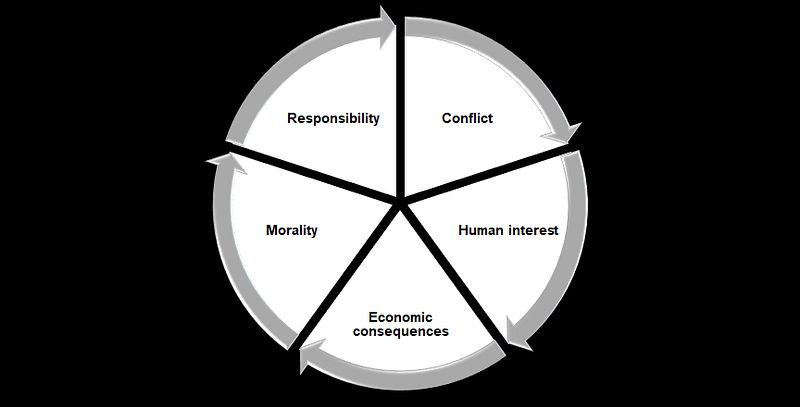
Said so, there is an interesting framework developed by Semetko and Valkenburg which can help assess how the content around 5 dimensions of how news could change voters’ perception. An example for each content framing type that could appear in the social and main stream media, in the next hours.
Conflict frame is based on emphasizing conflict among individuals, groups, or institutions;
Covid-19 healing: “I’m going to solve it now, despite all the obstacles by organizations, people and all: we have the Vaccine but XYZ does not let us to use it”.
Human interest frame leverages an emotional perspective to the presentation of an event, issue, or problem;
Covid-19 healing: “The Trump’s administration will fix the problem of the people in need: free treatments (vaccines) to all”.
Economic consequences frame is based on putting attention on the economical consequences for an individual, a group, an institution, a country, or a region;
Covid-19 healing: “Lockdown kills the economy, I was and I’m against it”
Morality frame highlights an event or issue under a religious or moral perspective;
Covid-19 healing: “Democrats’ healthcare systems is the problem to fix; I’ve already started to fix it, and to make it effective I need to be reelected”.
Responsibility frame is used to attribute responsibility for its cause or solution either to the government or to an individual, a group, or to uncontrolled external conditions or powers;
Covid-19 healing: “It is China, it’s the healthcare, it’s the way you account casualties, it’s not you, it’s not me”.

Conclusions
More than ever politicians are service providers who compete to offer their services to voters/consumers in the political marketplace. As advertisers use new commercials during the Super-Bowl to push their products, the time has come that both candidates’ spin doctors will play last cards to win the jackpot.
Media framing has been out there for a long: there is no doubt that the candidate who will convince more floaters will win the election.
Social media offer a great tool: from one side they help to analyze the forces that are currently influencing the environment, scouring for the most effective news; from the other, they offer they can be tailored around segments.
Although polls are clear, we know that last days can change the results, especially when lot’s of floaters around. We can expect in the last two days very strong, crisps messages, shouted out with to emotionally striking and change small but significant shares.
Few hours to go, few hours and we will know.
Disclaimer: This is not political advertising and the content, timing, and medium of this article are not meant to affect the election or suggest strategies. The purpose is to express the author’s point of view on how political marketing biases can be used to orient voters. Views or opinions represented in this article are personal and belong solely to the article writer and do not represent those of people, institutions, or organizations that the writer may or may not be associated with, in a professional or personal capacity unless explicitly stated.