
Keelhauling — Torture By Being Dragged on Ship’s Bottom
“The ship’s bottom, covered with barnacles, rasped upon the poor devils like nails”
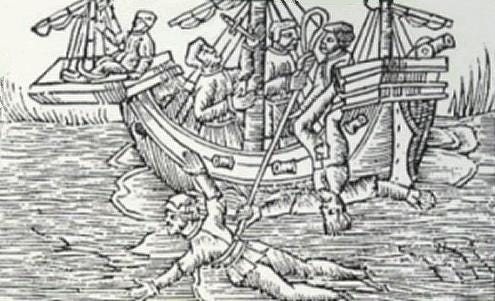
“Yesterday I tried to write a description of a most horrible sight. It was so revoltingly cruel, so barbarous, so infamously brutal, that I gave it up.” — a special correspondent of the London Morning Advertiser in 1882.
On a ship, the keel is the bottom of the ship. Normally, not much happened on the keel, but sometimes, sailors would get thrown at the bottom of the heel to be tortured and sometimes killed. This practice would have a sailor tied to the ship, or tied to a line of the ship, and get dragged along the heel. In other instances, the sailor would be tied down with weights attached to his legs to stop him from escaping and swimming away.
This practice of torture was known as keelhauling. Keelhauling was a punishment especially reserved for sailors and pirates, and according to The Infographics Show on YouTube, keelhauling was often used for the worst of sins and transgressions on ships, whether it was mutiny or simply getting too belligerent on a ship.
But keelhauling was used somewhat sparingly by pirates — instead, the British, French, and Dutch used it much more often as a form of punishment.
Kara Goldfarb at All That’s Interesting notes keelhauling was known as a message and warning. Keelhauling inflicted an excruciating amount of pain, often attaching a weight to the legs of a victim. On the rope, the victim would get dragged along the bottom of the ship. The keel of the ship also often had barnacles, which gave bruises and lacerations to the victim. These lacerations would later usually lead to infections.
Like other historically brutal forms of torture like the Blood Eagle, scaphism, and immurement, the amount to which keelhauling actually happened is still under contention by historians. Also, keelhauling was less brutal than many of these forms of torture because people often survived keelhauling.
But there is definitive evidence keelhauling was not just a myth.
The most vivid account of keelhauling
On September 9, 1882, a telegraph documented two Egyptian men court-martialed after an attempted murder near Alexandria. They were sentenced to a keel-hauling under Article 2 of the Egyptian Naval Code, and both men survived but suffered terribly. A New York Times article cites one of the English correspondents who witnessed this keelhauling, who describes the extent of their injuries:
“The one upon whom the strain of the rope had fallen was apparently lifeless. His face was turned toward us: it was bleeding and torn: his clothes were hanging in shreds, and his hands were dripping with blood. His eyes were open, but they seemed to be filled with blood. The ship’s bottom, covered with barnacles, rasped upon the poor devils like nails…The nose of one wretch was torn almost away. One ear was gone…He was bloody literally from head to foot.”
As for the other guy, he wasn’t doing much better:
“[He] seemed to be conscious. His back, as he hung in the air, and toward us, but he moved his head, we thought, and apparently to beg for mercy.”
After keelhauling the men again for 21 seconds, which felt like hours to the correspondent, the men seemed unconscious and “probably dead.” The correspondent said death would have been a better fate for the men than what they had undergone. After the officers of the ship brutally keelhauled the two men, they offered the English correspondents cigarettes and coffee in a display of generous hospitality.
“It is needless to say that we did not accept either. For my part I should have rather seen the entire ship’s company shot than accepted any hospitality at the hands of its officers.”
This is the last documented keelhauling in history.
The history of keelhauling
Goldfarb notes the first written accounts of keelhauling were mentioned by 17th century English writers, particularly in a book called The Naval Tracts of Sir William Monson. However, Monson provided a very vague account of keelhauling with no dates.
The Dutch, however, have records of keelhauling’s use. One painting, The Keelhauling of the Ship’s Surgeon of Admiral Jan van Nes, documents an official use of keelhauling. Painter Lieve Pietersz described the procedure as “a severe punishment whereby the condemned man was dragged beneath the ship’s keel on a rope. It served as a terrible warning to all mariners.”
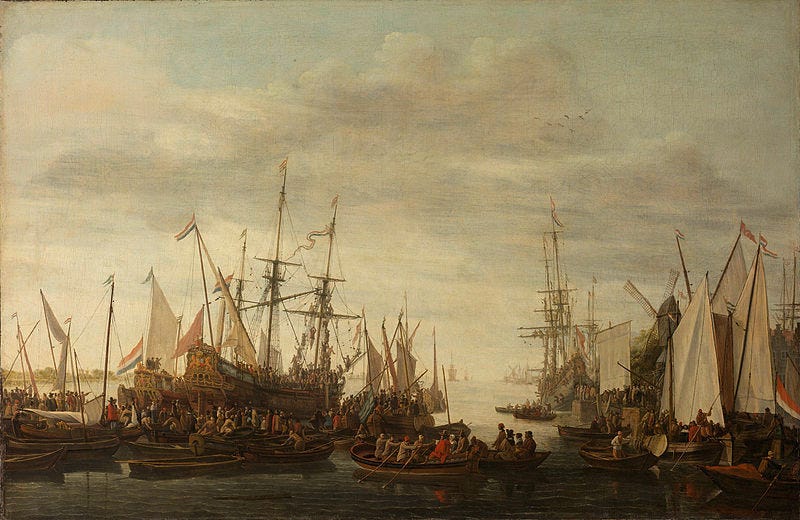
A close examination of the painting shows a very large crowd gathering on boats, hundreds of people coming to watch Admiral Jan van Nes suffer. Each rowboat holds between 10 to 20 people, and every person in the painting is looking in a certain direction towards the left side of the painting, but when you follow everyone’s eyes, you will notice a faint image of the surgeon hanging at the foremast, with his hands and feet bound.
Scottish poet William Falconer described the practice of keelhauling in detail as an “extraordinary sentence” done with the “serenity of temper particular to the Dutch.” The pain a culprit was allowed to recover from time to time before being passed under the ship’s bottom again and again. Winter would be a particularly bad time to be keelhauled since the victim would not only have their head hit against the bottom of the ship but hit flakes of ice and nearly freeze to death.
It is interesting Falconer describes keelhauling as “a punishment peculiar to the Dutch.” While it’s interesting and somewhat reassuring Falconer suggests keelhauling wasn’t intended to kill, we can imagine a lot of people died from keelhauling. And Falconer does not comment on the spectator nature of keelhauling that often saw it as a source of entertainment.
According to Sabrina Ithal at Ranker, the Dutch would ban keelhauling in the middle of the 18th century. But what crimes warranted a punishment? Apparently, that decision was made by the captain of the ship.
One account of a French keelhauling in the mid 19th century documented a man being lashed before keelhauled, and the man would hit the water “so violent as to cause serious internal injury.” He would be hauled under the keep, go up the fore-arm, and be suspended on the other side of the ship “like a drowned rat in a rope.” The whole process would be repeated numerous times at 10 to 15-minute intervals. A gun would be fired between each interval to scare the victim.
Takeaways
The most popular fictional account of keel-hauling in a 1935 movie called Mutiny on the Bounty. The film was not very historically accurate but centered around the HMS Bounty, a small British naval ship. The captain, William Bligh, was wildly unpopular among some members of his crew, and usually gave incredibly harsh punishments: one of these in the film was keelhauling.
It seems like keelhauling was a type of punishment where it was sometimes better to die than to keep living. But there are other documented keelhaulings where people survived without long-term injury. Pedro Ramón y Cajal, the brother of the father of neuroscience, Santiago Ramón y Cajal, was keelhauled as punishment for being a stowaway but had been allowed to continue journeying on the ship afterward.
Nevertheless, it is good keelhauling is now banned across the world, as it should be.


