
Kazakhstan likely to miss its 2030 renewable energy development targets
According to a new report from research firm Global Data, the share of renewables in Kazakhstan’s electricity generation will reach 10.3% by 2030, less than the 2021 target of 15%.
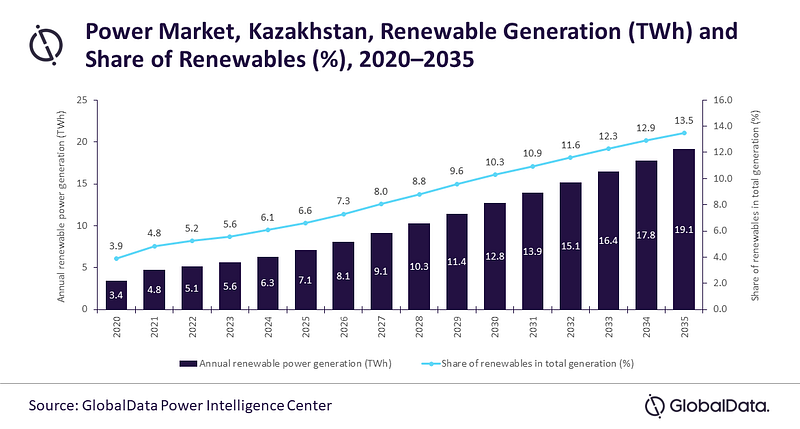
The country met its short-term goal of producing 3% of its electricity from renewable energy sources in 2020 and then increased the target for 2030 from 10% to 15%. In 2022, thermal generation accounted for 80.1% of installed capacity and 86.6% of annual output. Kazakhstan has significant reserves of cheap coal, which makes the country dependent on this source of energy.
According to the Kazakhstan Electricity Grid Operating Company (KEGOC), as of January 1, 2023, the total installed capacity of power plants in Kazakhstan is 24,523.7 MW, and the available capacity is 20,761.7 MW.
According to KEGOC, electricity generation in Kazakhstan in 2022 amounted to 112,865.9 million kWh, and its structure was as follows:
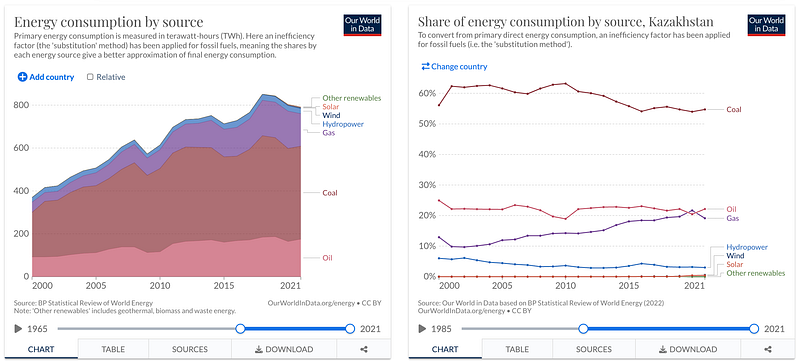
As we can see, the data is somewhat different from the GlobalData figures. It should also be taken into account that the target indicator for the development of renewable energy in Kazakhstan includes, in addition to SPPs and WPPs, small hydroelectric power plants and power plants operating on biofuels.
According to the Ministry of Energy of Kazakhstan, at the end of 2022, there are 130 renewable energy facilities operating in the Republic with an installed capacity of 2400 MW (including 46 WPPs — 958 MW; 44 SPPs — 1148 MW; 37 HPPs — 280 MW; 3 BioPPs — 1.77 MW ).
According to GlobalData analysts, the lack of flexible (flexible) capacity is the main problem for Kazakhstan in achieving its goal of renewable generation.
Although competitive selection is actively conducted in Kazakhstan, and their results are positive — they provide a low cost of electricity, according to GlobalData, the country should strive to make the tender system more attractive for foreign investment and the introduction of advanced technologies.
The authors of the report expect that between 2023 and 2035 Kazakhstan will add 3.1 GW of solar photovoltaic capacity and 2.9 GW of onshore wind farms.
This is a rather modest estimate, given the good pace of competitive selection and previously signed agreements with various investors. For example, in 2022, the government of Kazakhstan signed an agreement with foreign investors to build a 20 GW hydrogen plant and 40 GW solar and wind power plants to power electrolyzers.
In February this year, Kazakhstan approved a strategy to achieve carbon neutrality until 2060, which states that the development of renewable energy will be a key condition for successful decarbonization.
By 2050, the country expects to achieve a 50% share of renewable energy in electricity generation.