
Kapoor and Me, Now and Then
Intersections with the works of Anish Kapoor…
I remember my first essay as an artist about an artist. Sure, I did art before college but that elective step into post-compulsory education in art is a good marker-point of when I self-declared commitment to being an artist, for real. It was one of the first college trips to London and of course we had a ‘suggested’ itinerary plus a written assignment. The main essay was to be about an artwork of our choice, experienced first-hand, at the impressive and important exhibition simply known as The Sculpture Show.
In retrospect, I can see why the tutors ensured we made the train journey down from ‘The North’ to see what was the biggest exhibition of work by contemporary sculptors ever held in Britain. I certainly didn’t realise at the time what a historic exhibition it was, though I did appreciate its scale, presenting the work of more than 50 artists. Some were already well-established ‘crowd-pleasers’ that had been in the national news. Others were emergeant and yet to become important. At the time, nearly all of them were new to me. The show occupied both the Serpentine South Gallery and the Hayward Gallery at the Southbank Centre, plus larger works outside in the immediate surroundings, mainly Kensington Gardens. The exhibition ran from 13 August to 9 October, 1983.
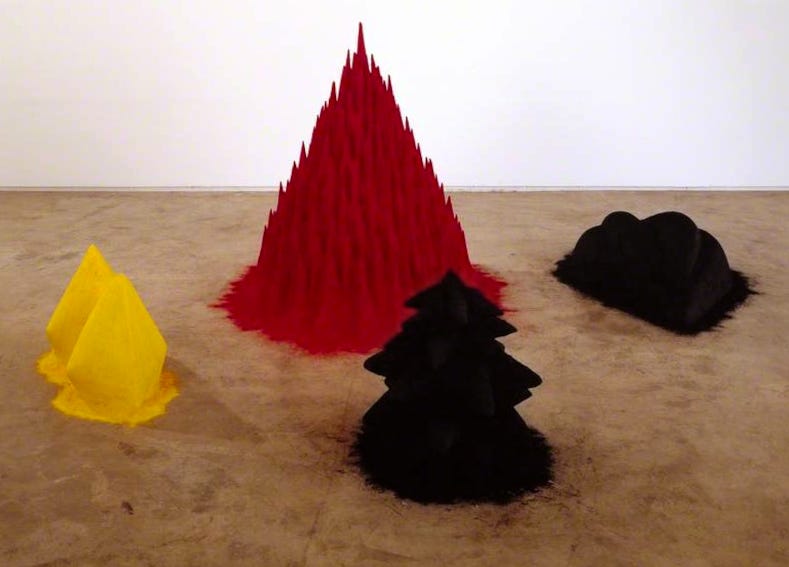
So, forty years ago, I was writing my first formal critique of an artwork and, from an array of strong contenders, I’d chosen a group of sculptures by a comparative newcomer named Anish Kapoor. The work was made up of what appeared to be piles of dry powder-paint that somehow retained gravity-defying shapes that suggest details from nature and the land — buds, seeds, perhaps smaller structures one may only observe through a microscope. They tapped-in to childhood memories of sandcastles on a beach and appeared fragile and transient, as if they could collapse if touched. Yet their tactile surfaces were tempting…
The dominant piece was a bright red cone made up of many smaller spires implying a fractal continuum resembling an unopened bud, distant temple or pine-forested peak during a particularly vivid sunset. Although only about waist-high, it played with perceptions of scale as one approached the group: if it was a mountain, then the other forms took on aspects of landscape and we were giants; if a tiny bud, then the work shrank us into the microcosm. The bright red and yellow forms emphasise the light-absorbing blue-black of the other two shapes and here we see the beginnings of a fascination with colour, form, and perception that the artist would explore throughout the long and successful career that lay ahead of him.
Kapoor’s work since has placed White Sand, Red Millet, Many Flowers in the context of a purely abstract piece intended to be a direct and immediate perceptual experience. It may be aesthetically closer to antecedents in abstract painting than it is to general sculpture. Among the works at The Sculpture Show it was striking in its bold use of colour, which most of the other sculptors seemed to shy away from. Though at the time, after researching the artist’s Indian origins, I saw clear references to the vivid spice markets and the bright pigments used in cloth dying and Holi festivals.
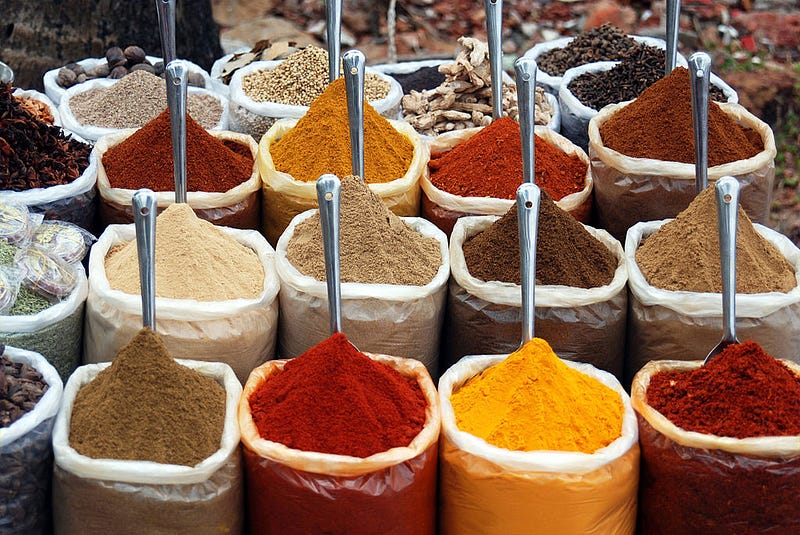
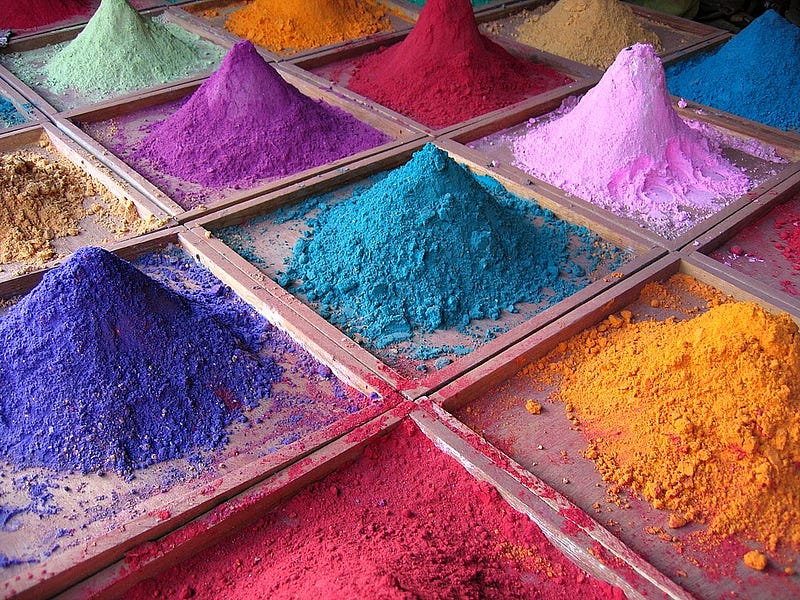
As a student, I found Kapoor’s early works inspiring because they achieved a pleasing, visually stimulating result with comparatively simple and, importantly, affordable materials. Pure powder paints poured over forms carved from plaster or polystyrene blocks doused in PVA glue. This was something that could be done with meagre funds and what could be found in the college store cupboards.
Ironically, Anish Kapoor went on to become the highest paid artist in Britain. Not necessarily in terms of his personal earnings, but in the huge budgets his commissions would command.
My next meaningful encounter with a Kapoor sculpture was at the dawn of the New Millennium, experiencing his vast installation in the Tate Modern Turbine Hall in the autumn of 2002. The biggest indoor art space in the world was once a main attraction of the gallery with some spectacular, challenging work that would welcome visitors and really make a statement that one had arrived at a Modern Art Museum with a BIG difference.
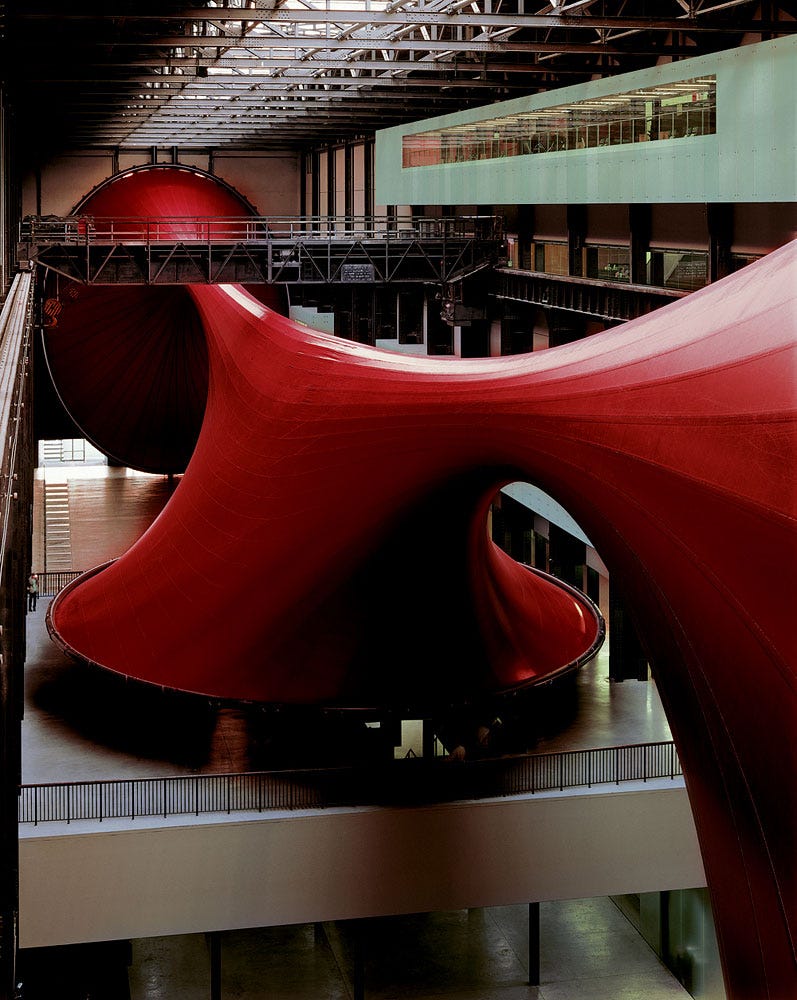
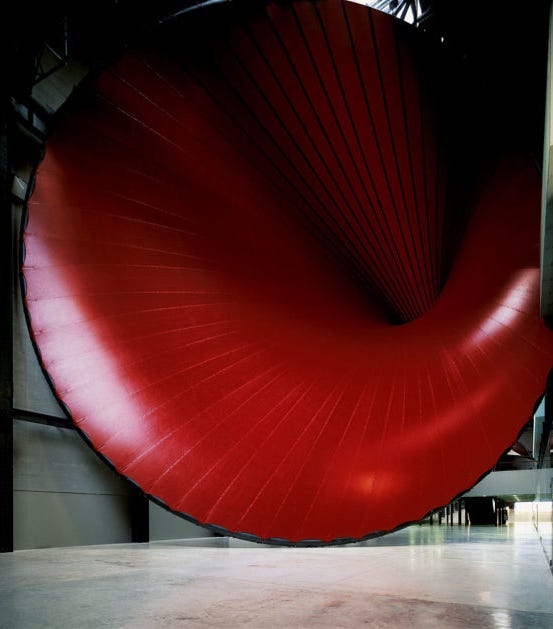
Anish Kapoor’s Marsyas filled the space so effectively that it seemed irrevocably lodged there, while leaving much of it empty. The relatively simple form dominated the vast hall, suspended like some great red beast. A taut skin of PVC was stretched between three huge steel rings, each around 35-metres in diameter. The huge hoops governed the form and dictated the mathematically complex parabola of the flimsy membrane — a geometric confluence of two funnels distorting into a third, inverted funnel as the horizontal and vertical transitioned. It’s a model of complexity arising from simplicity — a principle that underpins the physical reality of the universe.
The making of Marsyas was an impressive feat of engineering and to realise his grand concept, Anish Kapoor worked with a team of engineers and material scientists. It was also his first collaboration with Cecil Balmond, the architect and designer of monumental artworks with whom he would work again on Orbit, the sculptural observation tower built for the London 2012 Olympics. Orbit stands 115-metres tall, making it the tallest sculpture in the UK, but if Marsyas could be stood on end at its side, the latter would be taller.
The Marsyas structure was so huge that it obscured itself and could not be seen in its entirety from any one point within the gallery. It invited viewers to explore its form as a series of views and construct their own individual idea of the whole. In this way, the monumental structure also operated on a human scale and even introduced a playful interactive element…
From under the horizontal steel hoop that seemed to hover just above head-height over the Turbine Hall’s mezzanine, the viewer looked up into monochromatic void of blood red that receded in two directions to form the asymmetric structures reminiscent of gramophone horns. Together, these horns spanned the 150-metre length of the hall. One terminated at a connecting bridge affording a view into its throat. Here that gramophone structure paid off for it acted as a giant ear-trumpet and one could speak in clear conversation tones to a person standing on the mezzanine, tens of metres away.
The title of the piece is a reference to ancient Greek mythology. Marsyas was a Pan-like satyr and unusually gifted musician. In one tale he finds a magical double-piped aulos once played by the goddess Athena who had cursed the instrument because when she pursed her lips and puffed out her cheeks to play it, her perfect beauty was distorted. Marsyas mastered the pipes and, being an instrument of the gods, it made such beautiful music that he challenged the god Apollo to a contest.
It was a close call, and in some versions of the story, Marsyas wins but Apollo demands a rematch and raises the stakes so that the winner could do whatever he wished to the loser. Apollo wins by cunning means (some might call it cheating) and decides to have Marsyas flayed alive and his stretched-out skin nailed to a tree for display before being made into a wineskin for the god. Sore loser.
Kapoor chose the deep red colour as a clear reference to blood and the thin, heat-smoothed PVC is indeed a skin of sorts that separates the internal and external volumes of the form. The colour red and the concept of transitioning between inside and outside have since become recurring motifs in Kapoor’s work. He is endlessly fascinated by perceptions of solidity and void and blurring the threshold between.
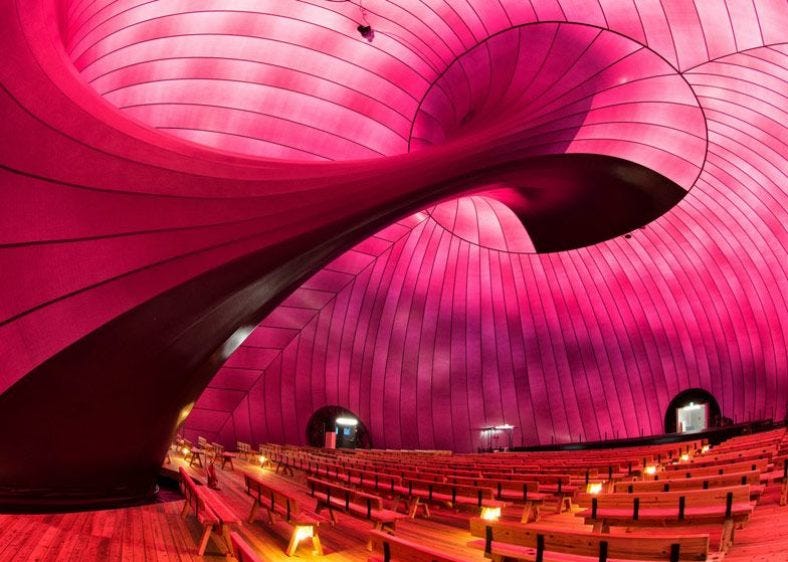
Although Marsyas was destroyed during removal from the Turbine Hall, the artist has repeatedly worked with variations on the theme and reiterations of the form at different scales in gallery spaces and in the environment. One of his more recent grand-scale works is Ark Nova, an inflatable concert hall completed in 2013. A collaboration with Japanese architect Arata Isozaki, it was intended to be installed as a temporary venue for the arts in regions struck by earthquakes. It has clear technical and aesthetic links to Marsyas.
While Marsyas still filled the Tate Turbine Hall, another of Kapoor’s works produced earlier, in 1995, was taken from its gallery setting and placed outside in the landscape where I was able to become an integral part of the art. It’s another piece that considers ideas about surfaces that contain and separate intangible volumes, playing with perceptions…
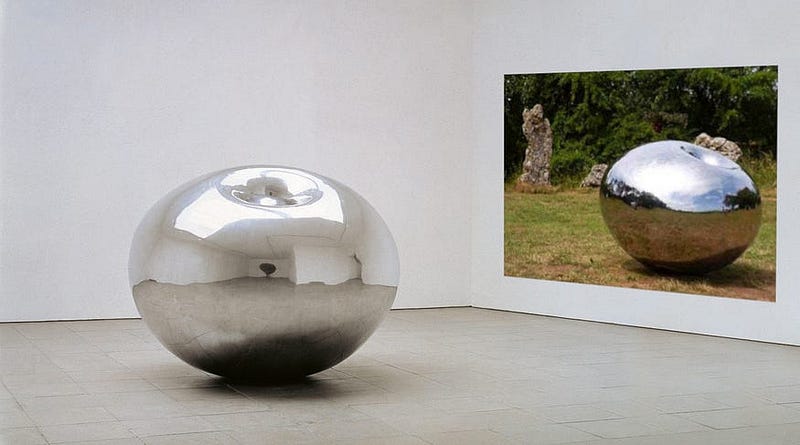
Although learning never ends, my ‘student days’ were now long over and I had just taken-up a post as a college arts lecturer. Whilst trying to come up with a general definition of art with a group of students, we found ourselves discussing the above image of Anish Kapoor’s Turning The World Inside Outside. For the summer of 2003, this piece had been removed from its clinically white gallery space and placed among the Rollright Stones, near Chipping Norton in Oxfordshire.
We thought that this does what good art should do. It’s attractive and engaging. It doesn’t initially challenge, offend or seem to be ‘really serious’… and it’s a beautiful object. Something like a big silver apple, or a bauble off a Yuletide Tree.
Like other reflective pieces by Kapoor — such as the great Cloud Gate installed, 2006, in Chicago’s Millennium Park — it also has that funhouse mirror thing that entertains children and invites you in. As you approach it, you realise that you have been incorporated into it — your reflected image is now part of the ‘work’.
One cannot actually see the object itself but perceive only where its surface disrupts and distorts its environment. It does not stand apart from its surroundings, it alters them and reflects them back to the viewer, who is also altered and reflected back. By doing this, it presents us with a new viewpoint that incorporates the piece of art, its environment, and ourselves.
Perhaps this shows us what good art can do. Its presence changes the way we see our environment, ourselves and others, but to some extent, it is up to the individual to respond to that view and reflect on what it could mean.
So perhaps ‘successful’ art should either reveal something to us that we were not previously aware of, about ourselves, others, and the wider world. Or change our view of these elements and the way they interact. Hopefully by doing this, art enriches our experience of being.
Maybe it’s sometimes enough for art to reflect reality and show us how subjective that concept may be.
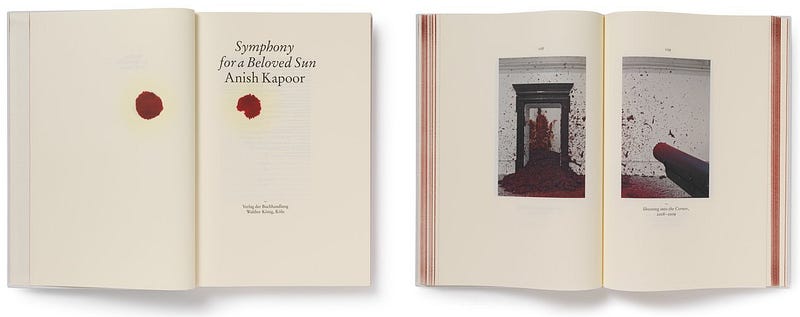
My most recent primary experience with a work by Anish Kapoor is a book that also acts as proxy for works I wasn’t able to experience in person. Symphony for a Beloved Sun is an artist’s book of sorts as well as the catalogue for a major exhibition of the same title staged in 2013 at Berlin’s Martin-Gropius-Bau Museum. The show was partly a retrospective although half of the works displayed were new. Many of those works were united by using the deep red colour that had become a major signifier for Kapoor. A bloody colour that represents an externalisation of the internal, the flesh animated by consciousness, art animated by concept, the inorganic perceived through our fleshy organs.
The centrepiece of the exhibition that also shares the title of Symphony for a Beloved Sun consisted of a huge red circle presiding over the gallery’s two-storey atrium and flanked by industrial conveyors, similar to those used in mines and quarries, that regularly transport large blocks of dark red wax to a great height before they then drop to the floor. This repeated action provides a slow but erratic rhythm for the symphony as the big blocks slap loudly onto the floor or add to the accruing pile of their misshapen predecessors.
The book itself becomes a separate work of art comprising the concepts of the 70 or so works but reduced from their architectural scale to a more intimate human scale in text and pictures. Its cloth-bound cover is pleasingly tactile, the leading edge of all the pages is a dark blood red, of course, and its layout is elegant throughout with beautiful typography using traditional metal typesetting.
So, it’s perhaps a little disconcerting that the minimalist cover is corrupted by the addition of a blob of oil paint — dark blood red, of course. Before drying, the oily pigment penetrated the surface of the cover sinking through the pages of the book. The Kapoor red stain sunk through the front matter and introduction, to a depth of nine pages with the final detectable dot on the title page of Norman Rosenthal’s essay, Anish Kapoor: The Artist in the Echo Chamber of History. Whilst giving the impression of individuality, subsequent facsimile editions faithfully reproduce this effect.
Not surprisingly, the book won a prestigious D&AD Award for its design. And whilst this is an affordable artefact — though perhaps not for many art students — Anish Kapoor's art is now typified by large-scale works that use industrial manufacturing techniques and require massive funding. For example, construction of Cloud Gate cost $23 million with ongoing cleaning and maintenance beyond that… No longer something I would aspire to with meagre funds and what could be found in the college store cupboards.
For a definitive list of works by Anish Kapoor see the artist’s official website.
* Signifier and the author cannot be responsible for third-party content on external sites which may contain advertising and are subject to change without notice. All images are used with license, are promotional material, or presented here for educational purposes under fair usage policy.


![2 ]](https://en.wikipedia.org/wiki/File:Indian_pigments.jpg)