In Rejecting Andre 3000’s Verse, Kanye West Communicates the Cost of White Approval
Kanye’s disrespect of a rap legend shows his willing estrangement with his Blackness.
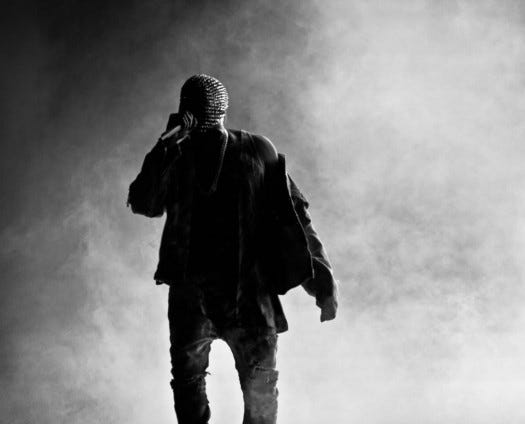
Last weekend, Drake released a verse that Kanye West omitted from DONDA written by the legendary Andre 3000. Hip-hop heads are already calling 3 Stacks’ work the best 16 bars of the year and amongst his finest work as he meditates on the enduring grief he feels toward his mother. Hell, I even rank it above his verse on International Player’s Anthem, one of my favorite songs of all time:
Hey Miss Donda, you run into my momma/
Please tell her I said say somethin’/
I’m starting to believe they ain’t no such thing as heaven’s trumpets/
No after over, this is it, done/
If there was a heaven you would think they would let you speak to your son/
Maybe she has in the form of a baby’s laugh/
On September 4th, Daniel Kreps of Rolling Stone reported on the statement Andre released about the leak. “A few weeks ago Kanye reached out about me being a part of the Donda album. I was inspired by his idea to make a musical tribute to his mom. It felt appropriate to me to support the Donda concept by referencing my own mother, who passed away in 2013,” Andre wrote. The context of the song he rapped for, however, was different from the track West sent him. Andre spat about his departed momma because “We both share that loss.” He was, however, blindsided by Kanye making the track he rapped for an insult track toward Drake. “The track I received and wrote to didn’t have the diss verse on it and we were hoping to make a more focused offering for the Donda album but I guess things happen like they are supposed to. It’s unfortunate that it was released in this way and two artists that I love are going back and forth.”
Kanye fans on Black Twitter claim that Andre’s verse was excluded due to his cursing and explicit content. Andre’s statement refutes that. “I thought it was a beautiful choice to make a clean album but, unfortunately, I didn’t know that was the plan before I wrote and recorded my verse. It was clear to me that an edited ‘clean’ format of the verse would not work without having the raw, original also available. So, sadly, I had to be omitted from the original album release.” The order of events does not support having Andre’s verse excluded for profanity.
Kanye West has become Tom Buchanan from F. Scott Fitzgerald’s the Great Gatsby.
Extending charity toward Kanye means taking the claim that excluded Andre because of artistic differences. Kanye, however, has run the Black community’s charity bone dry. We acknowledge his genius and grief. But his struggles have consistently manifested in behavior that distances him further away from Black personhood. His disrespect toward Andre, however, is rooted in his music, and white support of it.
“The Donda gigs answered the question,” Craig Jenkins wrote for New York for his review of Kanye’s album, “of whether people would still show up in numbers for Kanye after the embarrassing courtship of Donald Trump, the comment about slavery being a choice, and genuinely terrifying show of last year’s ill-advised, last-minute presidential campaign and the unfortunate political associations and restrictive, theocratic abortion stances in brought to the surface. They will.” These stances, especially the views on slavery and Donald Trump, are profane toward Black personhood. It is anathema. We have not forgiven OJ for his colorblind aspirations, Tiger Woods for claiming to be Cablinasian, or Hermain Cain making his deathly political home with Republicans. As of September 3rd, the New York Times reported that DONDA has received 180 million streams. Jenkins also referred to a Billboard report which showed that Kanye’s stadium listening parties have made millions. Such streaming and financial success, despite Kanye donating tickets to area HBCUs for his Atlanta listening party, cannot solely be attributed to Black support. There aren’t enough of us. Rather, his pop-star success can only be attributed to support from white fans, which explains why he can still have a thriving career despite his support for the racist, orange conman from New York.
Ta-Nehisi Coates saw this coming from years away. In his 2018 essay for the Atlantic, I’m Not Black, I’m Kanye, he saw that the thrust of Kanye’s behavior was toward the freedom that white supremacy promised to its adherents. But white supremacy, despite being a young creation of humanity, behaves like an old god hungry for sacrifice. “The rule of Donald Trump is predicated on the infliction of maximum misery on West’s most ardent parishioners, the portions of America, the muck, that made the god Kanye possible,” he wrote. Coates was writing about the spiritual cost of Kanye’s success upon the artist. He made the purchase, he noted, through being “overexposed, who holds the world’s attention through simply the consistent, amazing, near-peerless quality of his work.”
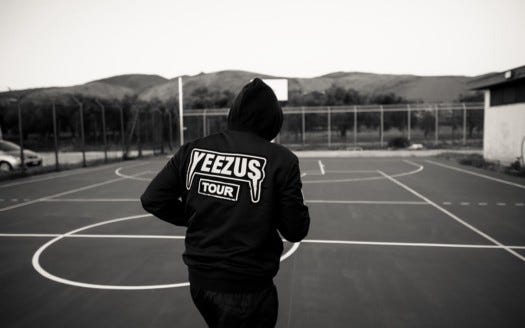
But Coates observed that the cost of that purchase was “a paucity of wisdom, and more, a paucity of loved ones powerful enough to perform the most essential function of love itself, protecting the beloved from destruction.” Kanye has been constantly on the outs with his day ones. His momma is an ancestor. He left his early love for Amber Rose and then Kim Kardashian. He had a longstanding antagonism with Rhymefest, one of his earliest supporters, that was only squashed last year. After Watch the Throne, his relationship with Jay-Z became strained until he got Hova as a feature on DONDA. None of them were able to stop Kanye from embracing Trump and wearing a Make America Great Again hat. For an artist whose first three albums were dedicated to the Black experience, his deviation was painful. “The weight is more,” Coates said about Kanye’s betrayal of the Black personhood that had his back since the College Dropout, “because they come from communities in desperate need of champions.” Kanye sold that support for “a white freedom”, which Coates listed as:
freedom without consequence, freedom without criticism, freedom to be proud and ignorant; freedom to profit off a people in one moment and abandon them in the next; a Stand Your Ground freedom, freedom without responsibility, without hard memory; a Monticello without slavery, a Confederate freedom, the freedom of John C. Calhoun, not the freedom of Harriet Tubman, which calls you to risk your own; not the freedom of Nat Turner, which calls you to give even more, but a conqueror’s freedom, freedom of the strong built on antipathy or indifference to the weak, the freedom of rape buttons, pussy grabbers, and fuck you anyway, bitch; freedom of oil and invisible wars, the freedom of suburbs drawn with red lines, the white freedom of Calabasas.
This was the calculus Kanye made when trading his community for fame.
Kanye West has become Tom Buchanan from F. Scott Fitzgerald’s the Great Gatsby, a rich white man who “smashed up things and creatures and then retreated back into their money or their vast carelessness…and let other people clean up the mess they had made.” That carelessness stands against all the qualities of Black personhood that influenced his mother and allowed our continued endurance in the West. It is more than creativity. Our endurance also honored the men and women who lifted us up when the gravity of white supremacy held us down; the community that saw his gifts and gave up paychecks and time to develop them into a genuine skill; the loyalty and support we gave him with his first three albums that centered our lived experiences in Southside and Westside Chicago and, by extension, every Black community in America; the mana that fueled early hits such as “Jesus Walks” and deep cuts such as “My Way Home, and “Crack Music;” and all the soul singers he sampled before he decided to dive toward the stadium sounds that now marks his sound. As an artist, he is allowed to expand his musical tastes as he makes his sonic mark. But by purchasing his white popstardom with the cost of his connections to his Black community, he enabled the conditions that caused him to disrespect Andre 3000 so thoroughly.
Andre was not simply honoring his mom, his ancestor, in the excluded verse. By constantly invoking Donda West, he was also honoring Kanye’s ancestor. Ancestorhood, and Black people’s defined, coherent connection with our departed, is the spiritual bulwark we have toward a white supremacy that strives to eat us up. Our endurance is a problem to a society that professes the equality of man and then passes voter suppression laws, that quote Martin Luther King Jr. regarding judging the content of character, and then enforces every stereotype that says Black character is lowly. At some point in his life, Kanye fought for us. But his rejection of Andre’s verse and the circumstances of it — really, you want to feud with another Black man to fuel more streams from white folks? — shows that Kanye, in the shine of being a pop star, has rejected the ways of the people who were responsible for putting him on. We were there for his star-making turn on Jay-Z’s Blueprint, the Gucci backpacks and teddy bear mascot. We are decreasingly present for him now.
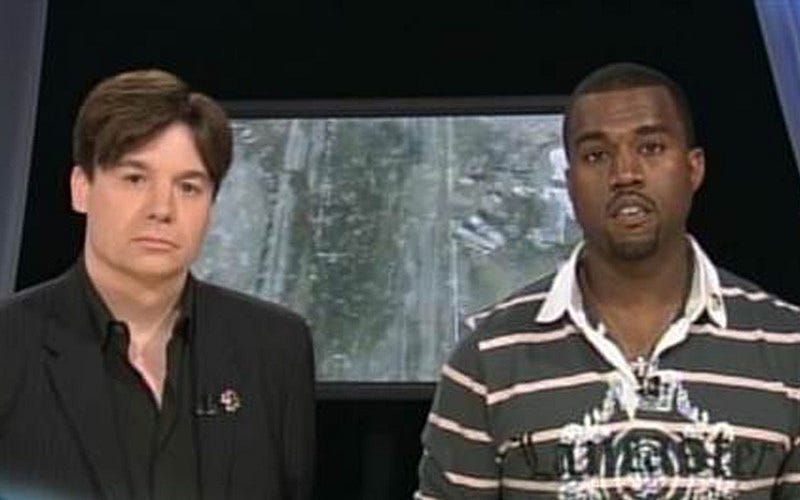

Andre is Kanye’s elder. Andre’s mother, and Kanye’s mother, are ancestors, whose afterlives are the best defense we have against the acquisitive nature of white supremacy. Our ancestorhood teaches us to create true to our communities. If we are able to ascend in a society where the laws of gravity were legislated to keep us earthbound, then we have a right to hold fast to our defenses. In his disrespect toward Andre, Kanye showed a deep disregard toward that instinctive wisdom.
Kanye’s pop-star success can only be attributed to support from white fans, which explains why he can still have a thriving career despite his support for the racist, orange conman from New York.
Only his pursuit of white freedom allows him to continue his behavior. White people have rewarded him by making him a billionaire. His wealth has placed him beyond the reproach of any Black people, for we are the raw material of capitalism; capitalists are not in the habit of conversing with their food. To seem levelheaded, many have claimed that Kanye’s admitted mental illnesses contributes to his betrayals. But their excuses are a white mercy. White people will make infinite excuses for the behavior of the people they accept, save the most rational reason. Kanye sees his people as collateral for his rise. He fails to realize that he is one horrible album away from his white base from leaving him, as white supremacy does not allow its Black avatars to make any mistakes. Leaving Andre 3000 off his album is a prophecy which shows that day may be coming sooner rather than later.
I’m mad as Hades.
I’m done with Kanye’s willful estrangement toward his people. I was so angry at Kanye that I hoped in the shower and, while scrubbing off the smells of Labor Day weekend BBQ and cigars, I channeled Issa Rae and began freestyling. I stepped out of the shower, moist and mad, and typed down the bars into my Notes app I wanted to hold onto:
Hey Miss Donda, come help your son/
’Cause since you died he’s been on one hell of a run/
toward whiteness, the devil in me wants to fight him/
but I wanna honor you and be more righteous/