
Just Because Lincoln “Freed the Slaves,” That Doesn’t Mean He Wasn’t Racist
Confusion about 'Honest Abe' does more harm than good.
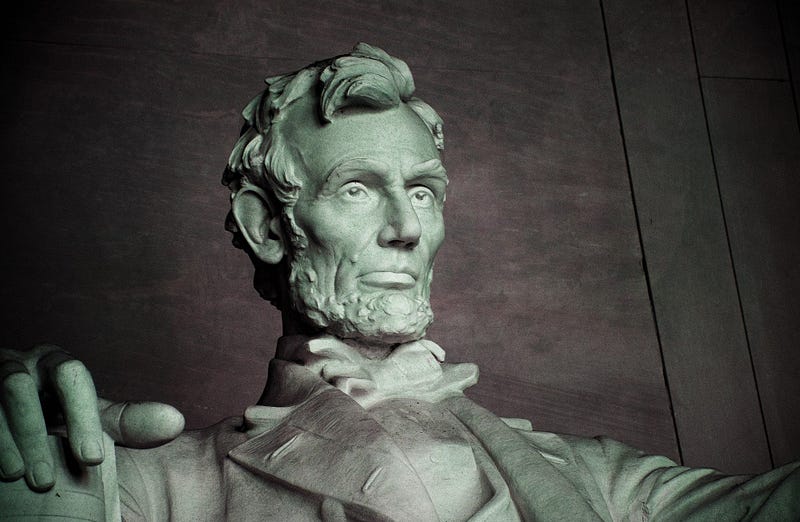
This is a story I’ve been meaning to write for a few months now, but I’ve been dragging my feet a bit because I know it’s going to bring out a lot of feelings for many readers. Back in December, when I read lots of angry comments from people who were up in arms over the removal of a famous Lincoln statue in Boston, I realized that far too many Americans don’t know — and don’t care — who “honest Abe” really was.
The Boston statute was a copy of the “Emancipation Memorial” in Washington D.C. It depicts a formerly enslaved Black man kneeling at the feet of Abraham Lincoln. While the statue still sits in Washington, the Boston version was removed after the city sided with protestors who claimed the monument sent the wrong message about American history and slavery.
The (mostly white) people who felt the statute should stay argued that they interpreted the president to be saying, “No, don’t bow before me — you’re equal now.” They’ve had a really hard time with this one and can’t seem to grasp why the statute is offensive. How can you tear down our history, they cried. Don’t you know that Lincoln freed the slaves and fought for equality? Don’t you know that it was former slaves who commissioned the memorial in the first place?
When folks ask these sorts of questions, I’m not sure if they’re being intentionally obtuse or truly out-of-touch. Based on the comments section of virtually every article I read on the matter, most Americans don’t understand American history. It seems that most of us were taught in school that Abraham Lincoln was “a good man because he freed the slaves.” Very few schools seem to be teaching the truth that Lincoln was a racist president who freed the slaves as a mostly political/military move.
Over President’s Day, you might have seen folks sharing a controversial quote by Lincoln on social media. In it, he says, “I am not, nor ever have been, in favor of bringing about in any way the social and political equality of the black and white races... there must be the position of superior and inferior, and I am in favor of having the superior position assigned to the white race.”
Sort of a strange comment for the president who freed the slaves, don’t you think?
Unfortunately, it gets much worse, as the quote has been removed from context and rather patchworked together. It comes from the fourth debate between Lincoln and Stephen A. Douglas on September 18 in 1858. While fighting for a senate seat, his opponent accused Lincoln of supporting “negro equality.”
Now, in his first debate with Douglas, it’s true that Lincoln argued for “equality,” but it was an extremely limited concession. He was against the institution of slavery, yet still concerned about protecting white supremacy:
“I have never said anything to the contrary, but I hold that notwithstanding all this, there is no reason in the world why the negro is not entitled to all the natural rights enumerated in the Declaration of Independence, the right to life, liberty and the pursuit of happiness. I hold that he is as much entitled to these as the white man. I agree with Judge Douglas he is not my equal in many respects — certainly not in color, perhaps not in moral or intellectual endowment. But in the right to eat the bread, without leave of anybody else, which his own hand earns, he is my equal and the equal of Judge Douglas, and the equal of every living man.”
Let’s be very clear about what Lincoln was saying. His entire definition of “life, liberty, and the pursuit of happiness” for Black men was rooted in inequality. Right there, he boasts that their black skin is not equal to his white skin, and suggests that Black men may not be as good or smart as white men.
What is that if it is not racism? Where is the confusion?
As it happened, many white men were still worried about Lincoln wanting total equality, so, he chose to set those minds at ease in the fourth debate. There, Lincoln went much further and did not hide his feelings about Black people. In fact, he seemed to feel it a nuisance that he even had to address the issue at all.
Here’s that quote in full context:
“While I was at the hotel to—day, an elderly gentleman called upon me to know whether I was really in favor of producing a perfect equality between the negroes and white people. [Great Laughter.]
While I had not proposed to myself on this occasion to say much on that subject, yet as the question was asked me I thought I would occupy perhaps five minutes in saying something in regard to it. I will say then that I am not, nor ever have been, in favor of bringing about in any way the social and political equality of the white and black races, [applause]—that I am not nor ever have been in favor of making voters or jurors of negroes, nor of qualifying them to hold office, nor to intermarry with white people; and I will say in addition to this that there is a physical difference between the white and black races which I believe will forever forbid the two races living together on terms of social and political equality.
And inasmuch as they cannot so live, while they do remain together there must be the position of superior and inferior, and I as much as any other man am in favor of having the superior position assigned to the white race. I say upon this occasion I do not perceive that because the white man is to have the superior position the negro should be denied every thing. I do not understand that because I do not want a negro woman for a slave I must necessarily want her for a wife. [Cheers and laughter.]
My understanding is that I can just let her alone. I am now in my fiftieth year, and I certainly never have had a black woman for either a slave or a wife. So it seems to me quite possible for us to get along without making either slaves or wives of negroes. I will add to this that I have never seen, to my knowledge, a man, woman or child who was in favor of producing a perfect equality, social and political, between negroes and white men. I recollect of but one distinguished instance that I ever heard of so frequently as to be entirely satisfied of its correctness—and that is the case of Judge Douglas’s old friend Col. Richard M. Johnson. [Laughter.]
I will also add to the remarks I have made (for I am not going to enter at large upon this subject), that I have never had the least apprehension that I or my friends would marry negroes if there was no law to keep them from it, [laughter] but as Judge Douglas and his friends seem to be in great apprehension that they might, if there were no law to keep them from it, [roars of laughter] I give him the most solemn pledge that I will to the very last stand by the law of this State, which forbids the marrying of white people with negroes. [Continued laughter and applause.]
I will add one further word, which is this: that I do not understand that there is any place where an alteration of the social and political relations of the negro and the white man can be made except in the State Legislature—not in the Congress of the United States—and as I do not really apprehend the approach of any such thing myself, and as Judge Douglas seems to be in constant horror that some such danger is rapidly approaching, I propose as the best means to prevent it that the Judge be kept at home and placed in the State Legislature to fight the measure. [Uproarious laughter and applause.]
I do not propose dwelling longer at this time on this subject.”
You can read the speech in its entirety along with Douglas’s response here. But I would hope that upon reading the passage above, you would finally grasp just how ridiculous it is for any of us to praise Abraham Lincoln for “freeing the slaves.”
On numerous occasions, he was clear about setting whites up as the “superior race.” That makes him a white supremacist, people. Lincoln was adamant that Black people shouldn’t be allowed to vote or marry white people. He wanted them to have some rights. But not all. We have done ourselves an enormous disservice by pretending that Lincoln wasn’t a racist man.
That’s not to say that Lincoln’s views never shifted. Years later, he did decide that Black men who served the Union during the Civil War should be given a limited right to vote. But even so, that’s not equality and it’s embarrassing to even suggest it means he wasn’t racist.
Abraham Lincoln had a moral opposition to slavery, but his proposed solution to it all was to send Black people away. Throughout his political career, Lincoln was no abolitionist. Instead, he favored colonization, and it appears that he only quit talking about the idea because it angered too many Black abolitionists — and he needed them on his side.
For years, Lincoln tried to garner support for Black colonization in Central America. Colonization was first suggested back in the early 1800s by the American Colonization Society (ACS) to deal with the “problem” of free Black people in America. In fact, that’s why the ACS founded Liberia — to send Black people “back to Africa.”
Lincoln argued that the differences between white and Black people were too great and that we would all be better off if Black people didn’t live in the same society as white people. But Lincoln also believed that such a move should be voluntary, and appears to have naively thought the support for colonization along Black people would be greater.
When we call Abraham Lincoln “the Great Emancipator,” we ignore history and fool ourselves about what the Emancipation Proclamation actually did. It was a military maneuver, first and foremost. And it was a political power play meant to bring the Confederate States back to the Union. If they didn’t return to the Union, Lincoln declared their slaves “shall be then, thenceforward and forever free.”
The uncomfortable reality here is that Lincoln never really freed the slaves. According to Virginia History, “The proclamation turned foreign opinion against the Confederacy and encouraged more slaves to escape to United States lines and enlist in the U.S. Army.” So, let’s be fair. Lincoln needed to stop succession, and the threat to end slavery in certain states helped him reach that goal. It also enabled him to use more slaves as soldiers.
As Lincoln famously wrote to Horace Greeley, “my paramount object in this struggle is to save the Union, and it is not either to save or destroy slavery, If I could save the Union without freeing any slave, I would do it, and if I could save it by freeing all the slaves, I would do it; and if I could save it by freeing some and leaving others alone I would also do that.” I’m not sure how much clearer Lincoln could have been about his goals. He only wanted to save the Union, not fight for equality.
It’s no surprise that the Emancipation Proclamation only applied to slaves in territories the Union didn’t actually control. And then, it was still up to those slaves in those Confederate States to risk their lives and escape to freedom. When we say that Lincoln freed the slaves, call him the Great Emancipator, or erect statues of Black men bowing before him, we blatantly disregard what abolitionists and Black people themselves went through to win their freedom. We give Lincoln credit he never, ever earned.
Unfortunately, we haven’t been especially honest with ourselves and our children about who Lincoln really was. And what really happened to end slavery. Many people seem to be confused, partly because Lincoln was assassinated. In killing Lincoln, John Wilkes Booth was motivated by his belief that Lincoln would ruin the South. Booth supported slavery, but we shouldn’t naively let that change our view of Lincoln.
Just because a president wasn’t racist “enough” for some folks, that doesn’t mean they were not racist at all.
The Thirteenth Amendment, which actually did make slavery illegal in the US, was ratified in December 1865, about 8 months after Lincoln was assassinated. And nearly 3 years after the Emancipation Proclamation. In recent years, activists have discussed the big loophole:
“Neither slavery nor involuntary servitude, except as a punishment for crime whereof the party shall have been duly convicted, shall exist within the United States, or any place subject to their jurisdiction.”
So, yes, the Thirteenth Amendment abolished slavery in the US… except, of course, in the case of punishment. It’s really no wonder then that “Black codes” filled the need for free labor which the end of slavery left wide open. After all, abolitionists fought to end slavery at any cost because it was wrong on every level. But men like Lincoln only opposed certain aspects of slavery and were not willing to end slavery when the risks seemed too great.
Whatever his personal objections to slavery, Lincoln was still a white supremacist. Our country is built upon so much racism that we have trouble recognizing reality even today.
Some people today like to argue that Abraham Lincoln was a lot less racist than his contemporaries. As if that’s something to be proud of. Many Lincoln apologists argue that he was just a man of his time.
So?
This is an argument we’ve heard a lot over the years when it comes to human rights. Not just for Black people but for women, gay and transgender people as well. There are endless problems with such reasoning, but one of the first issues is the way it forces us to argue that people are inherently racist and can’t help what they’ve been told. As if human rights aren’t… obvious. Worse yet, it’s as if we’re saying that things like racism or gender inequality aren’t wrong until society decides that they’re wrong.
To make progress, however, we must admit where we’ve been wrong. It’s not helpful to say that “everybody was racist back then (or sexist or bigoted, etc).” All that does is give people an “out” and make heroes of men who never really deserved it. It colors the way we see history and ourselves. It whitewashes reality.
Because clearly, not everybody was racist. If we look through history honestly, we will see abolitionists. We will see those who believed in women’s and Black suffrage long before they became movements. We will see those who were truly ahead of their times, and we can learn from them.
If we really want to understand ourselves and move forward, it’s important to view our history with an honest and nuanced lens. What other beliefs allowed supposedly good men like Lincoln to still decry racial equality? What beliefs have made equity so unpalatable for those in power? If we’re honest, we aren’t going to like a lot of the answers.
Things like power, white supremacy, and religion often intermingle in horrifying ways. But it’s time to be honest and accept the worst parts of our history and quit making excuses for racism or bigotry. Saying it was “a different time” doesn’t make it any better.
Yes, people want to make excuses to stick with the status quo. There’s the argument that “Black people commissioned the Emancipation Memorial, so that makes it okay.” But the reality is that Black people raised the money to honor Lincoln for his part in abolishing slavery after he was killed. It was white men, however, who executed the rest. White men who designed and crafted the statue. Even famed Black abolitionist Frederick Douglass criticized the statue for not telling the whole story. He noted that it minimized the role Black people played to free themselves, and still portrayed the Black man as subservient by placing him on his knees.
At the Washington unveiling of the original Emancipation Memorial in 1876, Frederick Douglass told people exactly who Lincoln was, and for white people, it gets pretty uncomfortable:
“Fellow-citizens, in what we have said and done to-day, and in what we may say and do hereafter, we disclaim everything like arrogance and assumption. We claim for ourselves no superior devotion to the character, history, and memory of the illustrious name whose monument we have here dedicated to-day. We fully comprehend the relation of Abraham Lincoln both to ourselves and to the white people of the United States. Truth is proper and beautiful at all times and in all places, and it is never more proper and beautiful in any case than when speaking of a great public man whose example is likely to be commended for honor and imitation long after his departure to the solemn shades, the silent continents of eternity. It must be admitted, truth compels me to admit, even here in the presence of the monument we have erected to his memory, Abraham Lincoln was not, in the fullest sense of the word, either our man or our model. In his interests, in his associations, in his habits of thought, and in his prejudices, he was a white man. He was pre-eminently the whiteman’s President, entirely devoted to the welfare of white men. He was ready and willing at any time during the first years of his administration to deny, postpone, and sacrifice the rights of humanity in the colored people to promote the welfare of the white people of this country. In all his education and feeling he was an American of the Americans. He came into the Presidential chair upon one principle alone, namely, opposition to the extension of slavery. His arguments in furtherance of this policy had their motive and mainspring in his patriotic devotion to the interests of his own race. To protect, defend, and perpetuate slavery in the States where it existed Abraham Lincoln was not less ready than any other President to draw the sword of the nation. He was ready to execute all the supposed constitutional guarantees of the United States Constitution in favor of the slave system anywhere in-side the slave States. He was willing to pursue, recapture, and send back the fugitive slave to his master, and to suppress a slave rising for liberty, though his guilty master were already in arms against the Government. The race to which we belong were not thecspecial objects of his consideration. Knowing this, I concede to you, my white fellow-citizens, a pre-eminence in this worship at once full and supreme. First, midst, and last, you and yours were the objects of his deep-est affection and his most earnest solicitude. You are the children of Abraham Lincoln. We are at best only his step-children; children by adoption, children by force of circumstances and necessity. To you it especially belongs to sound his praises, to preserve and perpetuate his memory, to multiply his statues, to hang his pictures high upon your walls, and commend his example, for to you he was a great and glorious friend and benefactor.”
Douglass’s speech is long but vital to our understanding of American history. He was not without praise for Abraham Lincoln, but was also honest that Black people had put their trust in an often exhausting white man:
“Our faith in him was often taxed and strained to the uttermost, but it never failed. When he tarried long in the mountain; when he strangely told us that we were the cause of the war; when he still more strangely told us to leave the land in which we were born; when he refused to employ our arms in defence of the Union; when, after accepting our services as colored soldiers, he refused to retaliate our murder and torture as colored prisoners; when he told us he would save the Union if he could with slavery; when he revoked the Proclamation of Emancipation of General Fremont; when he refused to remove the popular commander of the Army of the Potomac, in the days of its inaction and defeat, who was more zealous in his efforts to protect slavery than to suppress rebellion; when we saw all this, and more, we were at times grieved, stunned, and greatly bewildered; but our hearts believed while they ached and bled.”
It’s uncomfortable, even in 2021, but for all his glory, Abraham Lincoln was still a racist. He was still wrong. And we are wrong to keep giving him the credit he didn’t earn.
For further reading: