
Jumping Worms: Our Common Enemy
How this new invasive species will require us to reimagine pest management
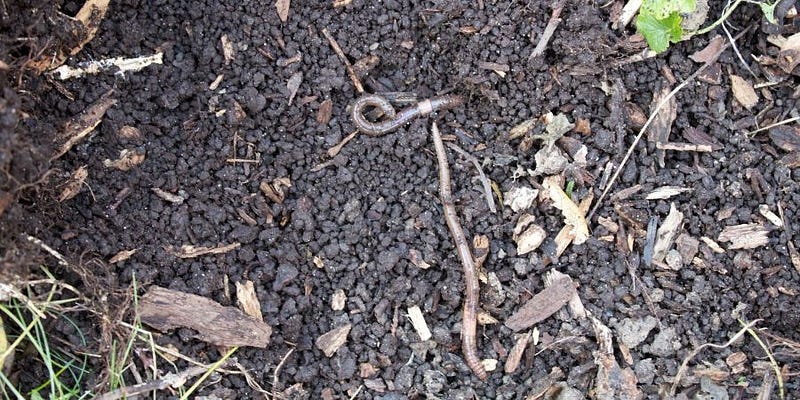
As Americans panic over the possibility of murder hornets spreading beyond the Pacific Northwest, a less conspicuous invasive species is making its way across the nation’s forests and fields. And it’s doing so with methodical aggression.
It’s called the “jumping worm.” The twin species are known as amynthas agrestis and amynthas tokioensis. They have been spotted in gardens and on farms across the Midwest, Great Plains, and Deep South.
This creepy critter is the same shape as the European nightcrawler, except it’s pinkish in color and smoother in texture. They are also known by the alternate nicknames of “crazy worms,” “snake worms,” “Asian jumping worms,” or “Alabama jumpers.”
Unlike run-of-the-mill earthworms, the jumping worm sucks moisture and nutrients from the uppermost layer of soil. Its selectively parasitic behavior leaves behind topsoil decay that resembles coffee grounds in appearance.
Believed to be native to Japan and the Korean peninsula, a jumping worm will thrash its body around in much the same way a full-sized rattlesnake would, when touched by a human finger. While it obviously lacks the venom and strike range that makes rattlesnakes so dangerous, jumping worms can propel themselves into the air to escape a predator. They have the ability to shed their own tails to escape that predator’s grasp.
In this case, a “predator” could be construed as a human who wants to physically remove the worm from one’s garden.
Along with its slippery nature, the jumping worm poses a threat due to its parthenogenesis (ability to reproduce without first mating through sexual intercourse). When it lays its eggs, the casings mimic topsoil in both shape and color. As more jumping worms hatch in a given area, an increasing amount of soil acreage can be deteriorated by these worms’ ravenous appetites.
In terms of pest control: the good news is that adult jumping worms themselves die easily in the frigid winter weather. The bad news is that their unhatched egg casings go into hibernation during those same winter months — inevitably resulting in new births to even more jumping worms during the following spring and summer, from surviving eggs.
Scientists haven’t yet found a reliable way to mass-eradicate the jumping worm from our biosphere. Until we learn more about them, there are some tentative steps that can be taken to manage them and limit their population growth.
As reported by Smithsonian magazine, experts recommend that if you are able to manually catch an individual jumping worm, you should place it in a plastic bag. By leaving the captured jumping worm in the sun for ten minutes or longer (while trapped in an enclosure), the worm will die. You can then safely dispose of it in the garbage.
Store-bought compost or mulch should have been pre-heated, since the egg casings die at temperatures of 104 degrees Fahrenheit (40 degrees Celsius) or greater. Gardeners and landscapers can also clean and inspect their equipment for any signs of egg casings, before tending to their properties. An act as common as raking leaves can potentially contribute to the spread of jumping worms’ cocoons, when the eggs get overlooked.
Brad Herrick, a renowned ecologist with the UW-Madison Arboretum, says there are three preliminary hypotheses as to why jumping worms could be spreading at the rate they currently are:
- We’re more aware of them than we previously were, so their spread appears to us as a (perceived) acceleration
- The Northern Hemisphere is gradually becoming heated due to climate change, allowing them to thrive during warmer months
- They are overpopulating due to a critical mass of their hatchlings
Herrick also points to some potential remedies for controlling jumping worm populations. Some fertilizers and fungi have been designed to repel them. Other soil ecologists have attempted a “mustard pour” over soil, which is helpful in driving to the surface a clew of jumping worms that might be infecting your mulch piles (as sort of an “outdoor fumigation” technique). These attempts, however, have only been preliminary. They need more research and development to prove their efficacy. Additionally, Herrick emphasizes how future R&D could help us assess which types of plants, if any, are better prone than others to surviving in topsoil that has been picked through by the jumping worms.
Basic awareness of their habits and identifiers is the first step. If you find an adult jumping worm on your land, grab it by the midsection (rather than the tail) before isolating it into a plastic bag. This is important because of how easily the worm can shed its own tail in order to escape your grasp. Remember that this slithery creature is NOT poisonous. Unlike snakes, a jumping worm cannot inject venom into your flesh, nor does it bite larger creatures in the way that even nonpoisonous snakes do.
Finally, as we continue to learn more about the jumping worm, we should be developing additional strategies for how to navigate permaculture while they remain in our presence.
An increase in gardening/farming indoors can go a long way toward controlling the environment in which our plants and fungi thrive. It will be much easier to protect fruits, vegetables, and herbs that benefit from rich topsoil when they are grown and raised within an increasing number of greenhouses, hydroponic facilities, vertical farms, and in-home atria. Transferring certain plant species from smaller to larger pots can partially mitigate the nomadic accessibility that jumping worms have to anything grown exclusively outdoors.
Ultimately, though, such personal amenities will need to be scaled up — from individual households to mass-propagation farms. Abandoned shopping malls or warehouses could be retrofitted — with government assistance — to provide the infrastructure that brings alternative farming to scale. It’s much more difficult for jumping worms to bypass metal and glass (shielding an aquaponic structure from the elements) compared to their slithery migration over weeks’ time across dirt roads and acres of grass.
If you detect any jumping worms on your own property — or across public forests, parks, and green spaces — notify your local DNR office. This will allow them to track local jumping worm populations to generate more awareness.
I would also highly recommend a program specifically designed to research and test new methods of eradicating the jumping worm, as part of the 2023 U.S. Farm Bill.
Jumping worms are like Mother Nature’s Tapeworm. They can spread through conventional, localized sprawl. They can also be transported over long distances via machinery, crates, boxes, or other packaged pallets — as unknowing “stowaways” once they’ve ingratiated themselves amongst international or intracontinental cargo.
But their greatest threat to our ecosystem is their propensity for ingesting soil nutrients. Their voracious microbial appetites prevent seedlings from sprouting into full-grown trees. They gobble up the bountiful chemical elements that more industrious earthworms would otherwise be consuming. And they fail to replenish soil health amidst their gluttony, thereby compromising overall soil fertility.
They’re a long-term threat to all of us. Let’s mitigate that threat.


