
Juice is the Same as Soda
And other food myths you should be aware of

I was recently seeing a patient who had all the characteristics of metabolic syndrome. These include
- High blood glucose/sugar
- Low levels of HDL (good cholesterol)
- High levels of triglycerides
- Large waist circumference
- High blood pressure
Although each one of the above is individually a risk factor for heart disease, when coupled together their effect is compounded and we now refer to that confluence as metabolic syndrome.
When I noticed his glucose levels were creeping into the pre-diabetic range, I asked about diet.
“Do you drink soda or sugary beverages?”
“No. My vice is bread. I buy a dozen bagels during the week, and eat bread for breakfast lunch and dinner.”
Carbohydrates, especially simple/processed ones like bagels are broken down into simple sugars. Your pancreas has to create insulin in order to bring that glucose from the blood stream into cells. Repeated exposure to simple sugars in this way increases insulin resistance and starts to diminish insulin production itself. Over time this can lead to diabetes.
This was news to my patient. We talked about ways to eat bread, which he loved, without stopping altogether. Changing white bagels to sprouted bread made of whole ingredients would significantly change how his body responds.
I am not sure my teaching and recommendations will have any effect on this particular patient, but I wanted to go over some common food myths as well as some less known facts about food in America.
Sugar is sugar, suga’
As discussed above, your body cannot tell the difference between sources of sugar. If you give it orange juice, it will release just as much insulin to deal with it as it does with soda. It just has to do with the number of carbohydrates.
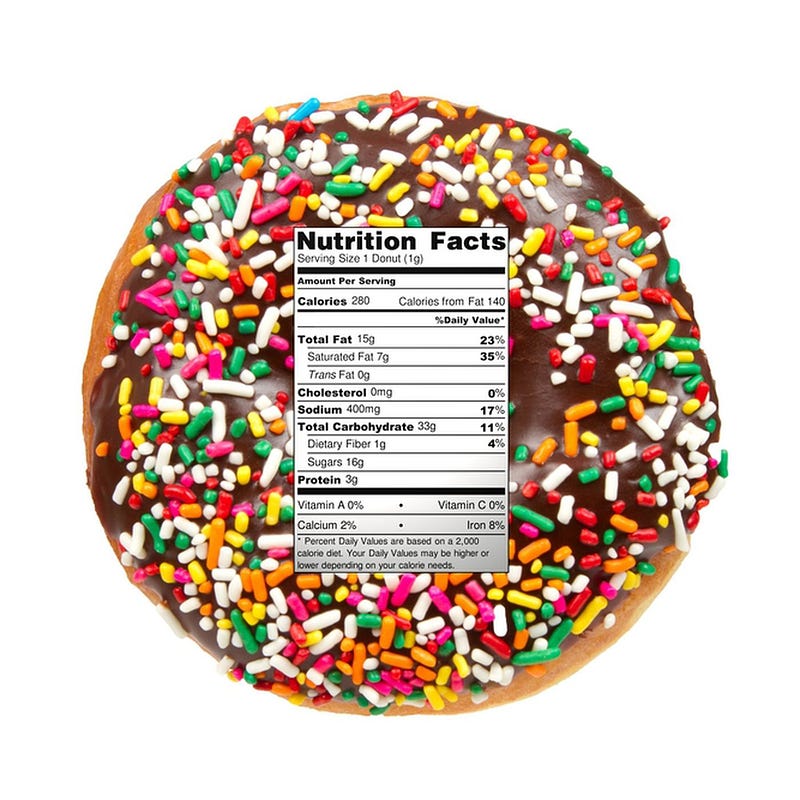
33g of carbohydrates is what your body has to deal with. The source can be this donut, soda, or juice.
Not all carbohydrate sources are the same. In the same label above we can see the fiber is 1g. If it was higher, let’s say 10 grams, it would negate part of the carbs. You can subtract fiber from carbs to get net carbs.
In this case net carbs are 32g and if the fiber was 10g, net carbs would be 23g.
A whole fruit is way better than fruit juice because it contains more fiber and therefore is digested more slowly, avoiding the insulin spike you get when you drink just the juice.
Whole grains are often no better
Patients I talk to always think that “whole grain” options are better than more processed “white” options. While this is true when things are actually made of whole grains, our food industry is good at tricking us into thinking something is so, when it isn’t.
Below is a label for Wonder Bread.
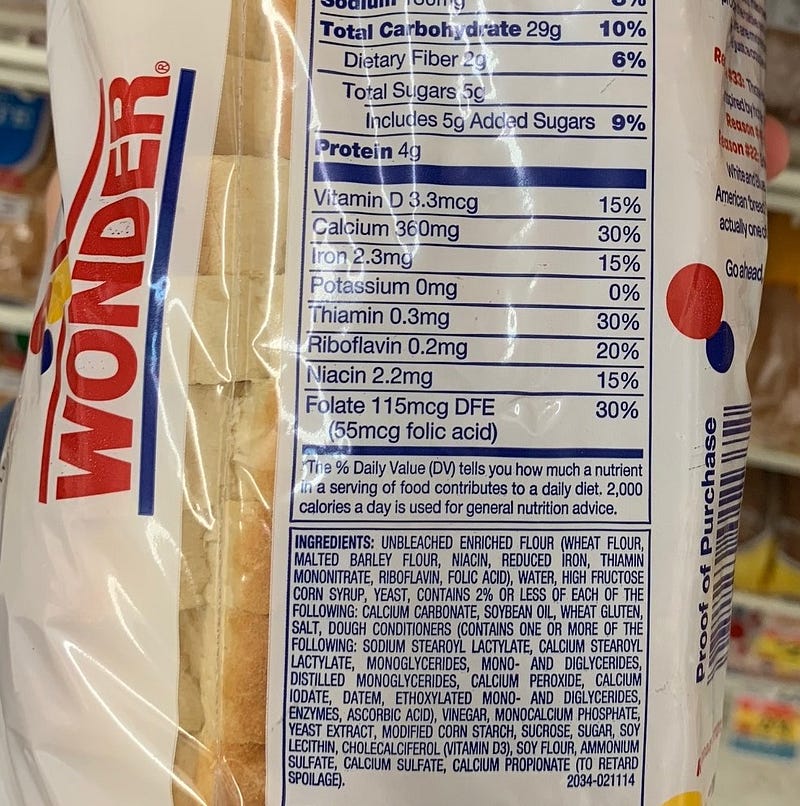
The label is for 2 slices. We will come back to the ingredient list in a bit.
Here is a label for a typical whole grain option.
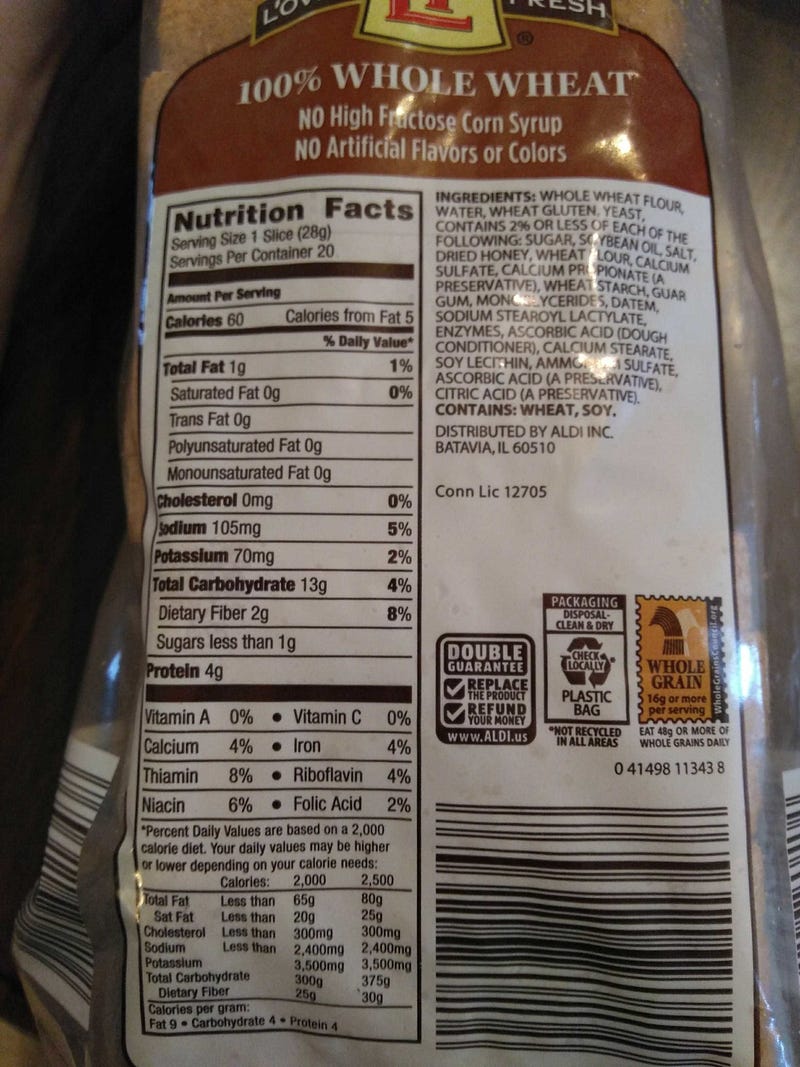
Since wonder bread goes by 2 slices, we will double the values (sandwiches need two slices anyway). This means that for 2 slices of the whole wheat bread we have 26g of carbs and 4g of fiber. This means 22g net carbs for the whole wheat bread. Wonder bread has 27g net carbs.
So based just on numbers, the whole wheat bread is better. But there is more to it than just numbers. Let’s talk ingredients.
Ingredients matter
Ok so, we discussed an example of whole wheat bread above. As you can see from the ingredients, they are much shorter than for Wonder Bread.
I often look at labels when deciding what to buy. In my mind, the fewer ingredients, usually the better. It depends on what they are. My rule of thumb for patients is if you cannot pronounce the ingredient, it likely does not belong in your food.
Whole foods made from real ingredients is what our bodies need. Take this label for Dave’s Killer Bread.
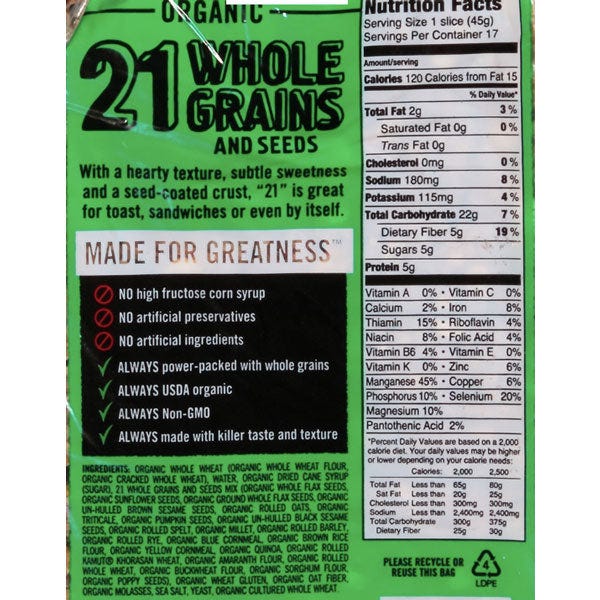
Any issues pronouncing any ingredients? This bread and Wonder Bread are not the same, despite both being “bread.” Your body will know what to do when you eat this.
“But Julian, this bread has more carbs than two slices of wonder bread. Doesn’t that mean it is worse for me?”
Given the amount of fiber in each slice, on top of the real ingredients, the way this bread will metabolize will be very different. Two slices will have 34g net carbs which is more than the whole wheat one we talked about above and the wonder bread, but again, your body will be digesting whole foods not chemicals. Your microbiome will thrive as a result and the positive effects on your body will far outweigh the increase in carbs.
Natural flavors are not natural
During COVID lockdown my wife and I tried to eat very healthy. We started watching Bobby Parish and his show FlavCity. He is a big proponent of whole foods (not the supermarket) and often would talk about ingredients in food.
One of the biggest sneaky “villains” in food is natural flavors.
This is directly from the Department of Health and Human Services:
The term natural flavor or natural flavoring means the essential oil, oleoresin, essence or extractive, protein hydrolysate, distillate, or any product of roasting, heating or enzymolysis, which contains the flavoring constituents derived from a spice, fruit or fruit juice, vegetable or vegetable juice, edible yeast, herb, bark, bud, root, leaf or similar plant material, meat, seafood, poultry, eggs, dairy products, or fermentation products thereof, whose significant function in food is flavoring rather than nutritional. Natural flavors, include the natural essence or extractives obtained from plants
But as the list is so long the term “natural can be deceptive. An article in the New York Times phrased the explanation well:
The loophole, as it were, is that for nonorganic foods, the regulations do not restrict the dozens of other ingredients like preservatives and solvents that can go into a so-called natural flavor. Ultimately, because of the wide variety of ingredients that typically go into “natural” flavorings, “there does not seem to be much of a difference between natural and artificial flavors,” said David Andrews, a scientist at the Environmental Working Group, a research and advocacy organization.
While food processors must list all of the ingredients on a food label, flavor manufacturers do not have to disclose their ingredients. They can add synthetic solvents, preservatives, emulsifiers, carriers and other additives to a flavor that qualifies as natural under current regulations. Natural flavors allowed for use in certified organic foods are subject to a different, far more restrictive set of regulations. They cannot contain a long list of ingredients, including synthetic solvents, carriers and emulsifiers or artificial preservatives, said Gwendolyn Wyard, the Organic Trade Association’s vice president of regulatory and technical affairs. They must use non-petroleum-based solvents, cannot be irradiated and cannot use flavor extracts derived from genetically engineered crops.
So be careful when looking at things as “natural.” In addition to flavors, the food industry will often invoke “natural” images on labels to fool you as well. Although a food says it is made with “natural ingredients” as you can see from the labeling rules, this can be easily manipulated. Maybe just one thing out of 50 ingredients is “natural” and therefore the food will be labeled as coming from “natural ingredients.”
Antibiotics and Meat
Did you know that 80% of antibiotics sold in the US go to animals? I did not know this until I was in graduate school.
No wonder 10–15% of adults have IBS.
But there is no other option when animals are raised in horrendous CAFO (Concentrated Animal Feeding Operations) conditions. The antibiotics are needed to keep them healthy, living and from passing on diseases to consumers. Too bad for antibiotic resistance though. It isn’t just people with colds asking for that Z pack from their doctor who are contributing to resistance.
Conclusion
If this information was already known to you, I assume you did not read past the first few sentences. But if you read all the way through and learned anything at all, I highly recommend becoming more involved in understanding the food you eat and the effect it has on your body. Sticking to foods made at home, made of whole things, rather than being full of chemicals, is always the smart play.
If you enjoyed reading and are not a member of Medium, consider a Medium membership. You get to read and learn a lot. Heck, you can even teach people new things!


