
Judging Amy Coney Barrett
Amy Coney Barrett’s very bad judgment
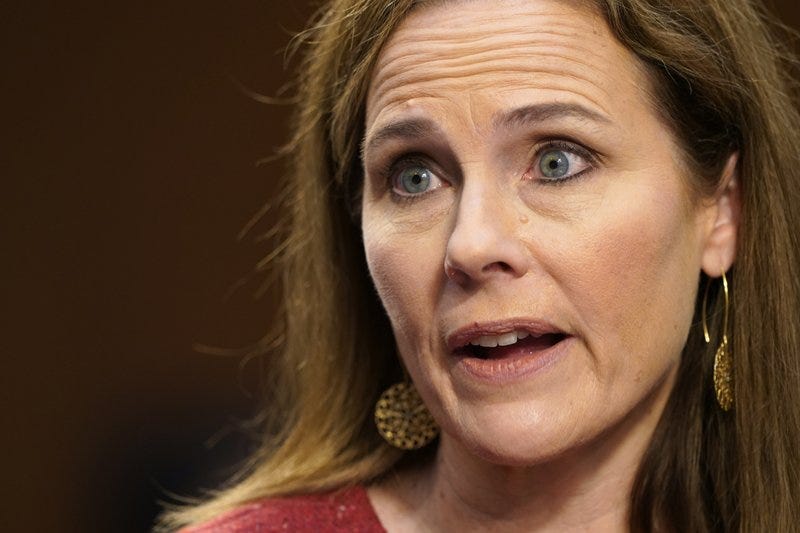
It’s as clear as a handmaid’s complexion that Judge Coney Barrett has very bad judgment.
Her decision to accept the nomination before an election in which millions of Americans have already voted belies good judgment and common sense.
Her decision to dismiss Ruth Bader Ginsburg’s dying wish for the next president to appoint her replacement disrespects RBG’s legacy and shows Judge Barrett’s disdain for the democratic process.
During the years RBG served our nation, she never put herself before the country as Judge Coney Barrett does, along with complicit Senate Republicans, as they rush to confirm Barrett’s nomination just days before an election.
In 2016, the Republicans held an opposite position on Obama’s Supreme Court nominee, which occurred far earlier in the election cycle. Of course, now they twist their words to justify their hypocrisy:
“… what Republicans are doing in 2020 is in line with past Supreme Court nominations in an election year when the same party controls the Senate and the White House.”
Judge Barrett mirrored Republican word contortions during the Senate hearings when she sidestepped the question, “Should there be a peaceful transfer of power?” which required a yes or no answer, and instead responded with tortured self-serving words.
“…that seems to me to be pulling me in a little bit into this question of whether the president has said that he would not peacefully leave office, and so to the extent this is a political controversy right now, as a judge I want to stay out of it.”
Judge Barrett testified that she wanted to “stay out of it,” but it seems more plausible that she dodged the question to hide her beliefs.
Her poor judgment was also on display at a recent White House event held in her honor during a pandemic, an event she attended maskless with her children in tow, along with other mostly maskless people. After many in attendance tested positive for COVID-19, the gathering became known as a “superspreader” event.
There are mothers across the country with far better judgment than Judge Barrett. Mothers who homeschooled their children for months because of the pandemic, sheltered in place with their families to protect them from contracting a disease that is still a mystery to doctors and scientists.
Yet, this mother, this Supreme Court nominee chose to put herself and her children in harm’s way by attending an event deemed unsafe by CDC standards, because White House officials didn’t follow social distancing rules and mask-wearing guidelines.
How can we trust a mother and Supreme Court nominee, who exhibits bad judgment in the care of her children, to preside over cases affecting the lives of other people’s children and families?
How can we trust her to rule on constitutional issues when she refused to say if a president has the power to pardon himself?
This Supreme Court nominee who agreed to participate in a nomination process after RBG had expressed her dying wish to delay the nomination until after the next president is elected. This nominee, with originalist views, who regards Social Security, Medicare, and other social safety nets as unorthodox, because they do not adhere to an originalist view of the constitution, a document written in the 1700s.
How can this nominee, once a handmaid in the People of Praise church that according to former members, regards women as subservient to men, decide cases that affect women who subscribe to 21st-century values?
Barrett’s views harken back to the early days of a country trying to find its footing in a world without a king.
We as a country have evolved since then.
We, as humans, aspire to evolve every day of our lives. Growth and improvement are intrinsic to human nature and values. Just as we try to improve our lives every day, we try to improve society and government, as the Founders did.
Just as humans aspire to evolve, the constitution, described as a living document, should also evolve and not remain at a fixed point in time.
The Founders likely would have scorned the idea of an unalterable document and static government. They likely would have encouraged the aspiration of a more perfect union. They would have embraced the evolution of ideas and marveled at the inner workings of the government today, 200 years after its inception.
If we stifle the evolution of the constitution and government by association, we capitulate to the arcane limitations of a monarchy.
If we choose a Supreme Court Justice who embraces the arcane ideas of bygone years, we will lose years of progressive policies that have improved society and the lives of the people within it.
The Founders had entrusted the care of their living document to their successors, hoping it would flourish in the hands of those to whom they entrusted its survival. They hoped their successors would possess good judgment to bolster democracy, not diminish it.
Unfortunately, the Republican-led Senate and SCOTUS nominee diminish the Founder’s legacy. By proceeding with the SCOTUS nomination process days before an election, they debase RBG’s dying wish, as well as the wishes of most Americans who believe the next president should decide who sits on the highest court.
This nominee who dismisses the dying wish of an iconic justice to bolster her career, puts herself before country, the epitome of bad judgment.
But she isn’t alone. She has accomplices: Senate Republicans hope to set the country on an arcane path for years to come.
Stacking the courts will be their legacy, as will the confirmation of a Supreme Court Justice with bad judgment and arcane views that will move the country backward, instead of forward.
These arbiters of bad judgment are not worthy of serving the American people. They are not worthy of sitting in a government chamber and determining the future of our democracy.
It’s time to retire them.
But before we send them packing, call them and tell them the American people should decide who chooses the next Supreme Court Justice, not power-hungry senators who enabled a corrupt president to nominate a Supreme Court Justice just days before an election.
The Founders weren’t perfect, but their intentions were.
Let’s continue their legacy to set the nation on a course of betterment, to evolve into a more perfect union, and not tether it to a fixed point in time, which undermines progress and the institutions the Founders hoped would prevail long after they were gone.
This November, let’s evict the impediments of democracy from Capitol Hill and continue the Founders’ legacy of aspiring to a “more perfect Union.”
© Lauren Salkin 2020