
Mind the (Generation) Gap
Journalists Desperately Seeking Relevance
As the Boomer Mom of a Gen-Y and Gen-Z, I’m Annoyed
Before sharing the “OK, Boomer,” and “Ugh, Millennials,” and “Oh, look at those “Gen-Z snowflakes” humor, ask yourself who benefits from ageism and division in society?
When it comes to serious issues like curbing gun violence, mitigating the effects of climate change on our planet’s habitability, ensuring against massive food insecurity and poverty, reducing dependence on non-renewable energy resources, eliminating police brutality, prosecuting anti-trust violations, encouraging anti-racism… who the hell benefits from the division among us?
It’s not US.
Attention-Grabbing, Divisive Headlines About Poorly-Understood Linguistic Research
Who controls commercial news media? Also not us. Take a glance at the following headlines:
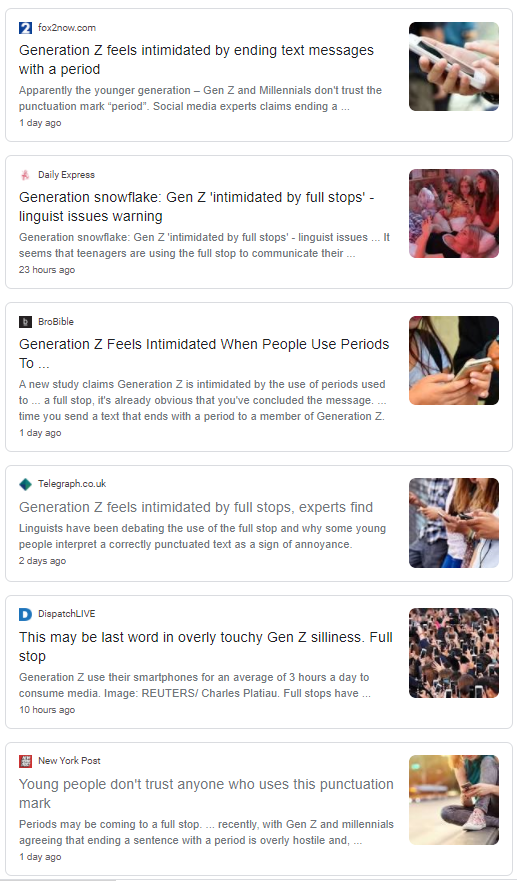
As the “Boomer” (arguably, “Gen-X”) mom of a “Millennial” daughter and a “Gen-Z” son, I see right through this ploy.
The Research
[In 2015,] Celia Klin, associate professor of psychology and associate dean at Binghamton University’s Harpur College, recruited 126 Binghamton undergraduates, who read a series of exchanges that appeared either as text messages or as handwritten notes. In the 16 experimental exchanges, the sender’s message contained a statement followed by an invitation phrased as a question (e.g., Dave gave me his extra tickets. Wanna come?). The receiver’s response was an affirmative one-word response (Okay, Sure, Yeah, Yup). (From https://www.eurekalert.org/pub_releases/2015-12/bu-stm120815.php
Participants were asked to rate the sincerity of the responses when given with or without a period at the end. They gave higher ratings to the ones without.
“Texting is lacking many of the social cues used in actual face-to-face conversations. When speaking, people easily convey social and emotional information with eye gaze, facial expressions, tone of voice, pauses, and so on,” said Klin. “People obviously can’t use these mechanisms when they are texting. Thus, it makes sense that texters rely on what they have available to them — emoticons, deliberate misspellings that mimic speech sounds and, according to our data, punctuation.” (Ibid.)
Now, that’s a perfectly reasonable conclusion. We’ve been doing that since online chat was invented, back in — what, the 1970s, 1980s? ;)
Show of hands: Who thought punctuation lacked meaning, tone, or intent?
If I said, “Will you come to my party?” would you read a different nuance to the meaning of the following?
- Johnny will be there?
- Johnny will be there.
- Johnny will be there…
- Johnny will be there!
- Johnny will be there
Did none of the people expressing surprise at this ever do a dramatic reading of anything? Do they not understand how punctuation normally works? Of course it expresses meaning, tone, and intent. To me, it says that younger readers may have become more adept at interpreting the speaker’s — the writer’s — intent. So much for the old notion that “sarcasm doesn’t come across well in writing,” or “online.” I think it means, if anything, they’re becoming more adept at recognizing nuance.
But again, I don’t believe it’s the period, itself — but the context of the communication — that makes the difference.
Code Switching and “The Older Generation”
I thought I left “Buzzword BINGO” behind, when I left the corporate world. The way people throw around sociolinguistic terminology like “code-switching,” these days, you’d think it was the newest buzzword.
[S]ociolinguist Einar Haugen coined the term in 1954…to describe language alternation, or the mixing of two or more languages, or dialects. …[T]he practice had been known since the early 20th century. Linguists studied code-switching to examine when it occurs, while sociologists studied why it occurs.”
[C]ode-switching facilitates several functions: to mask fluency and memory in a second language, go between formal and informal conversation, exert power over another, and align and unify among familiar group in certain settings. (From https://www.yesmagazine.org/opinion/2019/12/17/culture-code-switching/)
I read a comment on this debacle that claimed this punctuation business was an example of code-switching. “Older adults just don’t do code-switching as well as younger people,” the commenter claimed.
People of all ages were, I’m certain, code-switching long before 1954 — probably since the first words were spoken between one tribe and another.
I’m reading The Impossible Girl, by Lydia Kang — a novel set in mid-1800s New York City, where the protagonist regularly code-switches between “Flash” (a pidgin — the language of thieves) and the English spoken in uppercrust society.
“Most of Flash has been lost to history. But a few terms, like “birthday suit” for naked, survive still. And in the 1830s, New Yorkers abbreviated ironic misspellings of common phrases, something quite similar to textspeak today. So “oll correct” became OK.”
See:
I’d argue that older adults are better at it, in some circumstances; we’ve lived long enough to know we need to code-switch and not put emojis in an email to the CEO, if we want to be taken seriously.
Those Lazy Millennials!
There’s a theory that the period has just fallen victim to texting laziness. I don’t think that’s it, either. When Millennials were first beginning to use mobile phones and texting, text messages cost between 5–20 cents apiece — in both directions.
Their parents of chatty teens and tweens were tearing out their hair when the bills arrived! If Millennials find the period intimidating, it’s probably because they have flashbacks to all the yelling over a $1000 phone bill. Clever kids developed their own shorthand, so that they could pack the most punch in 140 characters.
Given that as context, you can hardly blame laziness or poor spelling and punctuation skills for their using “u” and “ur” instead of “you” and “your,” or for habitually omitting punctuation as an unnecessary cost. Those days are long gone, but old habits die hard. This is not to say our Millennials can’t — or haven’t — learned proper spelling, now that they’ve got fewer limitations on their communications!
I swear, every time I see someone write “ur” I long to ask them what their experience of the ancient capital of Sumer was like. The blank looks or the laughs tell me whether it’s a failure of our educational system or simply expedience.
Did you know? Twitter’s original 140-character limit on tweets was based on the original character limit of an SMS text message.
Fast Typing and The Anxiety of a Hanging Thought
Many people, during online chat or IM conversations I’ve had with them over the years, have marveled at my typing speed. Objectively, and compared with many others, my typing speed is merely above average (about 70–80 wpm) — and was a dismal 23-30 wpm when people started expressing surprise at how quickly I could type.
I finally figured it out: The secret to appearing to be a fast typist, when texting, is to hit the Enter key after meaningful phrases — not necessarily full sentences, and certainly not full paragraphs.
You would not put a period at the end of a thought, if it were not a complete thought. But you keep hitting the Enter key, to keep the other person busy reading, so they know that you have not left the conversation or forgotten about them.
Because you know the anxiety of waiting for the other shoe to drop. That hanging thought. Is there more? And nowadays, the wiggling dots, indicating typing on the other side of the screen — they just seem to just go on and on, while they slowly type a response. “OMG,” you think, “they’re going to drop a whole novel’s worth of a lecture on my head!”
I like to know, though, when the thought is over. So to me, a period is a courtesy — “Roger, over.” Your turn to speak.
What it is not is an excuse for intergenerational derision.