
Selling | Pen | Wolf of Wall Street
Jordan Belfort and How To Sell a Pen
The Art of Looping
One of the startups I worked with achieved a significant milestone recently.
Mike, the CEO, prepared for presenting the investment case to investors, as the company needed money to scale up.
The entire team worked diligently to move the company forward to this point where they reached this significant milestone. They could start thinking of pulling investor capital in to scale the company.
For weeks they sat down to prepare the presentation, straighten out the storytelling, prepare the pitch and foresee answers to all potential objections.
The big day came in the investor's board room. Mike went to the meeting with his CFO, Lily.
They told me afterward that most of the investor's representatives are partners, analysts, and assistants in the room. Most of them were listening; one partner was more interested in his smartphone and excused himself to answer crucial emails.
Nevertheless, they pushed through the presentation and got to the point at the end:
"Do you have any questions?"
They got two questions at the end.
After they finished, they felt that it went well, and they expected to receive a cheque right after.
Instead, after finishing their 15 minutes speech and answering the two questions, the partner that was playing with his smartphone looked up and said in a friendly tone:
"Thanks. That's interesting. I will be in touch. Goodbye."
They left, and that's it. No, follow up, nothing.
Isn't that frustrating?
How to go to a 100% Closing Rate
For me, it is:
Selling means dealing with rejections.
Like Mike and Lily did, Pitching for investments is not different from any other sales pitch.
Statistics say that 92% of sales reps give up after four no's.
And 80% of prospects say no four times before they say yes.
But, wouldn't it be much nicer to go into a room talking to a prospect once, and she closes right after?
Effortless?
Similar to what Mike and Lily wanted to achieve? Leaving the room with a nice big cheque?
Isn't there a secret sauce to close the deal right away?
Unfortunately, there is none.
This quick-to-closing wish of many salespeople is understandable. Wanting a secret sauce or a magic weapon to avoid rejection is a just desire as rejection hurts.
The body goes into fight and flight mode and releases hormones that don't feel well.
The ugly truth is, there is no way out.
Rejection is part of the sales game, and it is necessary to get used to the situation.
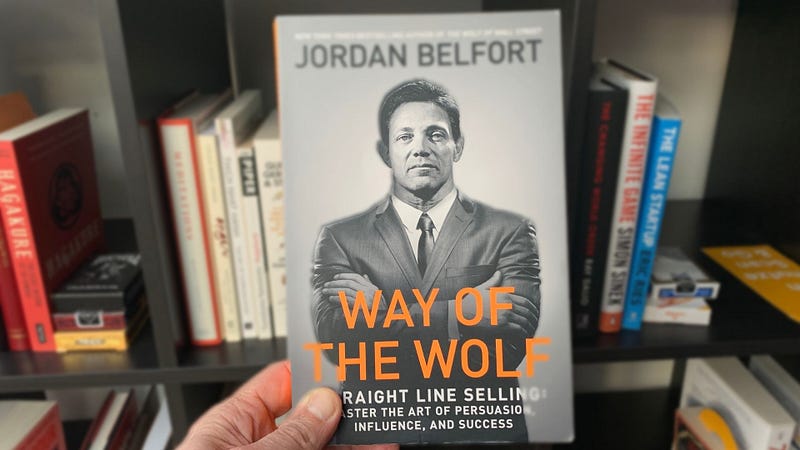
What solution does Jordan Belfort provide in his book the way of the wolf?
The Secret Art of Looping
The great thing would be to have a bulletproof method to pitch once and close right after.
Jordan Belfort points out that such deals exist but are the Unicorn amongst the sales deals.
It means that a tiny percentage of sales encounters end up with a close after the first presentation.
The reality is that it takes up to 8 touchpoints to reach a prospect and another five touchpoints to close the deal.
The majority of sales deals need a lot of interactions — in total, 1 to 20 when we put it on Gaus Bell Curve, with the majority around 8 to 13.
From my personal experience, the higher the value of a product, the more touchpoints are needed.
Jordan Belfort reframes the rejection in an excellent way and states that any objection is just a smokescreen to cover uncertainty.
The only thing a salesperson needs to do is loopback in the sales process and describe the benefits of the product/investment once again.
Knowing that selling is an iterative process, the big question is:
How many loops are necessary
Depending on the size of the deal, it can be more or less.
I assume that the readers are not happy about this answer; let me be more precise.
Every Day's purchases
Consumers with a high need for food, beverage, clothes, or anything necessary to fulfill basic needs have a high chance of closing after the first sales encounter.
I am thinking about the grocery and drugstore situation. A person who needs a toothpaste is pitched ones — when they see the product on the shelf — takes one and pays. Deal done.
Someone who doesn't need toothpaste won't buy one. A clerk running 20 loops won't change much. On the contrary, it might look awkward when a customer doesn't need the product.
What usually happens is presenting samples of products to consumers that they get for free to test them out.
Higher value consumer goods
Purchases that exceed a month's salary I consider to be more challenging close.
Products that fall into this category:
- expensive clothes
- Jewelry
- Cars
- Apartments
- Houses or
- an expensive holiday.
The likelihood of a person closing a deal right away is much lower here. If I were a salesperson in such a situation, I would expect to make more loops.
First, identify whether the person wants to buy the goods I have to offer or stops by to look. It is the test drive situation for car salespeople. Some customers want to test without any intention to buy.
Once that phase is over, many customers negotiate with more salespeople to get a better overview or leverage the negotiation. I expect some loops until the deal closes.
It is the classic tale from friends when they say they saw the perfect product right in the first store but needed to visit another seven stores to reconfirm their initial emotional decision from a logical point of view.
In such situations, I would expect more interactions, and the answer to the" how many loops question" is more to the middle of the bell curve and could be anywhere above eight loops.
Special case: B2B sales
Sales processes between businesses are a special kind of animal.
I have helped scientists since 2006 to position their companies in the pharma industry and close investment deals with industry partners and investors.
Those processes are, in principle, not different from other sales processes. However, they usually involve more people and are of higher value.
Investment deals usually need first to convince one partner of a fund, then other partners, then more funds to form a syndicate, afterward the due diligence team and then lawyers until a deal is closed.
Managing the entire process needs many touchpoints with a larger group of people.
Having the right expectations, selling can be a lot of fun.
First finding potential buyers for the product, then find out whether they are buyers or not, and then looping from the closing process working through objections.
Knowing that rejections are the norm rather than the exception helps tremendously shake the negative feelings and move forward in the process.
Having Jordan Belfort's approach of Looping in mind reminds me during every encounter that the rejection is most likely just a smokescreen for uncertainty and needs a bit of work and convincing.
Now that Mike and Lily know the statistics, they approach every pitch with a different expectation than their first one.
It is just the beginning of a relationship with a potential customer/investor…
Did you enjoy the content? Then you can do the following:
- Clap a couple of times and leave a comment.
- Check out my other profiles,
- Sign up for my deep tech newsletter,
- Subscribe to my medium profile for frequent updates,
This article is for informational purposes only. It should not be considered Financial, Investment, or Legal Advice. Consult a financial, investment, or legal professional before making significant decisions.


