
Jonathan Livingston Seagull: An Encomium
Neil Diamond, bitches.
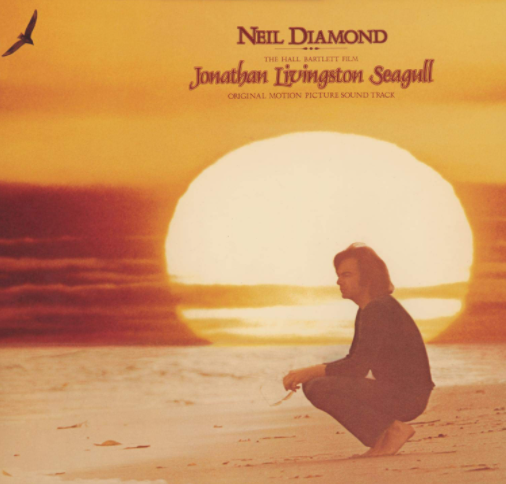
There is no such thing as an objective musical experience. I get that. My feelings about Neil Diamond and this particular album will forever be shaped by two facts. First, it was a favorite of my mother’s and thus a part of my world well before memory allows. Second, it was a favorite of my mother’s, who was amazing and passed away in 2004.* Oh, man, this record! I have intense sense memories of lying on the couch at age eight, my face pressed into the rough cloth couch cover that smelled like my Dad’s pipe smoke, with headphones covering my sweating ears, and just swimming in the emotion that Jonathan Livingston Seagull provoked.
Richard Bach’s book and the movie (of which this album was the soundtrack) were both dismissed as naïve, banal, schmaltzy, emotionally manipulative, etc. They were compared to Norman Vincent Peale’s self-help softcore fascism, and the only thing I can think of is that the folks saying that only got a quarter way into the story before being distracted by their own too-clever-by-half mouth breathing. Because after Jonathan … well, I won’t spoil it … the story has nothing to do with the sort of shallow self-aggrandizement that is Peale’s brand.
What the movie, book, and album — which made more money than the movie — share is a commitment to earnestness, something of a sin at the time. God knows I fully embraced the wave of sarcasm and irony that marinated the decade of my adolescence, but a small flame kept burning for honest emotion, and, at some point, I got over being pleasantly diminished by world-weariness.
The music here is all tonal and plays the tension-release angle without shame. The orchestra swells, and there are lines that still, forty-five years later, cause me to choke up. “Dear father, we dream.” Dammit, there it goes again. {choke} The sound is remarkable and the production immersive. Neil Diamond still had one of the best voices in pop. Just try working up a cover to one of his songs and you will immediately realize how inadequate your own mortal pipes are. The lyric is driven by the book, of course, philosophical, quasi-Buddhist, and inspiriting. The words are about love and longing and belonging, but it’s not the sort of longing that built Meat Loaf’s career. It’s the sort of love and longing and belonging that stays with you and sustains you through marriages, children, affairs, joy, divorces, deaths, and last loves. Sure, it is “banal” to wonder where you belong in the world every step along the way. And naïve to think a popular album can help you help others figure it out. But I’ll take it. Again and again. And it will, to quote another banal line from a banal movie, “make me want to be a better person.”
*Bonus third fact, my first concert, which my Mom and Dad took me to, was Neil Diamond at the Philadelphia Spectrum. I was eleven years old.