avatarJørgen Veisdal

Free AI web copilot to create summaries, insights and extended knowledge, download it at here

9329

Abstract

e<span class="hljs-comment">'s theological amplifications of his (not so hot) cosmology, and in particular about the fun Milne seems to find in connecting Creation with a singularity at t = 0. Hardy wishes to avoid this by introducing a parameter tau = ln t, which begins with tau = -infty, and thus satisfies his philosophical needs.</span></pre></div><div id="3226"><pre>I met Newman several times, <span class="hljs-built_in">and</span> I <span class="hljs-keyword">am</span> very glad <span class="hljs-keyword">for</span> having made <span class="hljs-keyword">his</span> acquaintance, he <span class="hljs-keyword">is</span> very attractive both from the topological <span class="hljs-built_in">and</span> from the human side. He <span class="hljs-built_in">has</span> postponed <span class="hljs-keyword">his</span> sabbatical leave <span class="hljs-keyword">for</span> <span class="hljs-number">1936</span>/<span class="hljs-number">37</span>, <span class="hljs-built_in">and</span> seems <span class="hljs-keyword">to</span> <span class="hljs-keyword">be</span> quite anxious <span class="hljs-keyword">to</span> come <span class="hljs-keyword">to</span> Princeton then.</pre></div><p id="4575">In 1935, <a href="https://en.wikipedia.org/wiki/G._H._Hardy">G.H. Hardy</a> (1877–1947) was still considered one of the foremost mathematicians in England, if not the world. <a href="https://en.wikipedia.org/wiki/Edward_Arthur_Milne">Edward Arthur Milne</a> (1896–1950) was a British astrophysicist and mathematician who had entered Hardy’s orbit around 1914 and would later propose various mathematical arguments postulating the existence of God, some of which were based on Hardy’s mathematics. As von Neumann expresses, Hardy, a lifelong atheist, was not too pleased.</p><p id="0cfa"><a href="https://en.wikipedia.org/wiki/Max_Newman">Max Newman</a> (1897–1984) was another mathematician at Cambridge who had been lecturing there since 1927. His later lectures on <i>“The Foundations of Mathematics and Gödel’s Theorem”</i> (1935) would be <a href="https://readmedium.com/alan-turing-in-america-db0104c965dc#9d96">what inspired a young Alan Turing</a> to embark on his pioneering work on the so-called <a href="https://readmedium.com/uncomputable-numbers-ee528830d295"><i>Entscheidungsproblem</i></a>. Newman helped Turing get his draft of “<i>On Computable Numbers with an Application to the Entscheidungsproblem</i>” into publication, as well as arrange for him to visit <a href="https://readmedium.com/uncomputable-numbers-ee528830d295#5e22">Alonzo Church</a> (1903–1995) in Princeton, where he ultimately later earned his Ph.D.</p><div id="ac6c"><pre>By <span class="hljs-keyword">the</span> way, there seems <span class="hljs-keyword">to</span> be quite a traffic-jam <span class="hljs-keyword">on</span> <span class="hljs-keyword">the</span> road <span class="hljs-keyword">to</span> Princeton. There are <span class="hljs-number">4</span> <span class="hljs-keyword">or</span> more advanced students <span class="hljs-keyword">or</span> PhD.'s who will come next <span class="hljs-built_in">year</span> <span class="hljs-keyword">to</span> Cambridge: A Commonwealth fellow M. Price, who <span class="hljs-keyword">is</span> very able, he worked <span class="hljs-keyword">in</span> quantum theory <span class="hljs-keyword">until</span> now, <span class="hljs-keyword">but</span> he wants <span class="hljs-keyword">to</span> change <span class="hljs-keyword">to</span> group theory; an NRC [National Research Council] fellow, <span class="hljs-keyword">whose</span> <span class="hljs-built_in">name</span> <span class="hljs-keyword">is</span>, I think Lewinsohn, who <span class="hljs-keyword">is</span> a pupil <span class="hljs-keyword">of</span> Weiner (!) <span class="hljs-keyword">and</span> spent this <span class="hljs-keyword">first</span> <span class="hljs-built_in">year</span> <span class="hljs-keyword">in</span> Cambridge (Hardy thinks <span class="hljs-keyword">that</span> he <span class="hljs-keyword">is</span> very good), Touring who you mentioned, <span class="hljs-keyword">and</span> who seems <span class="hljs-keyword">to</span> be strongly supported <span class="hljs-keyword">by</span> <span class="hljs-keyword">the</span> Cambridge mathematicians, <span class="hljs-keyword">for</span> <span class="hljs-keyword">the</span> Proctor fellowship (I think <span class="hljs-keyword">that</span> he <span class="hljs-keyword">is</span> quite promising); <span class="hljs-keyword">and</span> one <span class="hljs-keyword">or</span> two more, <span class="hljs-keyword">whose</span> names I forgot.</pre></div><p id="bef9">The three graduate students von Neumann mentions are:</p><ul><li><a href="https://en.wikipedia.org/wiki/Maurice_Pryce">Maurice Pryce</a> (1913–2003), a British physicist who went to Princeton in 1935 and earned his Ph.D. on the topic of “<i>The Wave Mechanics of the Photon</i>” under the supervision of an <a href="https://www.genealogy.math.ndsu.nodak.edu/id.php?id=42857">all-star cast</a> consisting of <a href="https://readmedium.com/the-golden-age-of-quantum-physics-9a3ddac68413#7e29">Max Born</a> (1882–1970), <a href="https://en.wikipedia.org/wiki/Ralph_H._Fowler">Ralph Fowler</a> (1889–1944), <a href="https://readmedium.com/the-golden-age-of-quantum-physics-9a3ddac68413#2054">Wolfgang Pauli</a> (1900–1958) and von Neumann.</li><li><a href="https://en.wikipedia.org/wiki/Norman_Levinson">Norman Levinson</a> (1912–1975), an American mathematician who was in Cambridge on a Redfield Proctor Traveling Fellowship and in 1937 earned his Ph.D. from MIT where was also hired in 1937 and remained for the rest of his career. The exclamation point von Neumann includes in parentheses is likely a comment on Levinson’s Ph.D. supervisor <a href="https://readmedium.com/the-absent-minded-father-of-cybernetics-norbert-wiener-2a0b66aa6b4b">Norbert Wiener </a>(1894–1964), who was known as famously eccentric and absent-minded, and so did not supervise many students.</li><li><a href="https://medium.com/cantors-paradise/the-turing-essays/home">Alan Turing</a> (1912–1954), the now very well-known British mathematician, who in 1935 was 23 years old. He <a href="https://readmedium.com/alan-turing-in-america-db0104c965dc#de7a">arrived in Princeton</a> the following year and stayed until 1938 after being awarded his Ph.D. Although von Neumann wanted him to remain in Princeton as a postdoctoral fellow, Turing <a href="https://readmedium.com/alan-turing-in-america-db0104c965dc">declined</a> and instead travelled back to Cambridge.</li></ul><p id="455b">von Neumann goes on to comment about the rest of the graduate group at Cambridge, mentioning several names who would later became well known:</p><div id="0a62"><pre>There is quite <span class="hljs-keyword">a</span> considerable <span class="hljs-built_in">number</span> <span class="hljs-keyword">of</span> good men <span class="hljs-keyword">in</span> <span class="hljs-keyword">the</span> young group <span class="hljs-keyword">in</span> C. [Cambridge] I was particularly interested <span class="hljs-keyword">in</span> <span class="hljs-number">3</span> <span class="hljs-keyword">of</span> them: Two fellows <span class="hljs-keyword">of</span> Trinity: L.C. Young, who works <span class="hljs-keyword">in</span> real functions, Stieltjes integrals, etc,; <span class="hljs-keyword">and</span> S. Chandrasekhar (<span class="hljs-keyword">a</span> Hindu) who is primarily <span class="hljs-keyword">an</span> astrophysicist, but who also has <span class="hljs-keyword">a</span> considerable knowledge <span class="hljs-keyword">of</span> quantum theory <span class="hljs-keyword">and</span> connected mathematics, too; <span class="hljs-keyword">and</span> <span class="hljs-keyword">a</span> fellow <span class="hljs-keyword">of</span> Caius: <span class="hljs-keyword">a</span> theoretical physicist <span class="hljs-keyword">with</span> <span class="hljs-keyword">the</span> name F.C. Powell.</pre></div><p id="5e77"><a href="https://en.wikipedia.org/wiki/Laurence_Chisholm_Young">Laurence C. Young</a> (1905–2000) was a British mathematician known for his invention of the <a href="https://en.wikipedia.org/wiki/Young_measure">Young measure</a>. Indian-American astrophysicist <a href="https://en.wikipedia.org/wiki/Subrahmanyan_Chandrasekhar">Subrahmanyan Chandrasekhar</a> (1910–1995) later became the 1983 Nobel Laureate in Physics for his <i>“theoretical studies of the physical processes of importance to the structure and evolution of the stars”</i>. Another Nobel Laureate, English physicist Cecil Frank Powell (1903–1969) would win the prize in 1950 for his discovery of <a href="https://en.wikipedia.org/wiki/C._F._Powell">the pion</a>.</p><div id="b0c0"><pre>I had <span class="hljs-keyword">the</span> audience <span class="hljs-keyword">of</span><span class="hljs-number">15</span>, ≥ <span class="hljs-number">20</span> people, which showed no <span class="hljs-string">"radioactive decay"</span>, <span class="hljs-keyword">until</span> <span class="hljs-keyword">the</span> examination period (around January <span class="hljs-number">3.</span>) came along. Then <span class="hljs-keyword">the</span> <span class="hljs-built_in">number</span> reduced <span class="hljs-keyword">by</

Options

span> several orders <span class="hljs-keyword">of</span> magnitude, <span class="hljs-keyword">until</span> I closed <span class="hljs-keyword">on</span> <span class="hljs-title">June</span> <span class="hljs-title">14</span>.</pre></div><p id="d3a0">One might excuse von Neumann’s graduate students for being unable to keep up with the great man. His brother Nicholas later described the difficulties audiences sometimes had in following his lectures as follows:</p><blockquote id="26ad"><p>“His fluid line of thought was difficult for those less gifted to follow. He was notorious for dashing out equations on a small portion of the available blackboard and erasing expressions before students could copy them.” (Vonneuman, 1987).</p></blockquote><figure id="b1f4"><img src="https://cdn-images-1.readmedium.com/v2/resize:fit:800/1*IkmRI0xEkqgthkMGQSVspg.jpeg"><figcaption></figcaption></figure><div id="923a"><pre>Fowler is looking forward <span class="hljs-keyword">with</span> much expectation <span class="hljs-built_in">to</span> his expedition <span class="hljs-built_in">to</span> Princeton. We made <span class="hljs-keyword">the</span> acquaintance <span class="hljs-keyword">of</span> <span class="hljs-keyword">the</span> Cooks, who live <span class="hljs-keyword">with</span> him, <span class="hljs-keyword">and</span> who are very charming. They will come <span class="hljs-built_in">to</span> America <span class="hljs-keyword">in</span> April, <span class="hljs-built_in">to</span> join him <span class="hljs-keyword">for</span> <span class="hljs-keyword">a</span> <span class="hljs-string">"transcontinental tour"</span>.</pre></div><div id="611f"><pre>The views about Eddington are essentially homogeneous in C. [Cambridge].: The astrophysicist are <span class="hljs-keyword">scared, </span>the physicists (like Fowler) very afflicted<span class="hljs-comment">; and advanced students highly amused. Nb.. he is really going from bad to worse, he wrote lately a paper on "relativistic degeneracy of gases", which is almost worse than his quantumtheoretical papers - a scarcely credible feat! He seems to have lost his contact with theoretical physics, and the methods which are in use for the last 50 years, completely.</span></pre></div><div id="3289"><pre>I met E. [Eddington] once <span class="hljs-keyword">or </span>twice, <span class="hljs-keyword">but </span>succeeded avoiding <span class="hljs-keyword">discussions </span>on anything more serious than graphology.</pre></div><p id="9c5c"><a href="https://en.wikipedia.org/wiki/Ralph_H._Fowler">Ralph H. Fowler </a>(1889–1944) supervised the doctoral theses of, among others Chandrasekhar, Dirac and Pryce. “The Cooks” von Neumann refers to are likely Derek and Phyllida Cook who cared for the Fowlers’ children.</p><p id="e68c">By 1935, Sir <a href="https://en.wikipedia.org/wiki/Arthur_Eddington">Arthur Eddington</a> (1882–1944) had gone from being the hero astronomer who in 1919 had travelled to West Africa to confirm Einstein’s General Theory of Relativity, to a somewhat controversial character. This largely for his work, starting in the 1920s on his own “<a href="https://en.wikipedia.org/wiki/Arthur_Eddington#Fundamental_theory_and_the_Eddington_number">fundamental theory</a>”, which reduced to <i>“almost numerological analyses of dimensionless ratios of fundamental constants”</i>. Among other controversies, Eddington also famously <a href="https://en.wikipedia.org/wiki/Arthur_Eddington#Dispute_with_Chandrasekhar_on_existence_of_black_holes">disagreed</a> with student Chandrasekhar’s early prediction of the existence of black holes.</p><div id="3356"><pre>Summing up, <span class="hljs-keyword">the</span> entire experience was <span class="hljs-keyword">a</span> very agreeable <span class="hljs-literal">one</span>, <span class="hljs-keyword">and</span> <span class="hljs-keyword">the</span> <span class="hljs-built_in">new</span> people we met are interesting <span class="hljs-keyword">and</span> nice throughout.</pre></div><div id="fe75"><pre>We went <span class="hljs-keyword">to</span> Oxford, too (<span class="hljs-keyword">for</span> <span class="hljs-number">3</span> days), <span class="hljs-keyword">where</span> we saw Schrödinger, Whitehead <span class="hljs-keyword">and</span> family. Mrs. Whitehead <span class="hljs-keyword">is</span> very charming, <span class="hljs-keyword">but</span> Whitehead's classical definition <span class="hljs-keyword">of</span> her (<span class="hljs-string">"I married a pianist"</span>) although literally <span class="hljs-literal">true</span>, bears <span class="hljs-literal">false</span> implications: She has a definitely <span class="hljs-string">"bourgeois"</span> background. We stayed <span class="hljs-keyword">at</span> Whitehead's house, <span class="hljs-keyword">and</span> had a wonderful <span class="hljs-built_in">time</span>. Whitehead's chief occupation <span class="hljs-keyword">is</span> presently <span class="hljs-keyword">to</span> knot tori, he constructed <span class="hljs-keyword">some</span> very funny examples.</pre></div><div id="4db5"><pre>Weyl stayed <span class="hljs-keyword">for</span> <span class="hljs-number">3</span> days <span class="hljs-keyword">with</span> us <span class="hljs-keyword">in</span> Cambridge.</pre></div><p id="c658">von Neumann had likely met <a href="https://en.wikipedia.org/wiki/Erwin_Schr%C3%B6dinger">Erwin Schrödinger</a> (1887–1961) while he was a student in Göttingen, <a href="https://readmedium.com/the-unparalleled-genius-of-john-von-neumann-791bb9f42a2d#1a31">studying under David Hilbert</a> (1862–1943). He had won the Nobel Prize in physics two years before (with Dirac) and would be awarded the Max Planck Medal two years later. A strong opponent of nazism, he i<a href="https://readmedium.com/the-great-purge-of-1933-93aa4598eaa9">n 1933 left Germany</a> for the University of Oxford. In 1935, famous collaborator (and former advisor!) of <a href="https://en.wikipedia.org/wiki/Bertrand_Russell">Bertrand Russell</a> (1872–1970), <a href="https://en.wikipedia.org/wiki/Alfred_North_Whitehead">Alfred North Whitehead</a> (1861–1947) was 74 years old, a professor at Harvard since 1924. He retired two years later.</p><div id="042b"><pre>I preached a sermon <span class="hljs-keyword">in</span> Paris. There seems <span class="hljs-keyword">to</span> be there a considerable interest <span class="hljs-keyword">in</span> operator theory, boosted <span class="hljs-keyword">by</span> G. Julia, <span class="hljs-keyword">and</span> <span class="hljs-keyword">the</span> younger group. Nb. <span class="hljs-keyword">the</span> latter includes several absolutely <span class="hljs-keyword">first</span> <span class="hljs-built_in">class</span> people (A. Weil, Leray), <span class="hljs-keyword">and</span> <span class="hljs-keyword">some</span> who are <span class="hljs-keyword">at</span> least interesting (C. Chevalley, perhaps D. Possel). A. Weil's wish <span class="hljs-keyword">to</span> have a chance <span class="hljs-keyword">to</span> come <span class="hljs-keyword">to</span> Princeton <span class="hljs-keyword">in</span> <span class="hljs-number">1936</span>/<span class="hljs-number">37</span> <span class="hljs-keyword">is</span> unchanged.</pre></div><p id="c60a"><a href="https://en.wikipedia.org/wiki/Gaston_Julia">Gaston Julia</a> (1893–1978) was a French mathematician whose works were later popularized by Benoit Mandelbrot (1924–2010). The other French mathematicians mentioned are:</p><ul><li><a href="https://en.wikipedia.org/wiki/Andr%C3%A9_Weil">André Weil</a> (1906–1998), the de-facto early leader of the Bourbaki group had in earned his Ph.D. in 1928 for his discovery of the connection between algebraic geometry and number theory later extended by the likes of <a href="https://readmedium.com/the-anarchist-abstractionist-who-was-alexander-grothendieck-cc396083d94e">Alexander Grothendieck</a> (1928–2014)</li><li><a href="https://en.wikipedia.org/wiki/Andr%C3%A9_Weil">Jean Leray</a> (1906–1998), who worked on partial differential equations and algebraic topology, earning a Wolf Prize in 1979;</li><li><a href="https://en.wikipedia.org/wiki/Claude_Chevalley">Claude Chevalley</a> (1909–1984), a founding member of Bourbaki who would later go to Princeton, where he remained until after the war when he went to Columbia.</li><li><a href="https://en.wikipedia.org/wiki/Ren%C3%A9_de_Possel">René de Possel</a> (1905–1974), another founding member of Bourbaki and pioneering computer scientist.</li></ul><p id="abe0">Following thirteen pages of equations, von Neumann ends his letter</p><div id="9efa"><pre>I hope <span class="hljs-keyword">that</span> your extension <span class="hljs-keyword">of</span> <span class="hljs-keyword">the</span> home <span class="hljs-keyword">is</span> completed <span class="hljs-keyword">and</span> <span class="hljs-keyword">that</span> you enjoy <span class="hljs-keyword">it</span>. With many greetings, <span class="hljs-keyword">from</span> Mariette <span class="hljs-keyword">and</span> <span class="hljs-keyword">my</span> mother, too.</pre></div><div id="22ee"><pre><span class="hljs-attribute">Yours</span> Truly,</pre></div><div id="2fb2"><pre>John.</pre></div><p id="51ca">* This is an Amazon Affiliate Link</p></article></body>

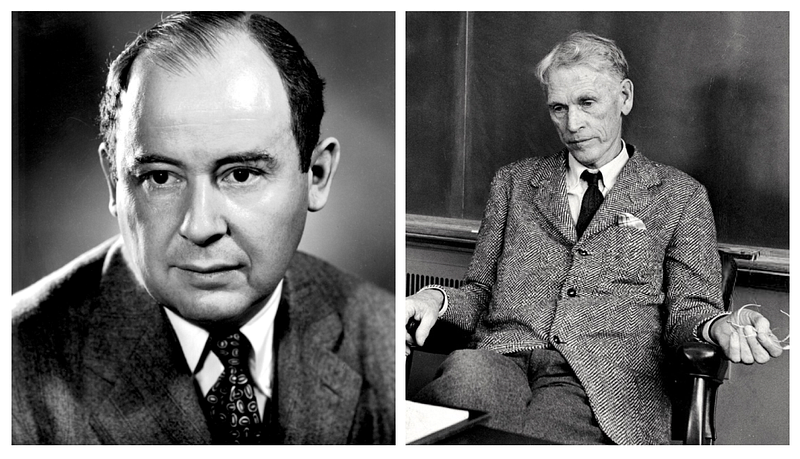
John von Neumann (1903–1957) and Oswald Veblen (1880–1960)

The von Neumann Essays

John von Neumann’s 1935 letter to Oswald Veblen

The book John von Neumann: Selected Letters* by Rédei (2005) is a fascinating collection of 150 of von Neumann’s correspondences starting in the 1920s until his death in 1957. Among von Neumann’s extensive communications included in the book are:

Also included are seven letters to von Neumann’s friend and colleague at the Institute for Advanced Study, mathematician Oswald Veblen (1880–1960) from the period 1930-45. One letter, written in the summer of 1935, stands out as a remarkable example of the great man’s eclectic mind.

von Neumann’s letter has it all: a discussion of the theory of spectra of Hermitean operators, a presentation of an idea connecting logic, quantum theory and projective geometry (including proof sketches), inquiries about spin-geometries and not least of all, gossip. Lots of gossip.

Letter from von Neumann to Veblen (July 6th, 1935)

By the summer of 1935, von Neumann had been employed at the Institute for Advanced Study (IAS) for two years. Founded by Abraham Flexner (1866–1959) with the help of Veblen, the IAS had been funded with money from Louis and Caroline Bamberger.

“The Institute” was at that point still housed in Fine Hall at Princeton University (now Jones Hall). Indeed, the IAS would remain in Fine Hall until 1939, when its own campus and its main building Fuld Hall was opened for its professors and visiting researchers. von Neumann had been one of six professors offered lifetime appointments when the IAS first opened. The other five were J. W. Alexander (1888–1971), Albert Einstein (1879–1955), Marston Morse (1892–1977), Hermann Weyl (1885–1955) and, Veblen himself.
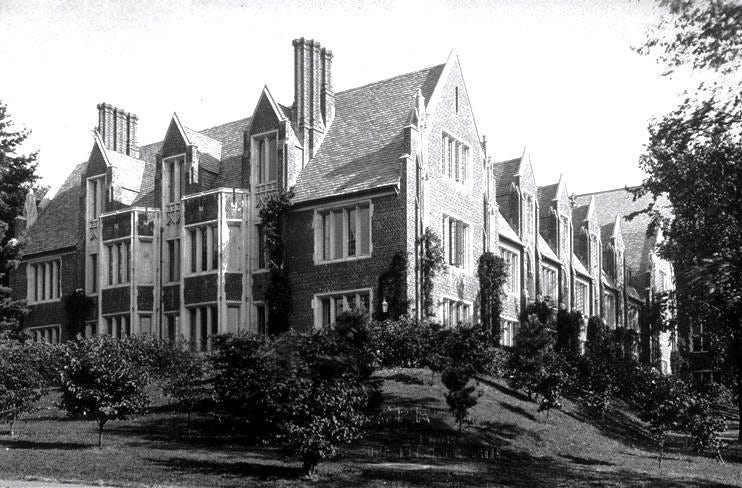
Princeton University’s Fine Hall (now Jones Hall) in 1931, where the Institute for Advanced Study was housed from 1933–1939 (Photo: The Trustees of Princeton University)

A socialite who was both extroverted and worldly, von Neumann frequently spent time away from both the IAS and his initial institution, the University of Berlin. Indeed, his employment at the IAS had been offered following a three-year stay as a visiting professor at Princeton University from 1930–33. In the summer of 1935, von Neumann had been a visiting professor at Cambridge University. He returned to his home city of Budapest for the summer, before travelling back to Princeton for the fall term of 1935. This is when he wrote his letter, which begins:

Dear Oswald,
Please excuse the size of my letter, which will probably be quite considerable before I am through. But there is quite a number of things I should write about.

The first six pages of von Neumann’s letter regard mutual acquaintances, politics and current events. After that, he goes on to derive 13 pages of equations, mostly on the topic of the theory of spectra of Hermitian operators. In the margin of the first page, he later notes:

“I see now with horror, what I did: My letter developed into a monster of 21 pages! But pp. 7-20 are mathematical, so please do not read them seriously unless you are very bored.”

Proceeding from the subjective to the objective, I have to report first, that we are all well, although Mariette is again engaged in her usual battle wit her elders, wether to put on weight or not. Mariana is well, and even gained 1 lb. between New York and Budapest, so that there is every reason to assume that she crossed the ocean without noticing it.

Marietta Kövesi was von Neumann’s first wife. She had been a brilliant student of economics in Budapest, where the two met in their early childhood. They married in 1929 just before von Neumann first left for Princeton, and had one child, Marina von Neumann Whitman (1935-), a distinguished Professor at the University of Michigan.

The two would split up less than two years later. A year after that, in 1938, von Neumann went on to marry early computer scientist Klára Dán (1911–1963), whom he had met during one of his (last) trips back to Budapest prior to the outbreak of World War II. According to Macrae (1992), von Neumann and Dán married two weeks after Dán’s divorce from Andor Rapoch was final. Prior to Rapoch, she had also been married to a man named Ferenc Engel. Her marriage to von Neumann would be her third, but not final, as she also married physicist Carl Eckhart in 1958, a year after von Neumann’s death from cancer. She herself died tragically in 1963, at the age of 52, from suicide as she “walked in to the surf and drowned” on a beach in La Jolla, California.

As briefly mentioned, at the time of writing the letter, von Neumann had recently returned from Cambridge, where he had been a visiting professor:

Cambridge was very beautiful and interesting. The main architectonic sensation is of course still Hardy. He was somewhat disturbed by Milne's theological amplifications of his (not so hot) cosmology, and in particular about the fun Milne seems to find in connecting Creation with a singularity at t = 0. Hardy wishes to avoid this by introducing a parameter tau = ln t, which begins with tau = -infty, and thus satisfies his philosophical needs.
I met Newman several times, and I am very glad for having made his acquaintance, he is very attractive both from the topological and from the human side. He has postponed his sabbatical leave for 1936/37, and seems to be quite anxious to come to Princeton then.

In 1935, G.H. Hardy (1877–1947) was still considered one of the foremost mathematicians in England, if not the world. Edward Arthur Milne (1896–1950) was a British astrophysicist and mathematician who had entered Hardy’s orbit around 1914 and would later propose various mathematical arguments postulating the existence of God, some of which were based on Hardy’s mathematics. As von Neumann expresses, Hardy, a lifelong atheist, was not too pleased.

Max Newman (1897–1984) was another mathematician at Cambridge who had been lecturing there since 1927. His later lectures on “The Foundations of Mathematics and Gödel’s Theorem” (1935) would be what inspired a young Alan Turing to embark on his pioneering work on the so-called Entscheidungsproblem. Newman helped Turing get his draft of “On Computable Numbers with an Application to the Entscheidungsproblem” into publication, as well as arrange for him to visit Alonzo Church (1903–1995) in Princeton, where he ultimately later earned his Ph.D.

By the way, there seems to be quite a traffic-jam on the road to Princeton. There are 4 or more advanced students or PhD.'s who will come next year to Cambridge: A Commonwealth fellow M. Price, who is very able, he worked in quantum theory until now, but he wants to change to group theory; an NRC [National Research Council] fellow, whose name is, I think Lewinsohn, who is a pupil of Weiner (!) and spent this first year in Cambridge (Hardy thinks that he is very good), Touring who you mentioned, and who seems to be strongly supported by the Cambridge mathematicians, for the Proctor fellowship (I think that he is quite promising); and one or two more, whose names I forgot.

The three graduate students von Neumann mentions are:

  • Maurice Pryce (1913–2003), a British physicist who went to Princeton in 1935 and earned his Ph.D. on the topic of “The Wave Mechanics of the Photon” under the supervision of an all-star cast consisting of Max Born (1882–1970), Ralph Fowler (1889–1944), Wolfgang Pauli (1900–1958) and von Neumann.
  • Norman Levinson (1912–1975), an American mathematician who was in Cambridge on a Redfield Proctor Traveling Fellowship and in 1937 earned his Ph.D. from MIT where was also hired in 1937 and remained for the rest of his career. The exclamation point von Neumann includes in parentheses is likely a comment on Levinson’s Ph.D. supervisor Norbert Wiener (1894–1964), who was known as famously eccentric and absent-minded, and so did not supervise many students.
  • Alan Turing (1912–1954), the now very well-known British mathematician, who in 1935 was 23 years old. He arrived in Princeton the following year and stayed until 1938 after being awarded his Ph.D. Although von Neumann wanted him to remain in Princeton as a postdoctoral fellow, Turing declined and instead travelled back to Cambridge.

von Neumann goes on to comment about the rest of the graduate group at Cambridge, mentioning several names who would later became well known:

There is quite a considerable number of good men in the young group in C. [Cambridge] I was particularly interested in 3 of them: Two fellows of Trinity: L.C. Young, who works in real functions, Stieltjes integrals, etc,; and S. Chandrasekhar (a Hindu) who is primarily an astrophysicist, but who also has a considerable knowledge of quantum theory and connected mathematics, too; and a fellow of Caius: a theoretical physicist with the name F.C. Powell.

Laurence C. Young (1905–2000) was a British mathematician known for his invention of the Young measure. Indian-American astrophysicist Subrahmanyan Chandrasekhar (1910–1995) later became the 1983 Nobel Laureate in Physics for his “theoretical studies of the physical processes of importance to the structure and evolution of the stars”. Another Nobel Laureate, English physicist Cecil Frank Powell (1903–1969) would win the prize in 1950 for his discovery of the pion.

I had the audience of15, ≥ 20 people, which showed no "radioactive decay", until the examination period (around January 3.) came along. Then the number reduced by several orders of magnitude, until I closed on June 14.

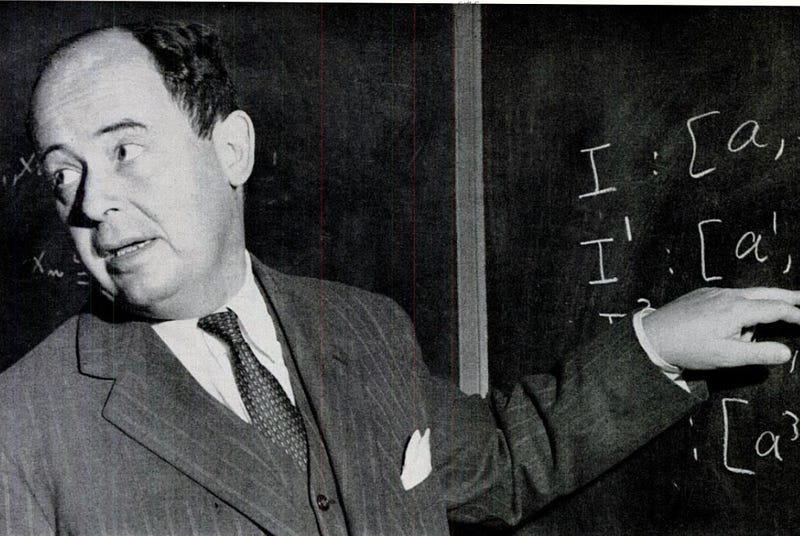
One might excuse von Neumann’s graduate students for being unable to keep up with the great man. His brother Nicholas later described the difficulties audiences sometimes had in following his lectures as follows:

“His fluid line of thought was difficult for those less gifted to follow. He was notorious for dashing out equations on a small portion of the available blackboard and erasing expressions before students could copy them.” (Vonneuman, 1987).
Fowler is looking forward with much expectation to his expedition to Princeton. We made the acquaintance of the Cooks, who live with him, and who are very charming. They will come to America in April, to join him for a "transcontinental tour".
The views about Eddington are essentially homogeneous in C. [Cambridge].: The astrophysicist are scared, the physicists (like Fowler) very afflicted; and advanced students highly amused. Nb.. he is really going from bad to worse, he wrote lately a paper on "relativistic degeneracy of gases", which is almost worse than his quantumtheoretical papers - a scarcely credible feat! He seems to have lost his contact with theoretical physics, and the methods which are in use for the last 50 years, completely.
I met E. [Eddington] once or twice, but succeeded avoiding discussions on anything more serious than graphology.

Ralph H. Fowler (1889–1944) supervised the doctoral theses of, among others Chandrasekhar, Dirac and Pryce. “The Cooks” von Neumann refers to are likely Derek and Phyllida Cook who cared for the Fowlers’ children.

By 1935, Sir Arthur Eddington (1882–1944) had gone from being the hero astronomer who in 1919 had travelled to West Africa to confirm Einstein’s General Theory of Relativity, to a somewhat controversial character. This largely for his work, starting in the 1920s on his own “fundamental theory”, which reduced to “almost numerological analyses of dimensionless ratios of fundamental constants”. Among other controversies, Eddington also famously disagreed with student Chandrasekhar’s early prediction of the existence of black holes.

Summing up, the entire experience was a very agreeable one, and the new people we met are interesting and nice throughout.
We went to Oxford, too (for 3 days), where we saw Schrödinger, Whitehead and family. Mrs. Whitehead is very charming, but Whitehead's classical definition of her ("I married a pianist") although literally true, bears false implications: She has a definitely "bourgeois" background. We stayed at Whitehead's house, and had a wonderful time. Whitehead's chief occupation is presently to knot tori, he constructed some very funny examples.
Weyl stayed for 3 days with us in Cambridge.

von Neumann had likely met Erwin Schrödinger (1887–1961) while he was a student in Göttingen, studying under David Hilbert (1862–1943). He had won the Nobel Prize in physics two years before (with Dirac) and would be awarded the Max Planck Medal two years later. A strong opponent of nazism, he in 1933 left Germany for the University of Oxford. In 1935, famous collaborator (and former advisor!) of Bertrand Russell (1872–1970), Alfred North Whitehead (1861–1947) was 74 years old, a professor at Harvard since 1924. He retired two years later.

I preached a sermon in Paris. There seems to be there a considerable interest in operator theory, boosted by G. Julia, and the younger group. Nb. the latter includes several absolutely first class people (A. Weil, Leray), and some who are at least interesting (C. Chevalley, perhaps D. Possel). A. Weil's wish to have a chance to come to Princeton in 1936/37 is unchanged.

Gaston Julia (1893–1978) was a French mathematician whose works were later popularized by Benoit Mandelbrot (1924–2010). The other French mathematicians mentioned are:

  • André Weil (1906–1998), the de-facto early leader of the Bourbaki group had in earned his Ph.D. in 1928 for his discovery of the connection between algebraic geometry and number theory later extended by the likes of Alexander Grothendieck (1928–2014)
  • Jean Leray (1906–1998), who worked on partial differential equations and algebraic topology, earning a Wolf Prize in 1979;
  • Claude Chevalley (1909–1984), a founding member of Bourbaki who would later go to Princeton, where he remained until after the war when he went to Columbia.
  • René de Possel (1905–1974), another founding member of Bourbaki and pioneering computer scientist.

Following thirteen pages of equations, von Neumann ends his letter

I hope that your extension of the home is completed and that you enjoy it. With many greetings, from Mariette and my mother, too.
Yours Truly,
John.

* This is an Amazon Affiliate Link

History
Math
Mathematics
Physics
Science
Recommended from ReadMedium