
Johannes Vermeer: Through the Looking Glass

New here? I recommend you learn about the Cool Continuum first. You can also buy the book to access 60+ artist profiles and the practical guide.
Johannes Vermeer, a luminary of the 17th-century Dutch Golden Age, was a painter who didn’t change art through innovation, but refined it, creating an unerasable mark of genius. Vermeer, by this measure, occupies the fifth level on the Cool Continuum — a space for the rarefied and extraordinary.
Vermeer’s stellar output may be due to his involvement within a vibrant community of painters. They often exchanged techniques, dabbled in overlapping themes, and shared studio spaces, fostering an environment rich in collaboration and inspiration. Vermeer’s membership in the Guild of Saint Luke in Delft, a haven for painters and various artists, was particularly influential. This guild granted him invaluable opportunities to engage with his contemporaries, serving as the foundation for his development. This camaraderie and the guild’s mentorship shaped Vermeer, allowing him to hone his craft to the genius level he later achieved.
The Level 5 Genius involves transcending traditional techniques and concepts, embodying an artistry that becomes as intuitive as it is unique. It’s the realm of an artist who creates a body of work so profound that it alters our perception of the world. Vermeer’s depictions of domestic scenes do just that, serving as a window into a tranquil universe that captivates us with its serenity and stillness.
Vermeer’s genius is like a maestro who doesn’t compose a new symphony but performs an existing one with such exceptional virtuosity that it forever changes how we listen to it. His understanding of light and color, his painstaking attention to detail, and his ability to infuse ordinary scenes with luminosity have rarely been matched. In “Girl with a Pearl Earring” or “The Milkmaid”, Vermeer transformed everyday scenarios into something sublime, leading us through an intimate narrative filled with suspense and revelation.
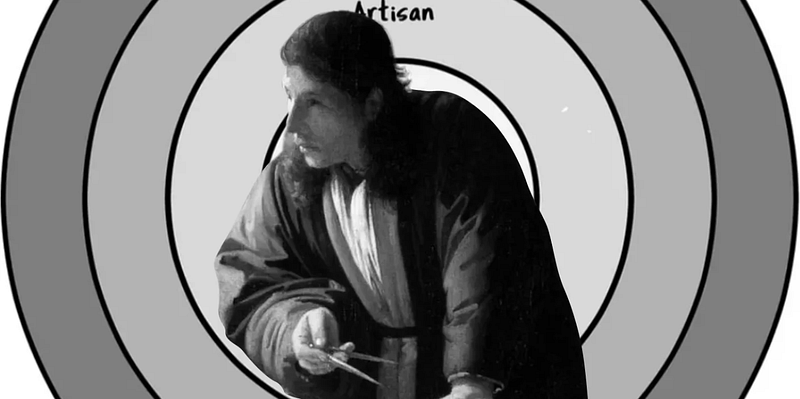
One might argue that Vermeer, using an optical aid as suggested by Tim Jenison’s theory, disqualifies him as a Level 5 Genius and instead plants him firmly as a Level 3 Artisan. An Artisan, in the Cool Continuum, demonstrates a solid grasp of techniques, consciously aware of abilities and limitations. They create aesthetically pleasing, technically proficient works. Yet, even if we accept the possibility of Vermeer using optics, it doesn’t designate him to the artisan’s realm.
Jenison’s theory that Vermeer used a camera obscura or similar device is compelling. The optical tool could project an image onto a surface, guiding an artist to replicate scenes with photographic precision. Jenison, not an artist by trade, managed to recreate a Vermeer painting through this process, offering an intriguing method to explain Vermeer’s virtuosity. But this technique does not account for Vermeer’s creative genius or his remarkable sense of composition.
Think of it this way: a typewriter alone does not make a novelist, nor does a well-tuned piano create a pianist. These are tools, and it’s the skilled hands and minds that manipulate them into something beyond the ordinary. Similarly, even if Vermeer used an optical aid, it doesn’t diminish his genius. The device doesn’t choose the right mix of pigments or compose a scene rich with narrative subtlety and emotion; the artist does. It is Vermeer’s talent to breathe life into static domesticity and his remarkable ability to make silence speak volumes, which land him in Level 5.
In Vermeer’s work, we witness not just technical excellence but a depth of understanding and feeling that transcends the mundane, making the everyday seem extraordinary. This profound intimacy with his subject matter and its delicate, almost tender rendering on the canvas is what separates Vermeer from the artisans. It’s why he belongs at the center of the Cool Continuum.
Cool Continuum is a collaborative effort by Jason S. Comely and ChatGPT. For more artist profiles and ideas on how you can make your mark on the art world, follow me on Medium.