
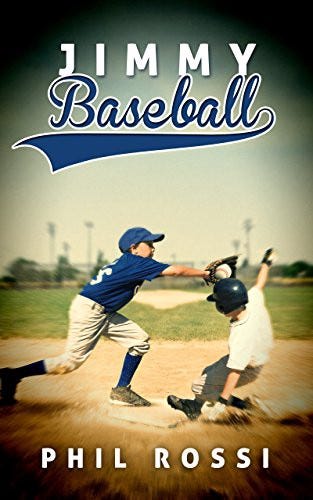
Jimmy Baseball — Chapter 9
The legend of a Little League phenom
9.
The years began to pass, and I forced myself to forget all about Jimmy. As if he and the entire friendship were something alien and confined to childhood. The things you bury and leave behind with goofy cartoons and silly jingles.
All this time, I never mustered the courage to knock down the door and think about him and that magical season. Even as I reached adulthood, married, and raised children of my own, I kept the whole episode shielded from my wife and kids.
Something shameful, like drug addiction or a prison term that I needed to hide, rather than the memories of brotherhood. I dismissed Jimmy and the promise I made to him at the funeral home. Instead of honoring his life, I hosed it off like some hard drive I needed to purge and destroy.
And I hated myself for it. I knew I humped it around a lot tougher than Ducky, Mike, and Eddie. We remained friends through the years, despite being peppered around the area. Over beers and a playoff game, Jimmy and that amazing season came up.
“Sure it’s sad. It was bad then and still is, now that we have kids of our own,” Ducky said.
“We really didn’t know him that long,” Eddie told us as if there was some sort of good priest, bad priest wafting inside Eddie’s mind. A healthy and realistic outlook, since there was nothing to do about it.
I envied how those two were able to keep Jimmy frozen-in-time. Some eternal present, where that Astro season was what it was — a great childhood experience and not to be confused with the rest of real life.
It still stung Mike, claiming Jimmy had to be sickened the second half of our Astro season. The slumps, shortness of breath, and mysterious absences due to his doctor visits. According to Mike, that last shot Jimmy hit in the title game should have sailed over the fence, landing somewhere between the street and folklore.
“I heard it guys. He didn’t fist it or break the bat. Jimmy whacked that pitch with the meat of the barrel. Forget the field — it should have left the town,” Mike said.
I continued to feel like a freak. Sure, I grew closer to Jimmy than the rest of us, but I couldn’t shake the guilt and shame I felt over ditching him in that ghost station of time.
I rode out the waves of suburbia as an everyday citizen with a providing job. A wife I still loved and called my best friend, two beautiful children, and a kid-loving dachshund. The big happy family living that dream with our shuttles parked in the driveway.
A lazy Saturday rolled in, and my son wanted to break things up at the batting cages. I knew the feeling, and once we polished off some chores around the house, I promised the trip. In the attic with my eleven-year-old son and nine-year-old daughter, busy with our spring cleaning.
Grammar school lunch boxes, Halloween costumes, baseball, and basketball trophies. Laughter and giggles over Dad’s goofy haircuts, clip-on ties, and less than stellar report cards. Framed renditions with fingerpaints, Crayola, and smudged watercolors.
I started thinking about a garage sale right before my children found a cardboard box from that marvelous spring and summer. Digging in, as if they discovered a lost Christmas present. Brandon lifted a scrapbook from the well, while Bianca pulled out an ancient media artifact called a VHS tape.
“What’s this Daddy?” she asked, holding up a copy of the title game between the Astros and Twins. (The cable company had provided copies to both teams at the awards dinner).
“You mean the object or what’s on it?” I asked with a crooked smile.
“Both,” she told me. I explained the once upon a time before DVDs and Internet streaming, this is how civilization viewed movies. By then, my son began to scan the photo album.
“You never told me you played in the championship game,” said my son Brandon, a Little Leaguer himself.
“Long time ago. I didn’t even know this stuff was still here,” I told him.
“Can we watch this?” Bianca asked.
“I don’t have the right unit, sweetie.”
“What about Nana and Pop-Pop?” she asked.
“Even Pop-Pop has a DVD player.”
“How do we see it?”
“I’ll take care of it.”
“Hey, Dad, who’s this?” Brandon pointed at the team photo.
“Jimmy.”
“Jimmy who?”
“Jimmy Baseball,” I said. I never called him that before. It just rolled off my tongue, so natural.
“Huh?” Brandon responded.
Surfing the web later that evening, punching up the next Google search. For the heck of it, I typed James Robert Fister and tapped send. The Internet might be the global sensation today but lived in the science fiction aisles during my Astro days.
A bit stunned when this stuff filtered in. I watched the roll of sluglines fill my widescreen. I scrolled the links and clicked. I spent the night reading the articles and legacy of Jimmy Baseball.
The Jimmy Fister Fund, the research, the trials. The children’s hospital nestled in the heartland. I read up on the incoming project and future. More articles, the Facebook wall, and Twitter feed.
There were pictures of Marybeth Jacobs, Jimmy’s kid sister we called Beth. Marybeth created and ran Jimmy’s foundation and fundraisers. There were some nice things looming in the immediate future.
I explained everything to my wife and hoped she’d understand and believe me. I know the damn thing sounded farfetched, but I had to grab a few days and exorcise this sweet and sour ghost. She granted me my few days. With enough room to plan things out, I cashed my personal days and booked a flight. I dropped the old tape off with a computer store that did VHS to DVD transfers.
I packed my best suit and headed for the heartland. I left arrivals in a rental car and settled on a local hotel the night before.
Big morning rolled in, and I zipped for the children’s hospital. No wonder Jimmy and the Fisters loved it here. Waves of emerald hills, teal grass under sunshine. Fresh wheels of lemon hay floated on quilts of purple clovers.
That’s when a magic castle built for a princess rose up through the dawn mist of the countryside. The flags, towers, and medieval design. Billboards on the roadway telling folks they weren’t seeing things. Arrows waving cars to stay the route.
I entered the children’s hospital, parked, and took a deep breath. Even if I did this for me, as much for him, I started to feel like it was a really good idea. Just like that night we raided the American ball field the night before the great game.
A big placard sat on the easel in the lobby, pointing people to the ceremony. I boarded the elevator to scale one of the magical towers. A life-sized Raggedy Ann and Andy greeted people and passed out candy. Window washers dressed as superheroes waved and high-fived kids through the glass.
A choir made up of children who survived their nightmares traveled from floor to floor. Lovely kids who sang about staying strong and holding on. Letting all the cancer patients know they found new friends to hold their hand, offer cheer, and greet them at the winner’s circle.
There were brief speeches and intros before Marybeth Jacobs enjoyed applause. Mr. and Mrs. Fister stood close by, as did Beth’s husband and children. She then took the podium.
Beth talked about her long-lost brother and the dicey road his illness traveled. Beth thanked all the donors and sponsors before she joined the mayor to pull the strings on the satin curtain.
The Jimmy Fister Pavilion. In bold chrome letters, Jimmy Baseball had returned! Three giant murals hung below the chrome and over the entrance. Oil paintings of his Astro days. A shot of Jimmy behind the plate in his catcher’s gear. In the middle, a smiling close-up with his jersey and cap. The mop of ginger hair fanned out from the baseball hat. The third had Jimmy taking a big swing with his wooden bat. A beautiful and awesome homecoming.
After the guided tour, there was a luncheon at the ballroom next door. In between the tour and reception, I waited my turn to approach Beth. So long ago and I doubted she’d remember me.
“Jerry? Oh my God,” Beth said, while cupping her mouth. I watched her eyes glaze over.
“Beth. You remember me?”
“Of course. You were my brother’s best friend in Maple Valley,” she said, lunging forward to give me a hug.
“You’re doing a great job,” I said.
“Thanks. It’s so rewarding, Jerry. I can’t begin to tell you how many children we’ve been able to save and heal. Not only are they living, but they’re also beating the disease and leaving the hospital cancer-free.”
When Jimmy fought this thing, they didn’t have the resources. Because of kids like Jimmy, doctors were able to do the research and trials. It’s still a rare and deadly disease, but more kids are beating it.
Mr. and Mrs. Fister seemed to recall the kid who was Jimmy’s friend. The whole time capsule, a heavy fog that could never be lifted. They thanked me for remembering their son and taking the time to come out.
In a funky way, there really wasn’t that much else to talk about. Beth filled me in on her life and introduced me to her kids and husband. I even met her son James, named after the uncle he never met.
I extended the wheels for one more stop. An hour from the hospital, I reached this great little town plucked from a Rockwell vision. I passed a church, high school, and Little League field.
The road snaked up a mountain, and spit me out on a large crest. There were wooded patches, open spaces, and a pooled brook from a mountain stream. A great place to rest.
On the ledge of the mountain, there was a cemetery. I parked the car and walked a field with bronze tablets. Minutes later, I found Jimmy’s final resting spot. The numbers between birth and death forged a twelve-year gap.
This little boy, old enough to be my son, now my age, all at the same time. I knelt down to trace the raised letters and numerals. James Robert Fister. I arranged the flower display I brought for my long-lost pal.
White carnations made into a baseball with red petals forming the seams. I asked him for forgiveness and to resume the friendship, ashamed that I reneged on my promise that night at the funeral home. With Little Leaguer’s of my own, anxious to share that special season.
When Jimmy died, it was just like a great player being called up to the majors. He left us and the world remained sad. His spirit continued to play ball. His fearsome bat, still swinging away. His moon shots bringing in all the sick kids stranded on infinite fields.
I told him of the breakthroughs and cures of his disease. That the doctors now knew what it was and how sick children could visit his new ballpark to beat it and live.
I went back to the fantastic times. So short, painful, and euphoric. Jimmy Baseball lived. He was my best friend and the greatest teammate I ever had. Jimmy Fister never stranded anybody, and that’s what I told him. For countless families, Jimmy continued to clear the bases, driving home the biggest runs in the history of the game.
For the first time since Jimmy’s death, I no longer blamed the heavens. I also released the shame I carried for pushing him away. Instead, thankful for the wonderful gift bestowed on us all, I closed my eyes and wondered how I should tell the world all about my friend.
The End


