
Jesus got me flagged on Facebook
Thank you, Jesus
My offense? I posted an ad that Facebook said included content that was “shocking, sensational, or excessively violent.”
To which I said, “Well, duh.”
I can also explain.
Facebook practically every day encourages me to “boost” a post — that is, pay them a fee to use its database to place my info, my ad, on the daily feeds of Facebook users who aren’t my “friends.”
I decided to give it a try. I was hoping to perk up interest in my memoir, Life After Deaf: My Misadventures in Hearing Loss and Recovery, which was published in November 2019 and is still selling pretty well considering how the pandemic put a serious, two-year crimp in my ability to do readings at book stores, libraries and what have you.
For my boosted post, I chose a prose-poem that’s included in the book. I composed it at a point in my hearing-loss “journey” when I was at a low ebb, desperate for sensory stimulation to make up for the loss of music in my life.
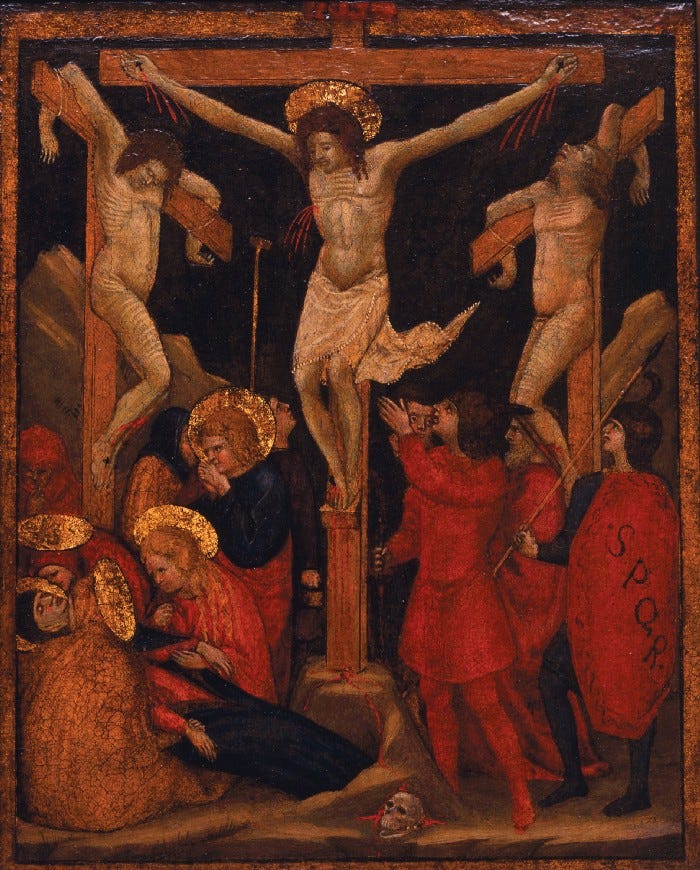
I was inspired by a beautiful painting by a 14th century Florentine artist named Paolo Schiavo. It’s on permanent exhibit, along with other religious paintings, at the Georgia Museum of Art on the University of Georgia campus in Athens.
The painting isn’t “shocking, sensational, or excessively violent.” It’s all three. It depicts what in its time amounted to a lynching, a horrible thing — the crucifixion of Jesus.
It’s also a tableau that has been reproduced by hundreds of artists over hundreds of years. Its central image, Jesus nailed to a cross, can be seen in some rendering or another in Christian sanctuaries from Rome to rural Mississippi.
I am guessing that my use of Schiavo’s vivid portrait freaked out some sort of image-recognition software Facebook uses, not a human judge. I can’t say for sure. While Facebook offers a button to click on to appeal decisions like these, it’s difficult to reach an actual person to whom one can make a counter argument.
I have indeed appealed. I will let you know what I hear back.
In the meantime, this is the artwork. Below it is the poem.
Listening to Art
I came to you because I’d gone deaf Not that I expected any healing, mind you I don’t believe in miracles Not big ones anyway I didn’t even know you were present In these gleaming pine corridors Hobnobbing with saints who say they knew you No, I came because I made myself a New Year’s resolution: “Celebrate the senses you have left, son. Indulge. Nuzzle that glorious velvet, trace an old hickory’s furrowed bough. Savor that wild strawberry, that kiss of mint. Smell the roses and the coffee, of course. And the sour mash ferment Of sweet gum leaves and carrot shavings making compost cider. Watch the sunrise blossom, the waxwings dining by the open window. Look at art. Yes! And really look this time.” And so it was that I came to this ivory hall, seeking a feast for my eyes Not you, just the $3 all-you-can-eat. But there you were, in that Florentine’s ferocious miniature, A king embracing eternity between thieves, dying for their sins, our sins Dying for your decency, for your inability to betray your loving heart. What a sensory magnificence. Schiavo’s palette burned my eyes, his reds dark like your last cup of wine, like blood I have given I could feel the rough timber beneath your pale limbs I inhaled sorrow, tasted triumph. And I could hear The Romans grousing, debating your paternity The sobs that had welled inside your mother for 30 years Magdalene’s words of comfort There, there. Sssssssh. Calvary was alive, aural, a cacophony. I could hear it. For a moment I could hear.


