
Jesus Died for God’s Sins
Jung’s intriguing psychoanalysis of Yahweh

Carl Jung once psychoanalyzed God, in a 1952 book called Answer to Job.
Luckily for Jung, the Goldwater rule wasn’t yet in effect, so he needn’t have feared recriminations from psychiatric associations for engaging in so indirect a psychiatric assessment. Mind you, God’s hidden to the point of not existing at all, yet even that didn’t stop Jung.
What if the biblical God existed? What should a psychiatrist say about God’s mental development, judging from the biblical narrative? Jung realized that the New Testament can be read as an answer to the book of Job.
Job saw Yahweh’s dark side
The problem that defines Judaism is that Yahweh implodes over the course of his associations with his chosen people. At first, he walks among them in Eden. Later, he boasts about his power to shepherd his people to the promised land, and he uses the very forces of nature to smite Israel’s enemies.
But God’s character is internally conflicted — which is to be expected since Jewish monotheism evolved from Canaanite polytheism, meaning that God’s character absorbed the characteristics of various gods that used to perform separate functions. Yahweh is a god of war but also of justice and peace. He’s a national, tribal deity for Jews, but also the cosmic creator.
These contradictions came to a head in Job’s confrontation with Yahweh. Job, the innocent man whom God smote to test his faith, expected justice but he got the dictatorial boasts. Only one side of God showed up in defense against Job’s accusations. In other words, God has a dark side, a “shadow,” to use Jung’s term. Gnostics would call this side the demiurge, and the Bible includes it as the Satanic tempter.
Yahweh harangues the innocent Job because Yahweh has projected his flaws onto humankind. As Jung asks,
But what does man possess that God does not have? Because of his littleness, puniness, and defencelessness against the Almighty, he possesses, as we have already suggested, a somewhat keener consciousness based on self-reflection: he must, in order to survive, always be mindful of his impotence. God has no need of this circumspection, for nowhere does he come up against an insuperable obstacle that would force him to hesitate and hence make him reflect on himself.
Perhaps God created a universe and especially living things so that God could learn about himself. Thus, as Jung says, “Job is no more than the outward occasion for an inward process of dialectic in God. His thunderings at Job so completely miss the point that one cannot help but see how much he is occupied with himself.”
Yahweh has no reason to be angry with Job since Job could be blamed only for “his incurable optimism in believing that he can appeal to divine justice. In this he is mistaken, as Yahweh’s subsequent words prove. God does not want to be just; he merely flaunts might over right. Job could not get that into his head, because he looked upon God as a moral being. He had never doubted God’s might, but had hoped for right as well.”
Jack Miles, who makes a similar case against God’s character, in Christ: A Crisis in the Life of God, points out that the Devil bested God twice, once when he “trapped the Lord into wrecking his own creation,” by manipulating Eve into eating the forbidden fruit. The second time was with Job when, “appealing to the Lord’s sense of his own greatness, Satan lured him into torturing” an innocent man.
What God discovers over the course of Judaism’s evolution — or rather, what Jews discover about the prospects of monotheism — is that God doesn’t fully know himself. His unconscious, dark side motivates him, conflicting with his more pleasing self-image.
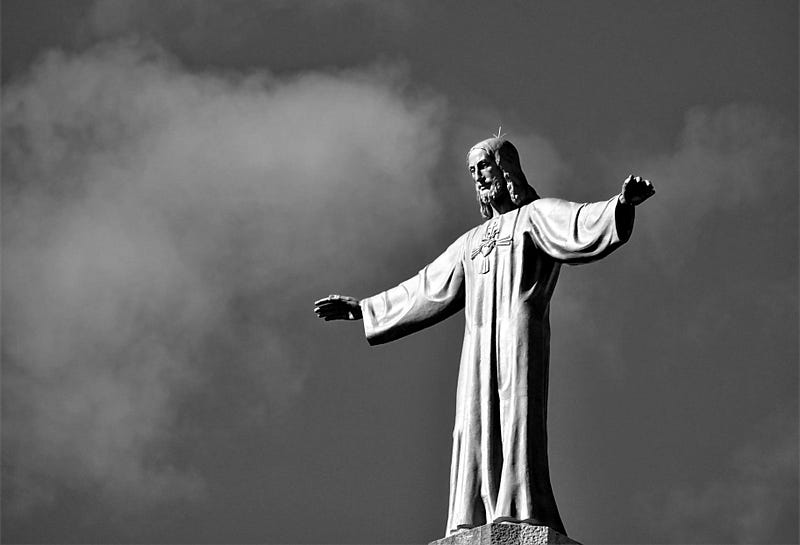
Why God punished himself in Christ
For Jung, then, the relevance of Christianity to Judaism is that God would incarnate himself so that he could reconcile his good and evil sides. More precisely, God would sacrifice his good side to reveal the extent of his evil and to apologize for divine sin.
As Jung says, “Man is not so much delivered from his sins, even if he is baptized in the prescribed manner and thus washed clean, as delivered from fear of the consequences of sin, that is, from the wrath of God. Consequently, the work of salvation is intended to save man from the fear of God.”
Instead of saying with the pious traditionalists that atonement is the “payment of a human debt to God,” Jung says Christ’s crucifixion is “reparation for a wrong done by God to man.”
In Jungian psychological terms,
The unconscious wants to flow into consciousness in order to reach the light, but at the same time it continually thwarts itself, because it would rather remain unconscious. That is to say, God wants to become man, but not quite. The conflict in his nature is so great that the incarnation can only be bought by an expiatory self-sacrifice offered up to the wrath of God’s dark side.
Jack Miles puts the thesis more plainly:
The disobedience of the first humans was a sin; yet it was not the enormity of that sin but, rather, the ruthlessness of God’s curse that brought death into the world. Thus, though sinners, for their own good, need to repent and be forgiven, it is God, in the end, who must atone for his vengeful and destructive reaction to their sin by restoring their immortality. God’s own ancient and long-running vengeance is the sin that, as the Lamb of God [Jesus on the cross], the Lord himself takes away when he replaces the curse of death with a blessing of eternal life.
Again,
Having blighted his own work and cursed his own image with misery and mortality, God faced an immense challenge. He had to restore his masterpiece. He had to redeem those whom he himself had exiled from paradise. For his own sake not just for theirs, he had to recover the lost crown of his creation. But instead of becoming again the calm and sure creator he had been at the start, he became, for long centuries, an angry and anxious warrior…
Christianity, then, represents the change of God’s mind. Instead of defeating Jews’ enemies, the Romans, as he had done with the Egyptians (in the biblical fantasy), God
allowed himself and his people to suffer a still more catastrophic defeat [in the Jewish-Roman Wars]; but before that doom descended, he joined them, suffering in advance all that they would suffer, and creating out of his agony a way for them to rise from the dead with him and return to paradise, bringing all nations with them.

The Pauline Whitewash of Gnosticism
What’s intriguing about all this is that Paul the Apostle, of course, sold the opposing view, that God had to suffer purely for our sake, to heal our original sin. For Jung, this Pauline and traditional Jewish perspective was a case of blaming the victim. God promised he’d reward Jews for their loyalty, but they suffered under the Assyrians, the Babylonians, and the Romans. The prophets often blamed Jews for these disasters, positing some hidden sins or insufficient faithfulness. God must be blameless, assumed the prophets since he’s necessarily perfect.
But what if God isn’t perfect? Or what if monotheism requires the Zoroastrian perspective of process theology? What if God can become perfect only by purifying himself in a process of self-reflection? What if God learns about himself in relation to his created universe, or in the guise of his material manifestation?
Paul’s emphasis on human sin as the reason for Christ’s sacrificial death is like Job’s friends’ chastisement of Job, as they suspect he suffers from pride in deeming himself wholly innocent. If Job’s been plagued, there must be a reason since God is necessarily just. Hence, it’s more likely that a fallible human has sinned and isn’t aware of it, than that the universe’s creator has sinned and doesn’t know himself. God must be all-knowing to have created everything so how could he be ignorant of his nature? How could he pretend to be benevolent when he’s secretly evil?
Yet this darker interpretation is just what the Book of Job insinuates.
Exoterically, the book ends in fairytale fashion, with God acting justly and restoring Job’s good fortune. It’s left for the inquisitive reader to read the tea leaves, to recognize that God’s tirade must be a bluff. There’s no need to appeal to the secrets of how the universe was made, to prove that God is more powerful than Job since the reason for Job’s torments are made plain to the reader beforehand. If this book’s author could tell the reader the reason — namely that Yahweh made a bargain with the Devil to test Job’s faith, experimenting on an innocent man — why couldn’t Yahweh tell that to Job? Evidently, it was because Yahweh was embarrassed by his evil side.
Here, then, there’s an opportunity to hoist Pauline theology by its own petard, as it were. Leaving out the Gnostic part of the story that’s always been implicit in Christianity is futile since these dualistic elements are bound to pop up elsewhere in the discourse. If Christ died to save us (rather than God), why do we have this original sin? Because Satan tempted us. And why was Satan allowed to tempt us? Who let Satan into Eden, and who created this serpent in the first place?
Following up on this Gnostic, Jungian take, the serpent is none other than God’s dark side, the inhuman one that isn’t worth worshipping. The more comprehensive Christian answer, then, is that Christ died because God saw the need to atone for his sin, for being the sort of deity from which he’d need to flee in horror. That’s precisely the character we’d expect an all-powerful sovereign to have, of course, that of a dictatorial, amoral, uncompromising, spoiled, child-like artist.
The upshot of the narrative is that God incarnated as a fallible, mortal man named Jesus to develop the virtue of humility so that he could repent of his sin of having bungled his creation. All along, according to what’s implicit in the Christian narrative, God’s been like us in being a sinner, too!
Paul says we’re like God in that we’re able to be as perfect as him, but this similarity would work both ways. Evidently, God’s like us in that he needed to learn the wrongs he’d done and take responsibility for them by dying on the cross.
And by whitewashing the logic of Christianity’s relation to Judaism (and especially to Job), Paul was speaking not for God’s good side, but for his bad one, for the Satanic unconscious impulses which operate in the shadows. God tried to bring them to light by punishing himself for all to see. Yet the Pauline Church stepped in to persecute the Gnostics, blame the victims, and hold up a phony, sanctimonious image of God.
The Gnostic aspect of Christian myths isn’t so politically useful, even as it’s truer to our existential condition. Nature is inhuman, so its supernatural source would have to be just as appalling to social mammals like us. When we personify this source and think through the analogy, we’re likely to imagine an atonement process, as the mentally complex and thus conflicted divine mind comes to terms with his ignoble inclinations.
Job is right to condemn God, and the esoteric reading of the New Testament is that God eventually recognizes that right and duly punishes himself. God changed his mind in that Job enlightened him, forcing the creator to confront the damage his cluelessness has caused. The tyrant is humbled, and he punishes himself in the only way he can, in an incarnated form.
What does this mean for Christians? The exoteric, benighted ones subscribe to the Pauline whitewash, to the anti-Gnostic interpretation that blames the victim to empower Christian institutions, in that the latter can associate with the caricature of a wholly good deity.
The question for proto-Lovecraftian Gnostics, though, is whether it makes sense to worship a flawed deity, assuming the myths could somehow be taken as telling us more about cosmic realities than about our fantasies and fears.
I collect my Medium writings in paperback and eBook forms, and I put them up on Amazon. Check them out if you’d like to have them handy and to support my writing in that way. The newest one is Questing for Epiphanies in a Haunted House, and its 600 pages include 99 recent, wide-ranging articles of mine.