
Social Philosophy
Jean-Jacques Rousseau’s General Will
It did not work.
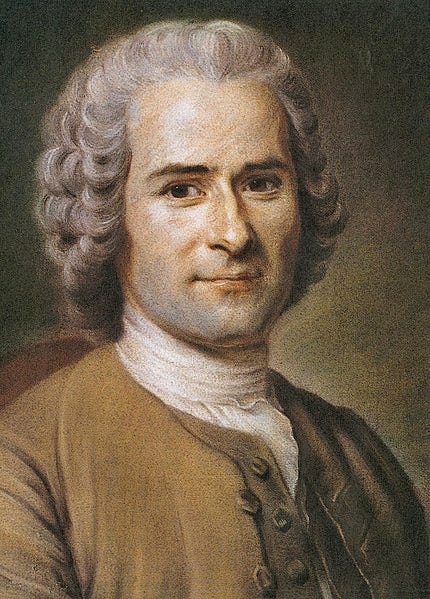
Jean-Jacques Rousseau (1712–1778) gets short shrift from many, but his philosophy was incredibly influential. His influence was mostly in France, however, which partially explains why he gets little attention in the English-speaking world. The other reason for the lack of attention is that his political philosophy was more or less a disaster when it was put into practice.
Rousseau has been called a “militant lowbrow” because he railed against what we consider “highbrow” culture. Rousseau’s targets included science, religion, the arts, education, government — basically everything we would call “civilization.” Others, like Thomas Paine who we’ll meet later in this chapter, described the 1700s as “The Age of Reason” and “The Enlightenment,” denoting their self-satisfaction with what they saw as humanity’s progress. Rousseau disagreed and offers us a challenge: Who are we? Why do we assume that our progress in philosophy, science, and technology is an improvement?
The quick version of Rousseau’s philosophy is summed up in his book, The Social Contract (1762):
Man is born free; and everywhere is in chains. One thinks himself the master of others, and still remains a greater slave than they. How did this change come about? I do not know. What can make it legitimate? That question I think I can answer.… But the social order is a sacred right which is the basis of all other rights. Nevertheless, this right does not come from nature, and must therefore be founded on conventions. (The Social Contract, I.I.1–2)
By the “social order,” he meant what Hobbes meant by “social conventions”: the class structure of society and the many related expectations of how people should behave. France was a hierarchical society in Rousseau’s time; a king, an aristocracy, and the common people. Everyone knew their place in the hierarchy because social recognition norms taught people what was expected from them and what to expect from others. That set of social relations was what made France a civilized society. But Rousseau saw civilized society as a prison. Its structure of social norms chained people, restricting their true expression.
Rousseau complained that social norms encouraged people to concentrate obsessively on the approval of others to maintain their social status. This social pressure created in people the artificial state of amour propre. Rousseau picked up the concept of amour propre (literally “self-love”) from the French moralist François VI, Duc de La Rochefoucauld (1613–1680). François, a contemporary of Descartes, was also raised on Scholasticism and was familiar with Augustine, who had condemned love of self, “amour de soi,” as the vice of making oneself more important than God. François added to Augustine’s amour de soi the idea that, motivated by love of self, people seek the approval of others. We are, in fact, so desirous of the approval of others that we put up a public front to cast ourselves in a flattering light, highlighting our positives and hiding our negatives, to win that approval. Being familiar with the French royal court, François saw how courtiers would go to great lengths to gain prestige and status. This pursuit, despite being motivated by self-interest, actually causes people to forget their true nature and misjudge their behavior. “We are so used to disguising ourselves from others that we end by disguising ourselves from ourselves” (François, Duc de La Rochefoucauld, Maxims Maxim 11). This excessive desire for esteem, François terms “amour propre.” The concept helps him explain why we behave as we do and why we are blind to why we behave as we do.
Rousseau took the concept further and defined amour propre as our constant desire for the approval and esteem that must come from others. This, he argued, was not natural self-love, or amour de soi, which Rousseau, in sharp contrast to Augustine, saw as positive. Rousseau claimed that amour propre was an artificial creation of civilization that caused in individuals a false need to compare themselves with one another to gain social status. He claimed that amour de soi was compatible with happiness but that amour propre corrupted individuals and led to misery and vice. Rousseau saw amour de soi as difficult, if not impossible, within civilized society, which is dominated by the pressure to conform to social norms.
Civilized man is born and dies a slave, Rousseau wrote in his novel, Emile. All his life, man is imprisoned by institutions. Man is naturally good, and in the state of nature we can live organically in unity with each other and ourselves. In nature, we are savage but noble, happy and with goodwill toward others. Civilization is harmful; its nature is corrupt. Imprisoned within it, we are forced to compete with others for esteem and status. We are deceitful to each other and to ourselves, alienated from our true nature. Our greatest evils, Rousseau says, flow from ourselves. Trapped together in society, alienated and confused, we are all in chains.
You may ask (as you should), how does this convert into a political philosophy? Well, that was the problem. As much as he’d like to see civilization swept away and ended, he understood it was not that simple. He settled for a lesser evil. The short version is that Rousseau, like Hobbes and Locke, adopted the concept of a social contract. Rousseau, however, had no tangible concept by which he could unite society under a contractual bond. So, in his book, The Social Contract (1762), he put forward the tenuous concept of the “general will” — a difficult combination of total political freedom with strong authoritarianism. Rousseau believed that in the state of nature, which he meant more literally than did Hobbes and Locke, an individual’s will would be allowed to express itself freely. Society was a prison; nature was freedom. Rousseau pointed to an idealized vision of the indigenous populations of North America, whom the French had come to know in their explorations of what is now Canada. Indigenous societies seemed to the French explorers to be less rigidly structured than was French society, its people more at peace with the land and with themselves. It was the myth of the “noble savage,” a person of dignity free from the social constraints of class hierarchy and war. If we were more free, as the indigenous peoples of North America are, Rousseau thought, we would be happier. This was his rough idea of the state of nature.
Rousseau’s general will is the combination of the necessary evil of society and the good individual will found in the state of nature. The general will is the abstract expression of what is best for all, as if the society were one individual. The idea is similar to Hobbes’s Sovereign as the embodiment of all. Rousseau, however, does not reduce the will of all to one man but considers the body politic as the Sovereign. (The Social Contract, I.VII.3) Also like Hobbes’s Sovereign, the collective general will is the sole source of sovereignty to which each individual must subjugate himself or herself. Because the general will is not one man, as Hobbes proposed, Rousseau adds that the general will is determined by individual participation. He believed that everyone should be required to vote directly on the laws of the land — no elected representatives. Good laws make for good citizens, but good laws can be willed only by good citizens, and laws are legitimate only if they are agreed on by the common assembly of citizens. Rousseau believed that through public debate and voting, disagreements that arose from individual opinions would cancel each other out. What is left is the general will. Everyone was required to obey that general will as the law of the land. In this way, everyone develops within a framework of equality under the law.
It did not work. Rousseau’s basic idea of the general will was implemented in the early years of the French Revolution. The idea of who decided what the general will of the people was slid into a morass of self-serving petty disputes. A bloodbath ensued, which came to be known as the “Reign of Terror” (1793–1794). In a few years, Napoleon grabbed power and plunged all of Europe and most of the world into decades of total war. It would be unfair to blame it all on Rousseau, but the American Revolution was philosophically based on Locke’s version of the social contract, and that turned out a bit better. These revolutions weren’t entirely about philosophy, but philosophy did have a part in them both.