
Java Concurrent Animated — Visualizing the Java Concurrent API
A Swing Application Demonstrating Core Java Concurrency Concepts

1. Overview
Have you ever found yourself pondering how multiple threads work in Java and how to effectively utilize concepts like “notify”, “notifyAll”, and “wait”? Moreover, why is the usage of the “synchronized” keyword crucial in concurrent programming? Wouldn’t it be amazing to witness this in action?
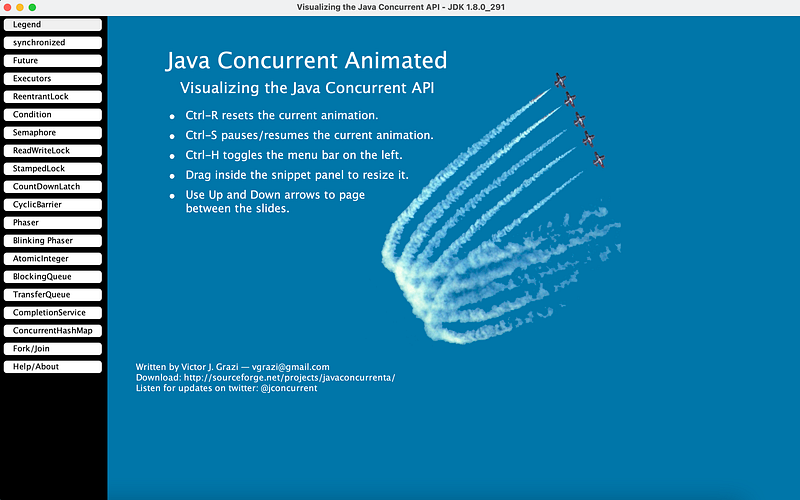
Introducing Java Concurrent Animated, a Swing application crafted by the Java Champion Victor Grazi. This program serves as an illustrative showcase of core Java Concurrency concepts, including but not limited to AtomicInteger, CountDownLatch, Semaphore, ReentrantLock, ReadWriteLock, and more.
“One thing that is really useful and you’re reminding me is that, a lot of times when you are in a concurrence situation and you know that you need some kind of construct, what I do is I load up Java Concurrent Animated and I just through all of them and I kind of get an inspiration what construct would solve my particular problem.” (Victor Grazi at JNation Conference, 2020)
2. Concurrent Features and Source Code
The extra code available for the following sections can be found in:
2.1. Synchronized Sample
The “synchronized” keyword is used to create synchronized blocks or methods, ensuring that only one thread can access the critical section of code at a time, thus preventing data race and maintaining data consistency. “Notify” and “notifyAll” are methods that allow threads to communicate with each other within synchronized blocks. “Notify” wakes up one waiting thread, chosen arbitrarily, while “notifyAll” wakes up all waiting threads, giving them a chance to acquire the lock. The “wait” method is used to make a thread temporarily release the lock and wait for a signal from another thread to resume execution [SynchronizedDemo].
By using these constructs, Java developers can safely coordinate the actions of multiple threads and enable effective communication between them.
Let’s see the same in the animation.
2.2. AtomicInteger Sample
AtomicInteger is a class in Java that provides a thread-safe way to work with integers in concurrent environments. It ensures that operations like incrementing, decrementing, and updating integer values occur atomically, without interference from other threads. This prevents data races and ensures consistent and accurate results. AtomicInteger uses low-level atomic CPU instructions to perform these operations, making it highly efficient and suitable for high-performance applications with heavy multi-threaded usage [AtomicIntegerDemo].
By utilizing AtomicInteger, developers can avoid the need for explicit synchronization or locking, which can improve concurrency and reduce the risk of thread contention.
Let’s see the same in the animation.
2.3. Semaphore Sample
A Semaphore is a synchronization construct in concurrent programming that controls access to a shared resource. It limits the number of threads that can access the resource simultaneously. Threads acquire permits from the Semaphore to access the resource, and when done, they release the permits for other threads to use. Semaphores are essential for preventing resource contention and ensuring orderly execution in multi-threaded applications [SemaphoreDemo].
Let’s see the same in the animation, remembering that the limit of threads that Semaphore can handle simultaneously for the sample is 4.
2.4. ReentrantLock Sample
ReentrantLock is a flexible synchronization mechanism in Java that allows a thread to re-enter a critical section of code it has already acquired. Unlike synchronized blocks, ReentrantLock provides a “tryLock” operation, allowing a thread to attempt to acquire the lock without blocking. If the lock is unavailable, the “tryLock” operation returns immediately, enabling the thread to take alternative actions.
ReentrantLock’s versatility, support for reentrant locking, and “tryLock” operation make it a popular choice in complex multi-threaded scenarios where precise control over resource access is essential.
Let’s see the same in the animation.
2.5. ReadWriteLock Sample
ReadWriteLock is a synchronization construct in Java that provides separate locks for read and write operations on shared resources. Unlike traditional locks, ReadWriteLock allows multiple threads to read from the shared resource simultaneously, as long as no write operation is in progress. This read concurrency enhances performance in scenarios where reads are more frequent than writes. When a thread wants to modify the shared resource, it must acquire the exclusive write lock, which prevents other threads from reading or writing during the modification [ReentrantReadWriteLockDemo].
ReadWriteLock is particularly useful in scenarios with data structures that are read-heavy, such as caching mechanisms or read-only data. By enabling concurrent reads and efficient exclusive writes, ReadWriteLock optimizes resource access, reduces contention, and improves the overall throughput of multi-threaded applications.
Let’s see the same in the animation.
2.6. CountDownLatch Sample
CountDownLatch is a synchronization utility in Java that enables one or more threads to wait for a set of operations to complete before proceeding further. It works by maintaining a count that is initialized before the operations begin. As each operation completes, the count is decremented. Threads can use the “await()” method to wait until the count reaches zero. Once the count becomes zero, all waiting threads are released, and they can continue with their tasks [CountDownLatchDemo][CountDownLatchDemo2].
CountDownLatch is especially useful when a task requires the completion of several subtasks before proceeding, or when multiple threads need to coordinate their activities to reach a particular point in the program. It simplifies the coordination of threads, enhances efficiency, and ensures that critical sections of code are executed only when all the necessary prerequisites are met.
Let’s see the same in the animation, where the pass count is 4.
2.7. BlockingQueue Sample
BlockingQueue is a concurrent data structure in Java that provides a thread-safe way to manage a collection of elements. It extends the Queue interface and adds additional methods that support blocking behavior. BlockingQueue is designed to facilitate communication and synchronization between producer and consumer threads. When the queue is empty, a consumer thread attempting to remove an element will be blocked until an element becomes available. Similarly, when the queue is full, a producer thread trying to add an element will be blocked until space becomes available [BlockingQueueDemo].
This blocking behavior ensures that threads automatically wait and wake up when necessary, minimizing busy-waiting and resource wastage. BlockingQueue is widely used in scenarios where thread communication and coordination are essential, such as thread pools, task scheduling, and other producer-consumer patterns. It provides a reliable and efficient solution for managing shared resources in multi-threaded environments.
Let’s see the same in the animation, where the queue size is 4.
2.8. CyclicBarrier Sample
CyclicBarrier is a synchronization construct in Java that allows a group of threads to wait for each other at a common barrier point before proceeding further. It is particularly useful when multiple threads need to perform a task in parallel and must wait until all of them have reached the same point before continuing.
CyclicBarrier is initialized with a specified number of parties, representing the number of threads that must reach the barrier. As each thread arrives at the barrier, it calls the await() method, which blocks until all the other threads have also reached the barrier. Once the required number of threads have arrived, the barrier is tripped, and all threads are released to continue with their tasks. The barrier can be reused reset() after it is tripped, making CyclicBarrier suitable for iterative tasks where threads need to synchronize at multiple points during execution [CyclicBarrierDemo].
CyclicBarrier is commonly used in applications where thread coordination and synchronization are crucial, such as parallel processing and divide-and-conquer algorithms
Let’s see the same in the animation, where the barrier size is 4.
3. How to Download and Fire Up
To access the source code, you can go to his GitHub project page:
There, you will find a link to the latest binary version, a JAR file which can be downloaded from:
Once downloaded, you can simply run it by triggering the command: java -jar javaConcurrentAnimated.jar
Conclusion
In summary, visualization is a valuable approach for mastering core Java concurrency concepts. By observing how these mechanisms work and interact with threads in real-time, developers gain deeper insights into their behavior and potential issues.
Armed with this understanding, developers can design scalable and responsive applications that fully utilize multi-core processors and effectively manage concurrent execution.
Be sure to download the Swing application and explore various ways to experiment with its features and other available options.
JNation Developer Conference
Victor Grazi presentation link on Youtube
Further Readings
Thanks for reading
- 👏 Please clap for the story (50 claps) to help the article to be spread
- 🌐 Share the story on Social Media
- ➕More stories about Programming, Career, AI and more.
- 🔔 Follow me: Medium | LinkedIn | Twitter


