
Japanese scientists employ the James Webb Telescope to decipher the mysteries of the universe.
A prevailing theory suggests that in the eons following the Big Bang, approximately 13.8 billion years ago, the universe primarily contained hydrogen and helium, with heavier elements forming later. However, discoveries by a Japanese research team have challenged this view, revealing the early presence of heavy elements like nitrogen and supermassive black holes during the time stars were actively forming. These findings disrupt earlier scientific assumptions and push the boundaries of our understanding.
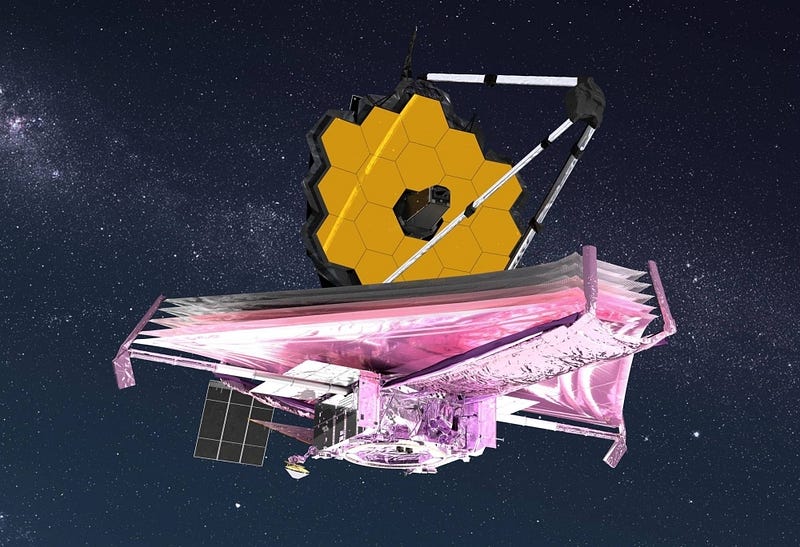
The pivotal tool in these groundbreaking discoveries is the James Webb Space Telescope (JWST), operated by NASA. Launched into service in 2022, JWST has provided an unprecedented window into the universe’s primordial periods, sparking a transformation in astronomical research.
Professor Masami Ouchi from the Institute for Cosmic Ray Research at the University of Tokyo, a contributor to this project, remarked on the significant advancements in early universe studies in the last year, noting the pace of progress as unprecedented in the last two decades.
Quasars, the most luminous and formidable entities known in the cosmos, serve as beacons to observe the early universe. Their brilliant light, emanating from supermassive black holes that can be up to a billion times the mass of our sun, takes eons to reach us.
Thus, peering at a cosmic body over 13 billion light-years away is akin to looking back in time by 13 billion years. But discerning light from such distant galaxies has historically been difficult as it shifts into the infrared range due to the universe’s perpetual expansion, and Earth’s atmosphere absorbs it, rendering traditional telescopes ineffective. Only with the advent of JWST, cruising in a solar orbit 1.5 million kilometers from our planet, have scientists been able to overcome these challenges.