
Japanese Only
A Chance Encounter with a Kamikaze Pilot Who Lived To Tell His Story
My Life in Vignettes (Table of Contents)
“Sometimes all it takes is a tiny shift of perspective to see something familiar in a totally new light.”
―Dan Brown,The Lost Symbol
The handwritten sign on the unassuming door said, in English, “Japanese Only.”
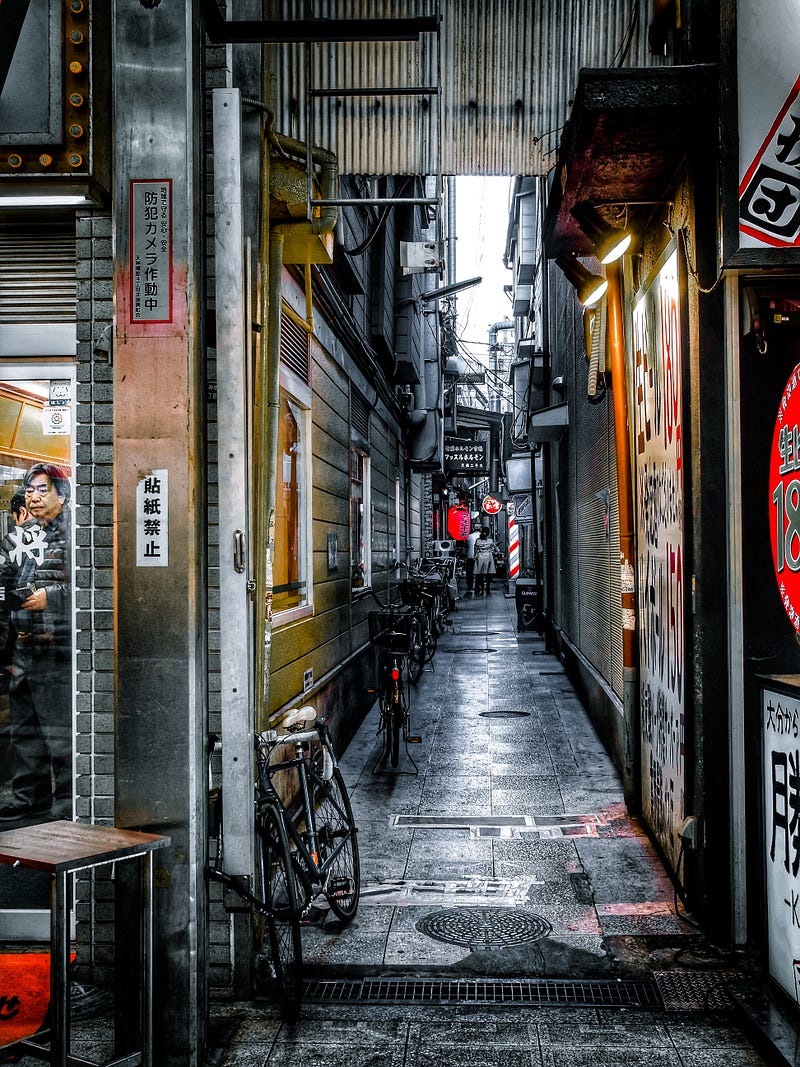
I had passed this squat, weathered, grey concrete building many times, walking from Naval Air Facility, Atsugi, Japan, to the train station, headed to Tokyo, or Yokohama.
It wasn’t the kind of place that screamed, “Come in, see what’s here… come, stay awhile.”
It was more the type of place that sighed to itself as I passed, eager not to make eye contact, content that it had safely avoided another visitor.
It was the kind of place that had regulars but rarely made new ones.
I stopped in my tracks… something about the sign had caught my eye, and my brain screamed, “STOP!!! … you have to go in!”
So I did.
I had a hypothesis. There were a few establishments around the base displaying “Japanese Only” signs. I believed they were displayed because the proprietors or staff didn’t want to deal with American servicemembers who spoke no Japanese or spoke poor Japanese.
I took a few steps, opened the sliding frosted glass door, and poked my head inside to take a peek.
I could almost see and feel the building cringe as I stepped through and slid the door closed behind me a bit too loudly.
I was greeted by a darkish smoky room, with a bar running down the left side and some tables and chairs scattered to the right. The place was pretty vacant, but it was still early. I counted two customers sitting at almost opposite ends of the bar. A small group was pressed into the farthest corner table, talking in hushed tones.
I heard a sharp sucking-in of air sound and saw a young man dressed in black slacks and a black long sleeve shirt quickly walking toward me. One hand went up and started waving back and forth as if to ward off an evil spirit.
“Sorry,” he said in English, “Japanese Only.”
“But, I can understand Japanese,” I said politely in Japanese, just loud enough for the proprietor to hear.
The young man looked over to the proprietor, standing behind the bar, arms folded in front of his chest, an almost scowl quickly forming and then disappearing from his face.
He looked at me very carefully, then gave a barely perceptible nod to the young man, who nodded back and led me to the bar.
I took a seat on an empty stool and waited for the Master (proprietor).
He retrieved a hot hand towel from a warmer below the counter and handed it to me. I unfolded the towel, wiped my hands, ran it over my face, then carefully rolled the towel back into its original shape and placed it on the bar in front of me.
Master nodded his approval.
“Why is it that you speak Japanese so well?”
Ah, the dreaded question. I dreaded it because it inevitably led to telling a long story about my childhood and growing up in the provinces.
“I was raised in Japan,” I said, volunteering nothing more.
He nodded and looked at me as if to continue the line of questioning but changed his mind.
“You can stay for a drink or two,” he said, “but not too long.”
I thanked him and ordered a beer.
He brought the beer and a small glass and poured it half-full.
I made small talk with the Master and sipped my beer slowly. Soon I felt light but persistent tapping of fingers on my shoulder. I turned to see a young man from the small group in the corner.
He looked at me and bowed.
“I’m very sorry to bother you,” he started. “My Grandfather would like to speak with you.” He pointed to the corner where the group continued their hushed conversation. “He can’t believe you speak Japanese so well,” he continued. “He wants to know if you are an American airman.”
I pointed to the leather flight jacket I was wearing. “Navy,” I said, “Naval Aviation.” I motioned to the empty seats beside me, and said “Please…”
The young man returned to his friends, and I could hear the sounds of hushed talking becoming a bit more animated as a discussion or argument began, but I couldn’t make out the words.
The man at the far end of the bar got up to the bathroom. As he passed behind me, he said in a low voice, “Don’t listen to that guy. He’s crazy!.”
An older man rose from his seat at the table in the corner and slowly made his way over to where I was sitting at the bar. The young man followed.
I gestured to the empty seats by me and asked if they would join me. The older man nodded and sat. The younger man remained standing beside his grandfather, bowing his head slightly to thank me for accommodating them.
“Sake!” he ordered to Master, who had already anticipated the request, and was walking towards the counter bringing a ceramic flask of hot sake.
“Do you drink nihonshuu?” asked the man, using the more formal, descriptive name for sake. I nodded. He asked for a second choko, a small ceramic cup for drinking. I held the cup while he filled it, then filled his. We raised our cups and sipped the hot liquid.
“Sake is best for nights like this,” he said. “It gives warmth to the bottom of the belly, and the warmth stays with you into the evening.”
He paused for a moment, then continued.
“It also allows us to say the things we really think, instead of the things we think others want to hear.”
This earned a frown from the young man, who began to look a little worried.
I nodded in acknowledgment, thought about what I had just heard, and took a moment to study the man sitting beside me.
He looked to be in his sixties, with greying hair cut short. He wore a dark woolen sweater over black slacks, and his scuffed work boots hinted that he worked in a trade rather than in an office.
“You say you are in the Navy… How is it that you learned to speak Japanese so well?” he asked.
“I grew up in Japan,” I replied.
“Were you born in Japan?”
“No, America. I first came to Japan when I was a baby.”
“Where in America?”
“Texas,” I said.
For some reason, this usually led to some kind of conversation about cowboys, or guns, or Country and Western music, since everyone in Japan knew something about Texas from movies and television. I waited for the follow-up, but instead, the man was silent for a few minutes, looking into his small cup of hot sake as if reflecting on some memory.
Finally, he looked up, and I could see in his eyes some strength but also a great sadness which seemed to flow into his face, stopping to settle into the crows’ feet at the corners and then leaping up into the deep lines carved into his forehead.
“You are a pilot?” he asked.
“No,” I said. “Aircrew.”
He nodded and paused for another long moment.
“Did you know that the airfield at which you serve was once the primary airbase of the Imperial Japanese Navy?”
I nodded. I knew it had belonged to the Japanese Navy during the war and that General Douglas MacArthur and his entourage had flown to Atsugi in 1945 to begin the postwar occupation of Japan.
“I am going to tell you something I have never said to a foreigner,” he said. “I am going to tell this to you because I think you might be able to understand me.”
I nodded but kept silent, not wanting to interrupt.
“I am hoping you are familiar with the term Tokubetsu Kougekitai, or Tokkoutai.”
“Kamikaze…” I said. I began to wonder where he was going with this conversation.
“That is correct.” He paused for a moment to gather his thoughts, then looked at me. His eyes became slightly unfocused as if he was searching himself for some long-forgotten memory, then became sharp again.
“Near the end of the war,” he continued, “I was stationed at the airbase, training to be a pilot. It was difficult because your bombers would come by here every night and put holes in the runway. But we kept patching it up so that we could continue our training.”
He now had my complete attention. It was very rare for the Japanese to talk about the war, and even more unusual to be able to hear a first-hand story about the war from someone who had been the enemy. I wasn’t sure why he wanted to tell me this, but I somehow knew that it was a once-in-a-lifetime opportunity.
“I was training to be a Tokkoutai pilot… That’s right,” he said, noticing as my eyes widened. “the airbase here at Atsugi was a training base for Tokkoutai at the end of the war. I am guessing you did not know that.
I nodded.
His face became more serious as he continued.
“We heard about the terrible destruction of Hiroshima, and there were rumors that something equally terrible had happened to Nagasaki. But we were determined to continue our training to protect our people from the enemy at all costs. We were prepared to die for the Emperor. In fact, and this was instilled into our hearts and the very cells of our entire living body, that it was our duty to die.”
“And I was prepared to die,” he said, “and I knew that a good correct death would bring glory to my family.”
He looked at me and paused to let that sink in.
“We were in our final stage of training,” he continued. “I had written my final letter to my family, and it was folded and placed in the inner pocket of my uniform, next to my heart, ready to hand to a colleague the moment I received my orders to go.”
His right hand went up from his side and caressed his jacket next to his heart, pressing slightly to show me where he had placed the letter.
“I remember the day well. In the year Showa-20, the eighth month, 15th day. It was a sweltering and humid day, typical for the summer here. Instead of taking lunch at the usual hour, the entire base was gathered in military formation to hear an important announcement. We were told that the Emperor himself would be speaking to us. How could this possibly be? We were commoners, and none among us had ever heard the voice of the Emperor. He was a God, and Gods do not speak to common people. At least, that is what we believed in those times.
“There was also excitement and anticipation. What was the announcement? Had there been a great victory and a celebration to follow?
“The broadcast began, and we bowed our heads in respect when we heard his voice. It sounded so small. Was this really the Emperor speaking? We had some difficulty understanding his words because he used the language of the Imperial Court. But it soon became apparent that there was no victory. Japan had lost the war.”
“We now hung our heads in shame. I heard quiet sobbing from several of my colleagues. And tears flowed freely from my own eyes. I covered my face with my hands in shame.”
“At that moment, I was plunged into total darkness. My entire reason for existing had suddenly evaporated, and I felt I had nothing to live for, no reason to continue my life. I looked into myself, and all I could see was a deep pit inside of me, pitch black, with no bottom, and I was being sucked down into it.”
He paused again, and our eyes met.
“And for years afterward, I was ashamed to be alive, and I could not look other people in the eye…”
For a brief moment, I became him, standing on the tarmac with his friends, cast into desolation. I had never imagined before what it might have been like to be Japanese at the end of the war when everything suddenly changed.
“Today,” he said, “I still have life. If the war had not ended on that day, I might not be here talking to you. I would not have had children. And they would not have had my grandchildren.” He looked over to the young man and nodded.
He turned back to me. “Thank you for listening, and thank you for allowing me to bother you with the memories of an old man,” he said.
“Thank you for telling me your story,” I replied. “You have given me a lot to think about.”
With that, he called out to the Master to settle the bill and left, taking his entourage with him.
Though I returned to the bar several times after that night, I never saw the man again. I had not even learned his name. But the story he told left an indelible impression on me.
When we think of war and death, we tend to think of those who have given the ultimate sacrifice for OUR side. But there are two sides of a coin, and in the end, even if one side is “right” and the other side is “wrong,” we are all human beings, we all have lives, and even when it is necessary, ending a human life has a cascading effect.
And I sometimes wonder what would have happened if the war had not ended that day.


