
Jakarta, or should I say Smog-arta?
Deadly air pollution tightens its grip on us
I’m so fed up. The smog seems to be taking over the skies here, making me feel like I’m in the midst of an apocalypse. Have a look at this photo:
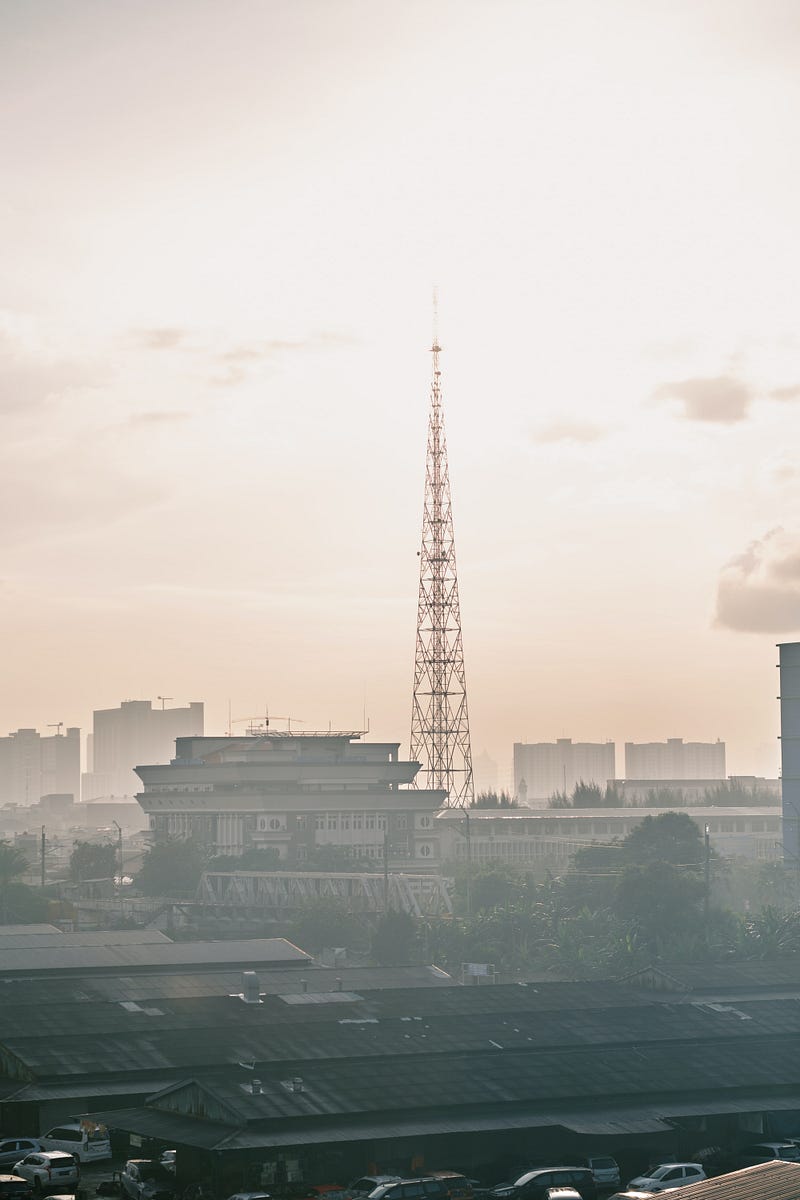
Yes, it looks like we’re all enveloped by massive smoke plumes.
Besides the fact that I’m still breathing, just gazing up at the sky, I prefer not to be.
If you’re unaware, the standard Air Quality Index (AQI) ranges from 0 to 50 AQI for specific areas. Can you guess this city?

Yes, 156 AQI, presented in red color, accompanied by an illustration of a person wearing a mask. It’s even considered ‘Unhealthy,’ as stated above, with the main pollutant concentration being PM2.5, which is 12.9 times higher than the average WHO annual air quality guideline values.
Even as I write this down, the AQI has climbed once more to 174.
For the past two months, this situation has been unfolding, yet our focus only shifted today, as the air quality deteriorated. This concern swiftly gained momentum and has become a prevalent topic across Indonesia. The entire population is engaged in discussions, as it profoundly impacts us all. Students, employees, seniors, and families with children, and babies. We’re collectively grappling with the challenge of inhaling clean air.
We’ve stopped venturing outdoors, and when necessary, we must don masks. Public spaces have turned deserted, children no longer play outside, and offices are starting to contemplate implementing work-from-home (WFH) arrangements.
People returning from outside are falling ill, primarily with coughs and colds. Safe havens of good air quality outdoors are nonexistent. Even seeking higher ground increases the risk of exposure to pollution.
Amidst this unveiling, Jakarta has been branded as the world’s most polluted city in terms of air quality.
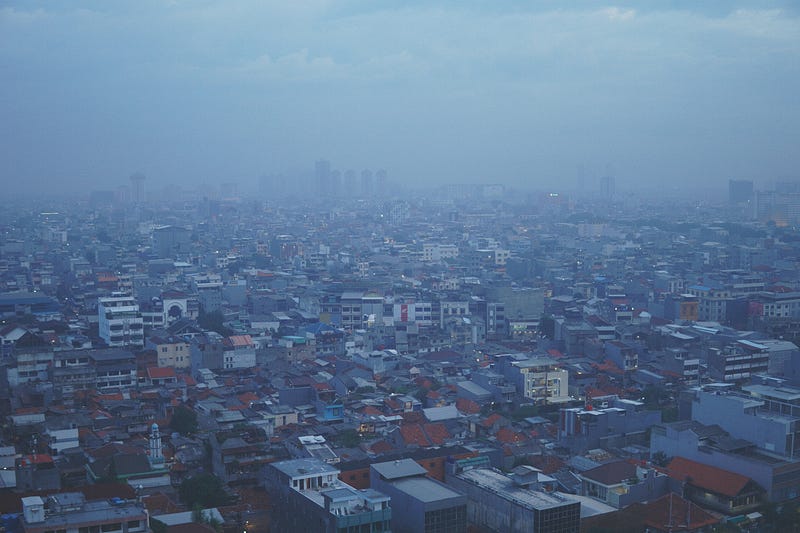
The origin of the smog could be attributed to various factors. Speaking to DW Indonesia, Miming Saepudin, the Head of the BMKG’s Weather Early Warning and Prediction Division, outlined potential reasons behind the smog phenomenon observed in Jakarta.
According to Miming, the smog covering Jakarta stems from an atmospheric inversion layer prevalent in the city and its environs. Inversions arise from the movement of air masses, inducing temperature disparities within the atmosphere.
Apart from this, smog can also develop due to pollution in Jakarta. When there’s a substantial buildup of pollution at ground level (including emissions from vehicles, factories, and smoke), combined with atmospheric inversion, the likelihood increases that this pollution will create a hazy air quality, trapped in the lower atmospheric layer.
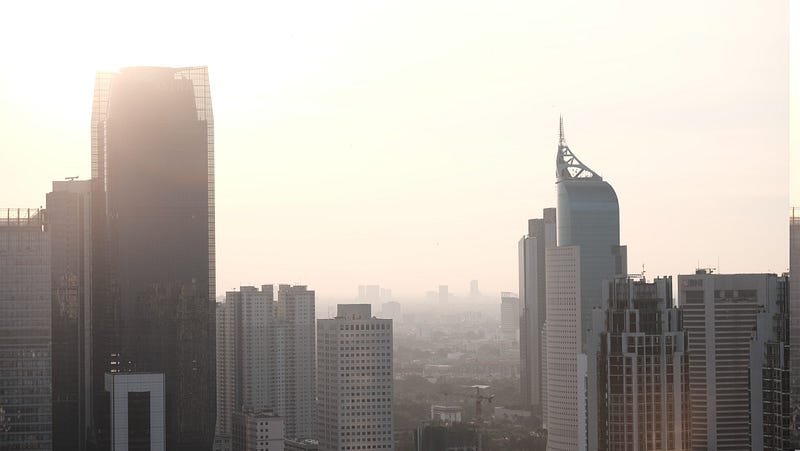
What is the source of pollution?
Numerous factors contribute to it, including emissions from vehicles, open-space burning, coal combustion, and construction dust.
While vehicle emissions are commonly attributed as the primary issue, it’s burning coal that likely plays the most significant role in Jakarta’s air pollution. Nearly a fifth of the pollution can be traced back to coal combustion. Adding to the concern, Jakarta is encircled by eight coal-fired power plants within a 100 km radius. To exacerbate matters, the Center for Research on Energy and Clean Air (CREA) reported in 2020 that 118 industrial facilities surrounding Jakarta further contribute to the city’s air pollution.
How are the authorities handling it?
The government is considering enhancing emission tests for vehicles that traverse Jakarta and its neighboring districts and towns. Additionally, they intend to introduce a policy known as 4 in 1, requiring a minimum of four occupants in a private car.
As previously mentioned, they are also suggesting a WFH initiative for employees whose tasks can be accomplished remotely. Certain offices have already put this program into practice.
However, everything mentioned above remains in the realm of plans and has yet to be executed by the government (except for the WFH initiative, which depends on individual company regulations).
Townspeople of Jakarta concur that the most significant source of pollution stems from a multitude of nearby coal-fired power plants (PLTUs). Presently, there are no less than 16 coal-based PLTUs situated near Jakarta. Strangely, the government appears to have neglected these factors, despite their contribution to pollution surpassing that of transportation, commerce, and households combined.
Curiously, discussions about factories as a source of pollution remain relatively infrequent.
The government consistently encourages the public to shift towards public transportation and adopt eco-friendly vehicles. Even though we all know that pollution doesn’t solely originate from motorized vehicles; factories also play a significant role.
Furthermore, several environmentally-friendly transportation facilities and infrastructure are being overlooked. This contributes to people’s hesitance in transitioning to public transportation and low-emission vehicles. Bicycle lanes have fallen by the wayside, and remarkably, a pedestrian pathway has been dismantled. Such policies do not align with the promotion of sustainable transportation.
What actions can we, as citizens, take?
In the face of extensive economic and political agendas hindering solutions, the only recourse may be self-reliance. On a personal level, limit outdoor excursions to essential ones and ensure you wear a mask when you do venture out.
Minimize your use of emission-producing vehicles whenever possible. Despite the neglect of numerous bike lanes, take the initiative to utilize them.
When indoors, seal windows and doors to prevent external pollutants from entering. If feasible, employ air filtration for improved indoor air quality.
Lastly, together we must encourage the government to seriously commit to carrying out the energy transition. It’s every individual’s responsibility to combat pollution, contributing to the creation of a healthy living environment.
To create a healthy city in which our children can live. To us grown adults, enabling us to breathe freely again. To our health, fighting off colds and coughs. To the essence of our mental health, so that we don’t have to stress about being unable to breathe freely.
To our lungs, so that they can absorb clean oxygen again.
Everything matters and everything counts. To all of us.
Thank you for journeying your time through these words. If you’d like to show support, you can leave a tip below (next to the subscribe button). Wishing you safety and warmth!