
Jack and the medieval mystics Chapter 6
Not knowing

She was there — in Starbucks — the girl with the purple hair. But it was busy and she didn’t have time to talk. Anyway, why would she want to go out with a guy who was so horrible? I bet she talks to her Mum on the phone all the time.
I found a seat right in the corner and got the book out, being careful not to leave it cover side up on the table. Not a good look — medieval literature — and religion at that. I reminded myself that I was only doing it for an experiment to see what effect that kind of thinking has on the mind.
The thought of entering for the Evan Williams Prize gave me a whole new burst of enthusiasm. The difficult thing would be tightening up the methodology. I’d have to do the experiment all over again — maybe over a longer time period. Have prescribed passages that I read over and over. Find a way to record the results in terms of my thinking. A thought occurred to me; perhaps I should enrol other people — put together a questionnaire. It would have to be qualitative. The whole area was too subjective.
Meanwhile, it wouldn’t do any harm to read the rest of the book for research. Maybe I could pick out some passages.
A text came through. It was Jem. ‘Up for going out tonight?’
‘Going out’ meant the town centre, not the campus bar or the local pubs near where we lived.
‘OK,’ I replied.
‘I’ll WhatsApp Kipper,’ he texted. ‘Anyone else?’
‘No.’ I liked drinking better with just the three of us.
Jem always got annoyed that I didn’t do WhatsApp and he had to text instead. I used to do WhatsApp, Insta, Tik Tok, everything, but during my second year I cut it all out. I suppose that was a kind of experiment too. I’ve always liked trying stuff out on myself, seeing what it does to your mind. But that one stuck. I discovered that I much preferred my phone being lean and clean. And I got more work done as well, which you need to do if you want to bag a First.
I went to pee and on the way back, I passed the counter and caught the girl’s eye. I smiled but she seemed not to see and just started serving the next guy. Shame. We used to talk a fair bit — just passing the time of day really — but I liked her. She had this way of tossing her hair back but it wasn’t at all posey. It was like she wasn’t self-conscious at all and she seemed to really listen when you said something, even if it wasn’t that clever or interesting. But obviously she wasn’t into me. Or I suppose she could have been with someone else. Maybe she was married with two kids — you never know with people.
I got back to the book and turned to a new chapter, with quotes from a different mystic. This one didn’t seem to have a name at all; they’d just found writing by him with no name attached. They called him the Cloud of Unknowing author, because that was the title of his main piece. I read through — the usual stuff about contemplation and prayer — but then it started to get more interesting. His or her big thing was discovering a different kind of knowing: ‘Do not attempt to achieve this experience intellectually. I tell you truly it cannot come this way,’ he wrote. Then this:
‘But now you will ask me, ‘How am I to think of God himself, and what is he?’ and I cannot answer you except to say ‘I do not know!’ For with this question you have brought me into the same darkness, the same cloud of unknowing where I want you to be!’
There was something in that, I thought. Surely, if God existed at all, they would have to be so supra-intelligent that a human being would struggle to grasp them with the ordinary thinking mind. So what did the author suggest instead? It seemed to be something about love.
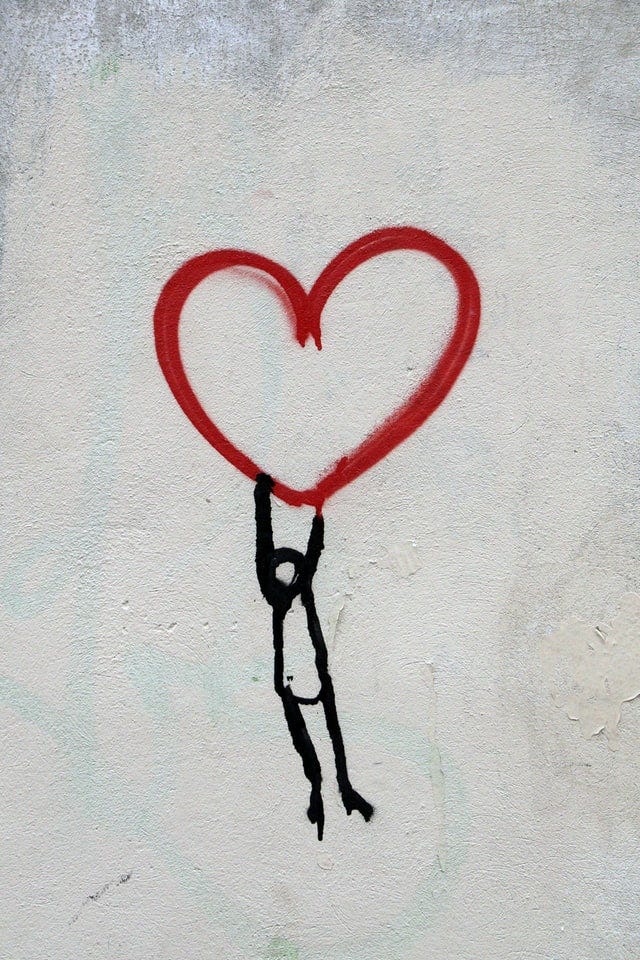
‘Therefore I will leave on one side everything I can think, and choose for my love that thing which I cannot think! Why? Because he may well be loved but not thought. By love he can be caught and held, but by thinking never.’
I read on but all the time there was something buzzing about in the back of my mind. Even after a second Americano it was still there. Something about the limits of thinking. How it can lead you down all sorts of rabbit holes. A thought (note the irony) occurred to me. Why do we believe our thoughts so much? After all, they change all the time — they’re hardly a reliable basis for action. Is there something else that we could rely on more? Like the Cloud man (or woman) said. An idea was forming in my mind.
By the time I’d finished reading, the coffee shop was getting empty. I put the book away and got my jacket on, then I walked towards the door. The girl with the purple hair (I didn’t even know her name) was clearing one of the tables. I went up to her confidently and smiled. This time she smiled back and said hi, as if she remembered me well.
‘Are you finishing up here soon?’ I asked.
She nodded. ‘Five minutes.’
‘Fancy a drink — not coffee?’ I asked.
She turned her head to one side, tossing her hair back. ‘Yeah,’ she said. ‘Why not?’
Thank you for reading. You can find Chapter 7 here
Links to all chapters are here


