
J.K. Rowling’s Portrayal of Butch Women and Effeminate Men
The Silkworm in relation to Troubled Blood

*Spoiler alert for the myth of Cormoran Strike*
J.K. Rowling caused controversy with her recent inclusion of a cross-dressing serial killer in her novel Troubled Blood. In her defence, she claimed that novelists have every right to reflect the real world, including rare forms of homicide. However, a remarkably high number of cross-dressing murderers turn up in crime fiction (compared to the real world), so why is there such a discrepancy between fact and fiction?
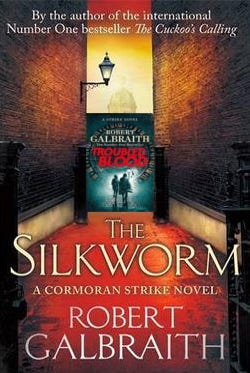
The transgender community fumed at her offering of Troubled Blood, but it is nothing like her earlier novel, The Silkworm. Here, we find a transgender woman, Pippa Midgley, carrying out persistent stalking, posting her excrement through a victim’s home, and attempting to carry out two separate stabbings. Pippa is then pushed to the side as the real killer comes into view, a cisgender woman called Elizabeth Tassel.
We are told that she has ‘mannish hands’ in the same paragraph where she’s described as the murderer.¹ Never mind what she wears: we’re encouraged to get excited at the idea of a biological woman being a threat because she has male physical characteristics. The author appears unaware that most younger readers would laugh at the irrelevant comparison. So what if her hands are masculine-looking?
A tension of opposites
We can use Rowling’s later portrayal of her cross-dressing killer to throw light onto Elizabeth Tassel’s hidden butch qualities.
The shadow is a term used to describe the collection of negative qualities which often lie hidden in the recesses of our psyche. According to dream analysis, backed up by statistical evidence, it tends to take on the guise of our own gender.² At least, it does for those with a simple binary nature to their gender. (Non-binary, Intersex, and Transgender people have yet to provide any detailed collective analysis of their dreams.)
If our shadow and animus/anima should conflate, projection often occurs with the opposite gender (to ourselves) taking the hit. I’d suggest that this is why Rowling’s cross-dresser, Dennis Creed, is so openly played out as a villain while Tassel’s butch quality remains mostly hidden. Within the myth of Cormoran Strike, Creed is the late peacock’s tail to Tassel’s previous quiet role:
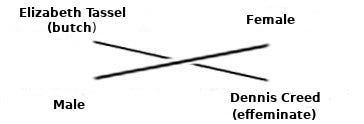
Tassel’s quality of being butch is hidden and underplayed until it flips at the point of her exposure as a murderer — her large ‘mannish hands curling into claws’. By contrast, Creed’s effeminacy is described openly. Now they are both in prison, we might wonder, do they correspond with each other? After all, in the subconscious world of dreams, characters can take on an autonomous nature. In Rowling’s myth, that would be a distant, somewhat clumsy correspondence based on contra gender extremes.
We can also see the same negative gender-fluid motif occurring with Rowling’s vile character of Rita Skeeter in her myth of Hogwarts. In Harry Potter and the Goblet of Fire, she’s described as having ‘clawed fingers’ and ‘large mannish hands’.³
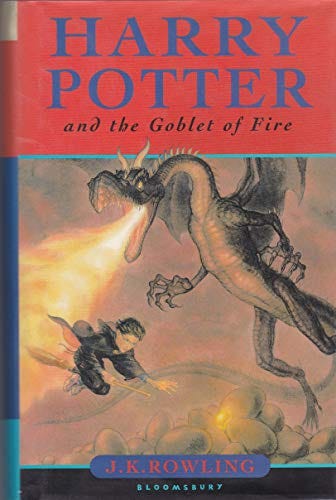
Now, wouldn’t it be nice to see a woman with loving ‘mannish hands’ in her fiction? What about some delight and enjoyment of gender fluidity?
Concerning modern, ongoing myths, we can view character quaternities as compass bearings towards wholeness and balance. I think this can be helpful when we’re dealing with a cultural complex such as the rights of people who happen to be gender fluid. An alternative is to fall into the collective unconscious along with its casual bigotry and projection of shadow qualities.
Modern witch hunts
To any ordinary person, the fact that Tassel has butch qualities would be irrelevant to her being a murderer, but not so with Rowling. Her conflation of butchness with negativity isn’t just her own Achilles’ heel; it also happens to be common to the transphobic community. Many in the cult have an unacknowledged fear and disgust of male effeminacy, which in turn, tends to backfire on butch women.
Individual biological women, in particular, have become focal points for this projection. One ridiculous case on social media recently saw a mannish-looking woman ‘accused’ of being a transgender woman. Her lesbian partner then came to her defence as a witness to her background. When the story unfolded to its natural conclusion, several people leading the online mob cringed off in severe embarrassment.
Cormoran Strike — crime fiction or fantasy?
Crime novelists can end up presenting imbalanced fantasy in their fiction rather than reflecting the real world. The old ‘whodunnits’ in particular, were often lacking in authenticity. Most crime fiction acts more as a place for readers to enjoy safe thrills, solve puzzles and gawp at dead bodies.
Body count ratios can also go askew. In the real world, female murderers are rare. According to the UK Office of National Statistics, the number of women murderers compared to male murderers is low, at around 1 in 20. By comparison, the Cormoran Strike series (up to book five: Troubled Blood) has a ratio of around 8 in 20.
Cynics will likely crack cheap jokes about equal opportunities. However, thoughtful feminists might ask why Rowling is transferring so much male violence onto women: Why should women carry the weight of so much male-orientated murder on their shoulders? After all, they’re not responsible for the extent of such violence in the real world. The myth of Cormoran Strike helps to maintain such a false narrative.
‘Robert Galbraith’, it seems, does not sit too easily with J.K. Rowling. As a result, the strict gender binary must continue to compensate within her mythology.
There is a biological woman who turns up fleetingly in Troubled Blood called Theo. She is broad-shouldered and easily mistaken for a man. She is described as ‘dark’ and somewhat mysterious. I wonder who she might be.
As a character with an element of gender fluidity, she remains a red herring, lost to the dark and currently undeveloped.
References: 1 — J.K. Rowling, The Silkworm, p. 441, Sphere, 2014. 2 — For example: ‘Examining the Unconscious with the Dream Grid’, by Daniel Anderson, Harvest — International Journal for Jungian Studies, Analytical Psychology Club London, 2006. 3 — J.K. Rowling, Harry Potter and the Goblet of Fire, p. 269, Bloomsbury, 2004.