
CAREER ASPIRATIONS
F. B. I. Director J. Edgar Hoover Wrote Me a Personal Letter When I Was Ten Years Old
The F.B.I’s longest serving and most controversial director was a figure of fascination for me as a kid who wanted so badly to be a G-man when I grew up
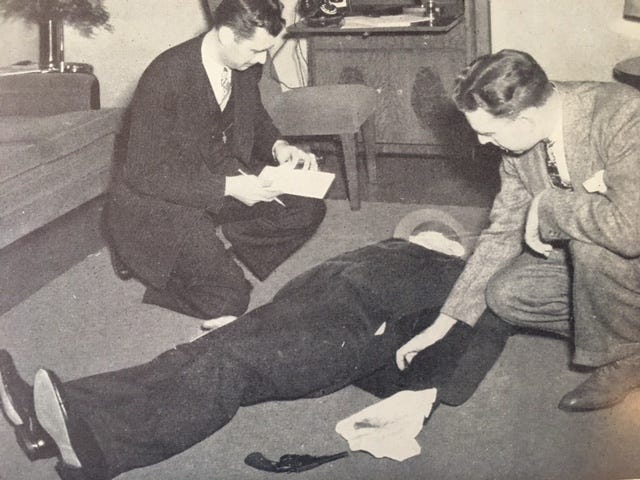
When I was a ten-year-old kid I was “president” of the S.P.D.A. — “Special Private Detective Agency.” I enlisted the help of my seven-year-old sister, and a few other neighborhood kids.
Our “mission” was to find and follow any “suspicious” people on our block or in the nearby shopping center. In those innocent days parents let their preadolescent kids roam the neighborhood freely on foot or bicycle.
Mom’s only admonition was “Don’t lose Vicki!” My younger sister was alternately a blessing and boat anchor.
A blessing when mom wouldn’t let me go somewhere unless I took her along. A boat anchor when I had to take her along.
The S.P.D.A.’s days became numbered when neighbors complained that I’d painted their front door knobs in clear liquid glue.
“Why on earth would you do that?” Mom asked.
I explained I was getting peoples’ fingerprints, and to do so I had to use a substance that would capture their “unique identifiers.” This, I went on to tell her patiently, was the exact science used by the F.B.I.
Mom broke into laughter, after which she said I must “turn in my badge.” My detective days were over.
To help me get over my disappointment she bought The F.B.I., written by Quinton Reynolds of Random House.
Because I was a voracious reader and unsatisfied by my school’s listless selection of library books, Mom enrolled me in a book club that allowed us to pore over dozens of titles and select one each month for a year.
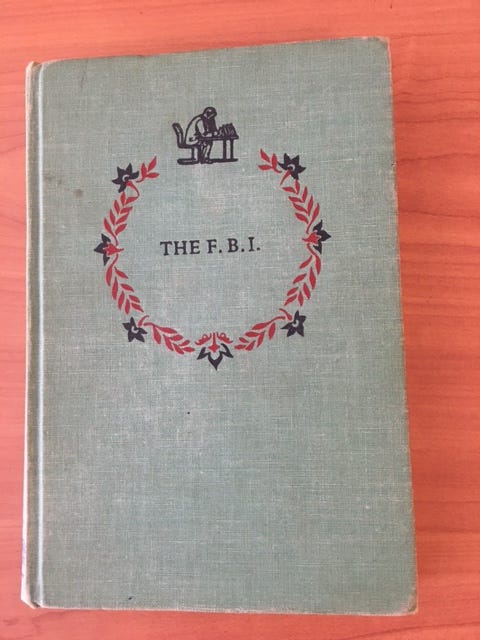
The F.B.I. was written for young readers. Upon its arrival, I devoured the book, swallowed it whole and went back to savor each part bite by bite.
I was already a fan of the T.V. series “The Untouchables.” Weekly, our family sat down in front of our black-and-white GE television to watch Eliot Ness track down a new nest of criminals and bad guys.
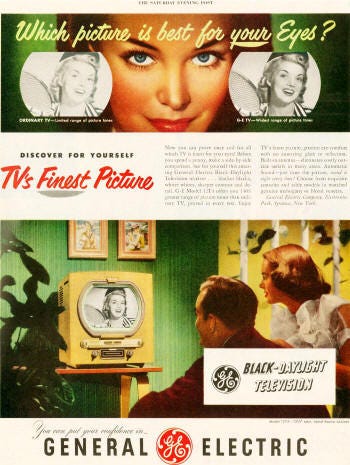
I was enthralled. I wanted to be one of them. One of the guys who snooped around for clues, took fingerprints and solved murders.
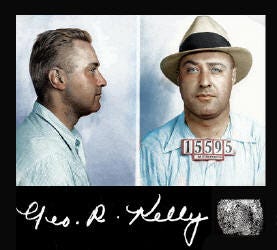
Mom and Dad fed into my true-crime addiction by telling me about the capture of the infamous bank robber and bootlegger, Machine Gun Kelly.
What? Machine Gun Kelly was born in my own city of Memphis and was captured in a house less than eight miles from where we lived. “Just ten minutes from here,” Dad said with a winking grin.
Kelly was the F.B.I.’s “Public Enemy Number One” before he was brought down in the early morning hours of September 26, 1933.
Operating on a tip, George “Machine Gun” and his wife Kathryn Kelly were taken into custody by FBI agents and the Memphis police.
At the moment of his capture — without his favorite weapon — Kelly cried out, “Don’t shoot, G-men! Don’t shoot!” The couple was tried and convicted of a recent kidnapping and was sentenced to life in prison.
“I want to see the house!” I begged my parents to take me by there on one of our Sunday drives.
We did, and it was a disappointment. The house at 1407 Rayner was ordinary. It was a simple brick bungalow— nothing like I thought it’d be, whatever that was.
But my curiosity was sated.
The F.B.I. was a game-changer for me. I learned about J. Edgar Hoover, the smashing of the Ma Barker gang, and America’s first atom bomb spy.
And yes — there is was! The story of Machine Gun Kelly’s arrest. Hoover said he didn’t want his agents to shoot Kelly unless their lives were at risk. And it described how Kelly whimpered, “Don’t shoot, G-men!”
They didn’t shoot, for they hated to waste bullets on cowardly rats like Kelly. As they handcuffed him and took him away, an agent asked, ‘what’s that you called us, Kelly?’
“G-men,” he replied. “You guys are government men, aren’t you? So I call you G-men for short.” The F.B.I.
The term stuck, and soon enough the media and the public began using the term to describe F.B.I. agents.
The book riveted me and made me restless. I felt Mr. Hoover was speaking from the pages — making a direct appeal.
In the chapter “Who are the G-men?” I read:
How would you like to be a G-man? J. Edgar Hoover is always looking for bright young men to join his department. If you want to be a G-man you must start early. The F.B.I.
Somehow I missed the “bright young men” part and focused only on the “bright young” part.
I was bright. I was young. He’s talking about ME.
He wants us to “start early.”
I can start early. I can start NOW.
One afternoon after reading and re-reading The F.B.I. I climbed into the chair at the dining room table where sat our olive green Remington typewriter.
I was already a proficient typist at ten, and I often sat for hours writing poems and short stories.
That day I wrote a letter to J. Edgar Hoover. In it, I told him I’d read The F.B.I. I explained I was just the kind of person he was looking for to train as a G-man.
I went on to suggest something even bolder. I told him I needn’t wait until graduating from college. He should consider hiring me right away.
I could be a unique asset. Who would ever fathom a person as young as I was as a “secret agent”? A G-man. Under cover I could help with all sorts of cases.
I gave the letter to Dad. To read and to mail.
I’m sure he and Mom got a good laugh over my effort but he read it seriously, and agreed to mail it the next day. The postage would have cost four cents.
I watched eagerly for the mailman to arrive. Several weeks passed. Impatience turned into discouragement.
Had he really mailed the letter I asked him repeatedly? Each time he assured me that he had.
“Honey, Mr. Hoover is a busy man. He may not have time to answer your letter. The F.B.I. is big agency, right?”
I reluctantly agreed, and resigned myself into thinking that maybe someday he’ll read it and respond, but it may be well into the future.
I remained optimistic, though.
One day — six weeks or so later — I received the letter I was waiting for.
My parents were impressed by the official letterhead and the envelope embossed with a shiny seal. It looks presidential my mother remarked.
The letter itself was disappointing. In a sprawling cursive, the handwritten note began, “My dear Debbie.” In one short paragraph Mr. Hoover admired my enthusiasm and agreed I would be a great addition to his department. But I must do exactly as he had done.
In the book it described how J. Edgar Hoover worked his way though college and then attended law school. He didn’t mention law school but wrote I’d definitely need to complete college.
Only then could I apply to the agency. He didn’t address the foolishness of my wanting to become a “child” agent for the organization.
The letter was short but personal. It was complimentary and encouraging. It was a letter anyone would appreciate if they were asking for career advice or moral support.
I tucked away the letter in a special box kept in the bottom drawer of my bedroom dresser. It sat there for years.
Gradually I lost interest in the F.B.I. For a while I considered the field of criminology. The science of forensics fascinated me.
Putting together the clues of a crime to build an incriminating map leading to an arrest or conviction was something I could enjoy.
By the time I entered college I was focused on anthropology and other studies. I was still a true-crime enthusiast but wasn’t pursuing the field as a career.
One day I was having lunch with Mom. We were talking about my social life at college — the sorority, the cute guy in chemistry, my part-time job at Goldsmith’s.
The phone on the kitchen wall rang and Mom gabbed a few minutes with one of her friends. I heard her answer Marion’s questions about how college was going for me.
Mom said she didn’t know what it was I was going to do after graduation. I was still considering several career paths. Not teaching, that’s for sure, I heard her laugh into the yellow rotary telephone.
“She might still be thinking about the F.B.I., though.”
I heard laughter at the other end.
“Like an secret agent or something,” Mom continued. Marion howled through the receiver.
After she hung up I cried, “Mom, how could you! That’s so embarrassing! You know I gave up that silliness years ago!”
That summer I removed boxes of crap from the attic. Mom said to go through stuff I didn’t want anymore and throw it away. The attic was becoming too cluttered and most of that junk was mine.
I came across a box filled with old birthday cards, love notes from high school sweethearts, and other youthful memorabilia.
I spotted the impressive envelope from the F.B.I. I pulled out the handwritten letter by J. Edgar Hoover with its slanting cursive on official stationary.
I recalled Mom’s laughter about my youthful desire to be a G-man.
Scornfully, I tossed the letter into the pile of stuff destined for the trash.
I’ve told this story to people numerous times— and watched them gasp in dismay for throwing out a collectible piece of history. The letter — if sold — could have fetched up to $2,000. Since it was completely handwritten, not just signed, its value was probably higher.
Some suggested the letter wasn’t actually written by him. I doubt that. If someone other than Hoover cranked out responses to people like me they would have had the letters typed and signed.
They wouldn’t have taken the effort to write a letter by hand. Too much work.
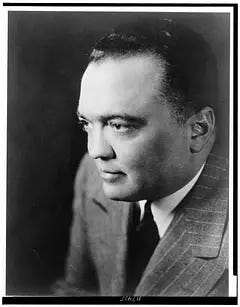
Over time I came to realize what a complex and controversial individual this man was.
In 1924 Hoover became the first permanent director of what was initially called the Bureau of Investigation. Later it was renamed the Federal Bureau of Investigation.
J. Edgar Hoover remained stubbornly in his position for almost 55 years, serving under eight presidents. His tenacious hold on his office was legendary.
Beverly Gage, in her biography, “G-Man: J. Edgar Hoover and the Making of the American Century” states each of the presidents he served were “…either beholden to him, scared of him, or both.”
Gage’s book is a fascinating retrospect of a man who eerily resembles Joseph McCarthy in his disdain of defense lawyers, civil rights leaders, and criminal justice reformers.
Like McCarthy, Hoover was so anti-communist he imagined them crawling from the woodwork. He saw communism as a persistent and unrelenting threat equal only to what he saw as the dangerous rise of left-wing and civil rights organizations.
He also harbored what Gage describes as a “sentimental attachment to the Jim Crow South.”
Rereading The F.B.I. — decades later
Somehow this book survived my childhood — in remarkably good condition. Its sturdy pages, its attractive graphics and its dozen black-and-white photos.
First published in 1954, Mom bought it for me in 1960 in its twelfth printing.
I read this now and can see it for the propaganda it was.
It was clearly a recruiting tool — which wasn’t necessarily a bad thing. But it was also shaded with narrative hinting at certain kinds of bigotry.
It made no bones about what the “ideal” American is: Staunchly conservative, softly xenophobic, and closed to anything not rigidly patriotic.
I didn’t realize reading it the first time there was no mention of women in the F.B.I.
I didn’t know when Hoover was first tapped to lead the agency he fired all female agents and banned the future hiring of women.
Over these years learning more about J. Edgar Hoover has been a disappointment. Although there’s still much to admire, there’s just as much to be ashamed of.
But I’ll never forget the initial joy and excitement about receiving that letter from Hoover. I wish I still had it. I wouldn’t sell it — I’d keep it as a reminder of how my lifelong love of books and learning has lead me down many paths of interest.
If you like my stories and want to read more, please use my referral link! Your $5 monthly membership supports me and other writers on Medium. https://medium.com/@deborah.camp/membership Maybe you’d like to write on Medium and earn a little money too. Either way, here’s my link to get you started: https://medium.com/@deborah.camp/membership


