
I’ve Gone Up “Schitt’s Creek” Without a Paddle — And I Regret Nothing
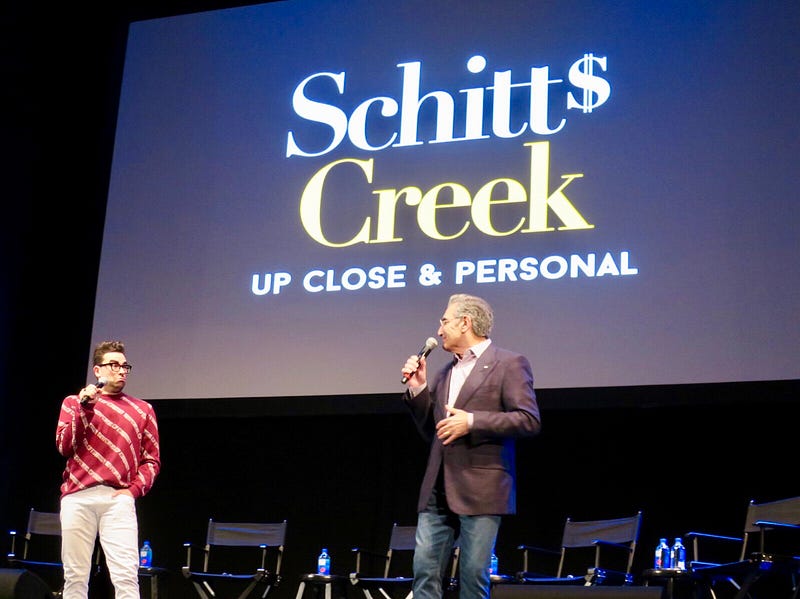
In April, I decided to take a dip in Schitt’s Creek, the Canadian sitcom that has recently exploded into a pop culture phenomenon. I was instantly hooked and managed to finish all 66 episodes in 53 days, just in time to be dazzled by the cast as their “Up Close and Personal” tour hit Hollywood.
[Author’s Note: A follow-up article chronicling the final season and series finale of the show can be found here.]
Last month, I was scrounging for topics while making small talk with my highly esteemed academic mentor at a work dinner. I typically gravitate toward discussing film, television, or music when in such situations, but in the twelve years of knowing her I have only ever heard her reference one piece of popular culture —Downton Abbey (which is fitting because she definitely gives off serious Dowager energy at times). Seeing an opening, I asked her if she had heard about the recently released trailer for the new Downton Abbey movie. “I’ve moved on from Downton Abbey,” she said. “But I have discovered a new show that I just love. Have you heard of something called Schitt’s Creek?”
This is when I truly realized what a phenomenon Schitt’s Creek had become.
Coincidentally, I had not just heard of Schitt’s Creek but had actually taken the plunge just a couple of weeks earlier. I was vaguely aware of its existence for years, but as Season Five aired on the Canadian Broadcasting Company (and PopTV in the US), rave reviews, hilarious GIFs, and celebrity endorsements started filling up my social media feeds. (Let’s be honest, once Mariah Carey endorsed it there was no way I was not going to watch it.)
I wasn’t even done with the first season when I heard that the cast was coming to Los Angeles for their Up and Close and Personal tour and I already knew I had to get tickets. With a commitment to watch all 5 seasons before I saw the live show, I shoved work deadlines and personal relationships to the side and devoured all 66 episodes over 53 days.
And I regret nothing.
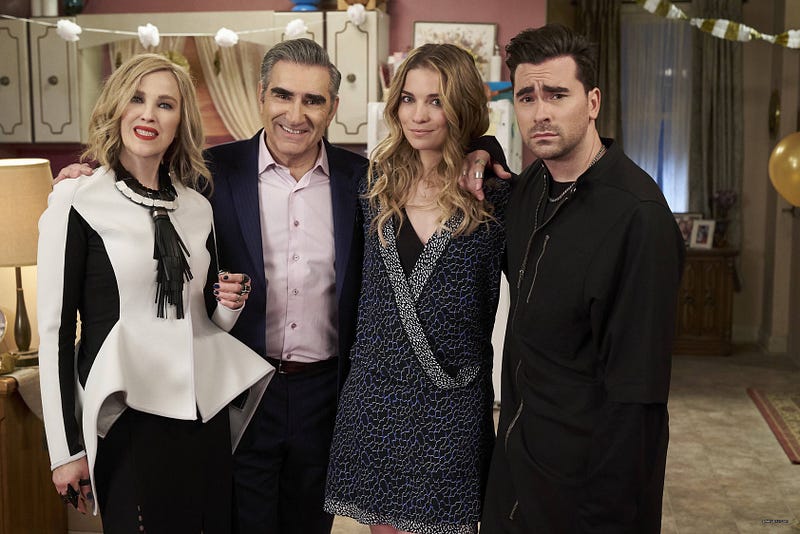
Schitt’s Creek is a somewhat hard show to describe. In concept, the sitcom is part Green Acres and part Arrested Development, with the mega-rich completely out-of-touch Rose family being forced to relocate to a remarkably unglamorous rural town after their business manager runs off with their money and their remaining assets are seized. Well, all of their assets except for Schitt’s Creek — the town Johnny Rose bought for his son David as a joke in 1991.
Despite the clear inspiration of those two shows on Schitt’s Creek set-up, in its execution it captures the spirit of something more akin to The Office and Parks and Recreation. Like those shows, it has a large ensemble cast of brilliant character actors who bring quirky, nuanced creations to life in episodes that are leisurely paced, making room for awkward silences and plenty of emotion.
The Inhabitants of Schitt’s Creek
The show’s cast is headed up by Eugene Levy, the gifted comic actor perhaps best known for his roles in the American Pie films and Christopher Guest’s delightful mockumentaries. He plays Johnny Rose, the exasperated businessman who is struggling to suppress his utter rage and disappointment over his current situation. It is an interesting choice to have such a familiar and talented comic actor playing more of the straight man, but it is a choice that works.
As his vain, semi-delusional, former soap star wife Moira, the brilliant Catherine O’Hara gives a performance that truly must be seen to be believed. The vastly underrated actress, who starred alongside Levy in several Guest films and also has big screen credits featuring blockbusters like Home Alone and Beetlejuice, gets what may just be the role of her career. With her 100% commitment to the utterly absurd faux-posh accent and avant garde look (complete with a wig collection that would be the envy of any pop diva), she gives one of the most inspired comic performances in recent television history.

As their son David, co-creator Dan Levy (who is also Eugene’s real-life son) plays a trendy, high maintenance pansexual art curator whose vanity and snark belie a profound loneliness and insecurity. David is a singular comic creation from the series’ opening frame, but as the show progresses and his character deepens, Dan Levy proves to be a revelation.
Dan Levy is matched by his onscreen sister Alexis, played by Annie Murphy. Initially, the Instagram-ready heiress persona is a bit one dimensional, but before long the vapidness and vanity becomes balanced out by complex and charming nuances imbued in the character by Murphy and (of course) the gifted writing team.
The quartet would only be suitable for a zany, Arrested Development-style farce were it not for how beautifully they are balanced out by their new neighbors. David is brought down to earth by acerbic motel clerk Stevie, who in the hands of Emily Hampshire becomes so much more than a quirky supporting character. She matches every caustic comment delivered by the Rose family beat for beat while also wordlessly giving us a glimpse into her soul with her rich nonverbals. Alexis is humanized by her attraction to Mutt and Ted, two genuinely good local guys with whom she gets into a love triangle. In addition to humanizing each other with their surprisingly functional marriage, Johnny and Moira are matched by Roland and Jocelyn Schitt, the town’s first couple. Although Chris Elliott’s Roland veers toward grotesque caricature a bit too much (especially in the first season), Jennufer Robertson’s Jocelyn accomplishes the complete opposite — she imbues so much dignity into what could have been so horribly one-note. (And then there’s Karen Robinson’s perpetually unimpressed Ronnie, who is perhaps the most underrated of the whole ensemble.)
The Evolution of Schitt’s Creek
The show starts off strong in Season One, with each episode having a clever set up, genuine laughs, and engrossing character development. However, the show never truly finds its ideal pacing, with scenes that run on a bit too long, and scripts that lack the tightness of the truly great single camera comedies that have emerged in the past two decades. It’s a solid first season, no doubt, but when it wraps it is unclear what direction it is headed in terms of quality. After all, when a sitcom is born with a quirky premise like Schitt’s Creek, they usually go one of two ways. The most common is that once the novelty of the premise wears off, it becomes readily apparent that the show wasn’t built to last. The decidedly less common outcome is that the show grows beyond its jokey and novel premise and becomes something deeper, richer, and more expansive than one ever imagined it had the potential to. That is the case with Schitt’s Creek.
The second season improves on the first in nearly every way, with the most notable being the shifts in tone and deepening of the characters. The first season had a sharp-edged snark that resulted in some characters being one dimensional and the show working through a far-too-familiar “fish out of water” sitcom set-up. But in the second season, the show gets a stronger sense of identity and it all becomes more heartfelt. We see Johnny struggling to retain his prowess as an entrepreneur and becoming genuinely concerned over the well-being of his family. We see Moira overcoming her prejudices to connect with the townspeople and see the insecurity beneath the vanity. We see David confront his loneliness, get his first real job, and even have a touching emotional awakening toward the end of the season. And perhaps no character grows more drastically than Alexis, who we see navigate a complicated love triangle with surprising sincerity, confront her fears of being alone, and find a higher purpose as she, too, gets her first job. We also see the bonds between the Roses and the community grow more intricate.
Against all odds, the third, fourth, and fifth seasons each successively improve on the quality of the prior season. It’s an almost unheard of trajectory for a television comedy and, interestingly, it is not accomplished by major plot twists or cast changes. Each season of Schitt’s Creek continues the series’ upward trajectory by doubling down on everything that made the second season such a strong improvement over the first. Each character gets wonderful arcs, with David starting a business and beginning a relationship with a man named Patrick (Noah Reid) who ends up changing his life. Moira joins the town council, attempts to deepen her connection with her children, and struggles to revive her long dormant acting career. Alexis finishes high school, starts a business, finds love, and learns to care about things other than herself. Johnny eventually moves more and more to the side, being a constant and vital presence but not one who typically drives the plot or the comedy. And then there’s Stevie, the unofficial fifth Rose family member, whose emotional development culminated with her taking on the lead role of Sally Bowles in a community production of Cabaret in Season Five.
The Magic of Schitt’s Creek
By the end of Season Five, Schitt’s Creek no longer feels like a quirky comedy with a cult following. It feels like a fully formed television series that has finally found its perfect balance of edgy humor and unabashed sentimentality. That’s part of what made it so heartbreaking when Dan Levy announced that the upcoming 6th season would be its last. I understand the desire to go out on top and on your own terms, but I am not even close to letting go of the show.
A large part of the reason that Schitt’s Creek has developed such a passionate fan base — and appears on the verge of becoming an all-out phenomenon — is less about the laughs it elicits and more about the heartstrings it tugs at. Many shows match Schitt’s Creek on a laughs per minute metric, but few can make viewers swoon and sob to the same degree. There’s the time Johnny and Moira pick the Schitts over the snooty friends from their former life. And when Alexis graduates and her mother’s a capella group unexpectedly shows up and serenades her. And then there’s pretty much any scene involving David and Patrick’s courtship, including — but not limited to — a rendition of Tina Turner’s “The Best” that marks one of the finest musical moments in modern television history.
As if the big laughs and surprising emotional depths Schitt’s Creek were not enough, the show also provides rich yet subtle cultural commentary at nearly every turn. The Rose family represents the absolute worst of the 1%. They are vain, disillusioned, and utterly disconnected from reality. However, rather than make them the target of humiliation the show thoughtfully explores the myriad costs of their extravagant former life and the intriguing mixture of heartbreak and liberation that their fall in status provides. And rather than depict the Schitt’s Creek denizens as simpletons, they are fully formed characters with big hearts and sharp wit. The result is one of the most humane portraits of small town life a television comedy has served up in ages. (Although, it’s never actually clear where this small town actually is…)
And then there’s its quietly revolutionary full-on embrace of queerness. David is pansexual — and even though very few people get it, they are okay with it. David isn’t the quirky side character, he quickly becomes the main character who all the straight characters provide support to. David struggles emotionally, but for reasons far more complex than the challenges inherent in his minority identity. And David finds love with a man in a soaringly romantic, witty, and complicated courtship that provides arguably the best queer romance ever depicted on a sitcom. The show is never overly heavy-handed with its messages of love, acceptance, and authenticity, but they are readily apparent.
Schitt’s Creek: Up Close and Personal Live at the Wiltern
The fact that Schitt’s Creek has finally become a smash is not just word of mouth resulting from legions of new viewers discovering the show’s past seasons on Netflix (although that certainly played a large part). It is also the result of an elaborate and unique approach to self-promotion. This approach is two fold. The first is that Dan Levy and the show itself have developed into substantial social media presences, dynamically interacting with the fan base. The second is that the cast actually goes out and entertains their fans in person.
The idea of a TV show going on tour is a bit of an odd one (especially when it is not a musical series), but the cast of Schitt’s Creek saw a unique opportunity to cash in on their buzz and connect with their fan base. Despite the lack of a clear template to work off of, they ultimately created something quite special with their Schitt’s Creek: Up Close and Personal tour. I had the pleasure of seeing the show from the third row when the tour stopped in Hollywood at the historic Wiltern Theater on May 25th and 26th. (Both nights sold out.)
The approximately 90 minute show begins with Dan and Eugene Levy coming out to warm up the crowd and introduce the evening. They then bring out their co-stars Catherine O’Hara, Annie Murphy, Emily Hampshire, and Noah Reid. They highlight each of the six characters in succession with a mix of live comedy bits, Q&A, and “best of” clip packages. They also play a lively and amusing Family Feud-style trivia game where the cast faces off against 5 audience members handpicked by Murphy. (The night I was there, the audience wiped the floor with the cast, underscoring how devoted the fan base of the show is.) Then the show caps with a live rendition of one of the emotional highlights of the series, Noah Reid’s acoustic cover of Tina Turner’s “The Best.”
The success or failure of such an endeavor ultimately hinges on whether or not the cast is as funny and charming as the characters they portray. Thankfully, that is the case with the Schitt’s Creek cast. O’Hara and Murphy in particular were interesting to see out of character, as they were more subdued and refined but with no less sparkle. It’s a bit of a shame that they couldn’t bring along more of the cast, but I can see why they capped it at the primary sextet. The capacity crowd was clearly entertained, cheering and laughing consistently throughout the evening.
For me, the evening did its job of entertaining me and deepening my connection to the show. The only down side is that it left me yearning for more. And with no details about when we will expect the final season of Schitt’s Creek, I guess I’ll just have to start back at the pilot episode and see what I missed the first time around.

Follow the author on Medium and Twitter.
Read recent articles by the author about Game of Thrones and Murphy Brown.
[Note: All photos included in the article are personal photos from the event unless otherwise indicated.]


