
I’ve Finally Chopped Down Those (Wretched) Decision Trees
It took me too darn long
I am not a fan of indecision.
My character plays a part. I like to get things done. It bugs me when the first task I get busy with comes from yesterday.
Partly also because I hate wasting time. Of course, this definition is personal. How you think about wasting time will not be perfectly aligned with me.
But I think one of the best management practices is an ultimate time killer.
It encourages unnecessary teetering, and hem and haw.
Heard of the Decision Tree?
Options, Calculations, Expected Results.
How does Decision Tree(s) work?
According to the Harvard Business Review,
“The decision tree can clarify for management, as can no other analytical tool that I know of, the choices, risks, objectives, monetary gains, and information needs involved in an investment problem.”
That is the premise. Now, this is the mechanic.
“Each subsequent alternative course to the right represents an alternative outcome of this chance event. Associated with each complete alternative course through the tree is a payoff, shown at the end of the rightmost or terminal branch of the course.”
The Decision Tree is like a fishbone diagram extending from the principal problem to a list of potential solutions with an attached percentage.
This is the illustration from the same HBR article.
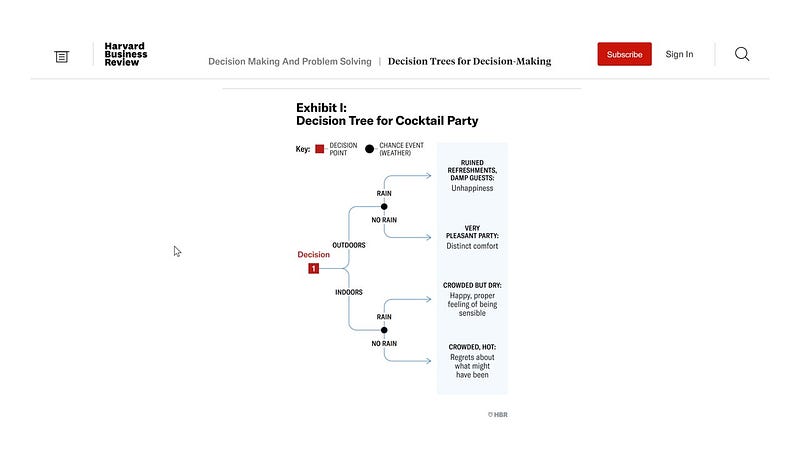
I find this decision-making method too idealistic. On paper, it’s brilliant.
We’ve got all the expected benefits worked out, and we can follow the best course of action as circumstances unfold.
I think it works brilliantly for machines, robots, and software.
For humans? Well. I have my reservations.
If you are surprised… Here’s one question for you.
Have you ever lunched with your colleagues?
The Never-Ending Decision Tree (Just for Lunch)
When I head out for lunch, the last thing I want is to,
- Take forever to get to the lunch place,
- Decide between multiple locations of the lunch venue,
- Consider recommendations coming from all corners of the real world and social media.
This is, to me, a perfect waste of time.
It is as if we have not wasted enough time with our boss during the late morning.
We get stressed, need a break, and pin all our hopes on a good lunch.
Yes, I do that, too. Sometimes, a good bowl of soup perks me up.
What doesn’t, however, is the journey to get there.
This is where we witness the wretched Decision Tree play out in social economics.
“If we walk past, and there is no queue, shall we try out this new café?”
“Oh, restaurants A & B have a new dessert menu! Shall we go to Restaurant A today and then B tomorrow? What do you think?”
“Aldric suggests we drink soup! Okay, shall we have Korean, Japanese, or Chinese? The Korean one has ginseng, the Chinese one is smooth, and the Japanese one comes fast! Which one do you want?”
Okay, look.
I get annoyed with such happenstances.
There are too many decisions to be made in the workplace. Lunch should not be one of them. We think of a place, head there, order, eat, and leave. Period. Why overthink it?
I never understood.
And so, to avoid creating an unnecessary social rumpus… I did the following.
I chopped down the socially driven Decision Tree.
I head for lunch on my own.
Duh!
There Are Many More Decision Trees in the Workplace
Yup, and such trees are planted in,
- The boardroom,
- Meeting rooms,
- Boss’ office.
These trees, often invisible, are present whenever people congregate to speak up, present, propose solutions, and ask for a budget.
You will realize, as I did, that,
- The first 45 minutes of the meeting is a breeze. One person is talking. Many people are sleeping.
- The final 15 minutes is a real chore. The person talking is asking for a definitive answer. The rest of us? We try to sound intelligent without giving our commitment.
What happens next becomes predictable.
We will start playing alternative exploration games.
- “I like option A. But option B seems feasible. Can you elaborate more on B?”
- “I have my doubts on both options. Have you considered this and this?”
- “I like the list of solutions you presented. Can we sleep over it?”
I can see an invisible Decision Tree being planted, getting watered, and taking root in the meeting room right before my eyes. My job is to kill it.
“People, focus. Shirley has presented the situation and the best options she can ever think of. She is looking to us for definitive support. Let’s give her one. Today. Option A or B.”
And you might wonder.
Why rush it?
Simple.
Because we overcomplicate things. I don’t think the decisions made tomorrow will be better than the ones we take today.
It encourages and extends delay.
This is time we can invest to work on the issue or task.
Let’s get to work.
And, and, and.
There is no perfect solution to any issue or proposition. None. Most of the time, we don’t know enough. Uncertainty permeates various aspects of our life.
Why not take a step forward?
We will find our way.
The Close
I am not a fan of extensive Decision Trees.
There is a place for analyzing options. No doubt.
But it should not invite procrastination or group dawdle. These are precious minutes, hours, and days that can be spent on good work.
You (probably) want to take note of the people you are working with, too.
Indecisive folks tend to extend out the Decision Tree without pressing the button.
And chances are, you cannot avoid working with these people.
But. There is a green shoot.
You don’t need to plant that wretched Decision Tree in the meeting room.
Trust me. Just don’t. You work happier.
Enjoy my writing? Consider subscribing here.


