
I’ve Been Somewhere You Haven’t
Unless you’ve been to Nakhchivan, in which case great for you!
How often do you meet a taxi driver who ends up being the coolest dude on your trip?
I’m talking about the unlicensed touts standing at the arrival gates clamoring to pick up a fare. And granting a guy (sarcasm alert) the sought-after experience of being catcalled.
I’m not talking about your Uber/Lyft/Grab/Gojek/Didi or the car your accommodation arranged for you.
My plane landed in Nakhchivan, an enclave of the former Soviet republic of Azerbaijan separated from the rest of the country by Nagorno-Karabakh, a region claimed by Azerbaijan and its neighbor and arch-nemesis, Armenia.
In Baku, the Azeri capital, at Heydar Aliyev International Airport, I went to the wrong terminal. I had only flown internationally. On the other side of a dry patch of land with nothing resembling a road or a sidewalk loomed a rustic aircraft hangar. The domestic terminal. This trip was going to be a little different from Tbilisi, the lovely capital of Georgia.
(This was 2014. Since then, the old international terminal has become the new domestic terminal, and the new international terminal is a snazzy new building that is under-capacity.)
A year ago, upon telling friends and family in California about my plans to move to Azerbaijan, they gave me blank stares. A few months ago, upon telling friends and colleagues in Baku, both local and foreign, about my upcoming vacation in Nakhchivan, they gave me the opposite of blank stares.
“Are you sure?”
“Isn’t it dangerous there?”
“Don’t you need a travel permit to go there?”
Yes, maybe, and no. Isn’t travel inherently dangerous? Especially if you’re alone, ignorant of the local language, and sporting a face that sets you apart (funnily enough, that Gradient app keeps telling me I’m about a quarter Azerbaijani).
Before Azerbaijan, I lived in Turkey and Oman. Islamic architecture and dusty landscapes were familiar. Also familiar were taxi drivers waiting to pounce at the arrival gates of any transport hub who inevitably ended up being unpleasant.
One such tuk-tuk driver in Agra, famous for the Taj Mahal, started out friendly enough. Then he demanded a big tip. He also barged into my friends’ hotel room to coerce them into hiring him for the drive from Agra to Jaipur. The guy who drove me from Amman to Petra lied about the buses. The two on the drive from the airport to the city center in Almaty were total crooks.
Taxi drivers get a bad rap. In their defense, my driver in Cairo was a great guy, but he had a working relationship with my hostel.
Jason (not his real name) stood among the drivers first in line at the arrival gates of Nakhchivan International Airport, a title earned mostly through flights with Iran.
Somehow, I made the correct decision of choosing him to be my driver. Well-built but not very tall, he seemed trustworthy without being intimidating. We communicated in a mix of bad Azeri and worse Russian, which I would not come to speak until I moved to Moscow years later.
Unsurprisingly, on the ride to the hotel, as we cruised through a city not nearly as dusty as I had imagined, he offered to be my guide.
Surprisingly, when we arrived at the (admittedly swanky-looking) hotel, he went inside without me, asked about the prices, came right back, and told me a hundred dollars a night. Way too pricey, he said. I agreed. He took me to a decidedly less swanky hotel that charged a decidedly more attractive price.
He probably got a kickback from the owner. I still appreciated the effort. On the third day, when we went to Ordubad, an enchanting village of sun-bleached buildings that brought me a beguiling sense of peace, he paid for my lunch.
Before that, we visited Noah’s Mausoleum, located a bit outside of town, where the landscape got pretty dusty pretty fast. The next day we went farther outside of town to Snake Mountain, which looked more like Stegosaurus Mountain to me. We climbed to the top; it’s a popular pilgrimage for most locals.
After the mountain and some tortuous roads up another mountain, we happened upon a structure, a temple perhaps, not featured in my guidebook. Jason puffed out his chest in pride.
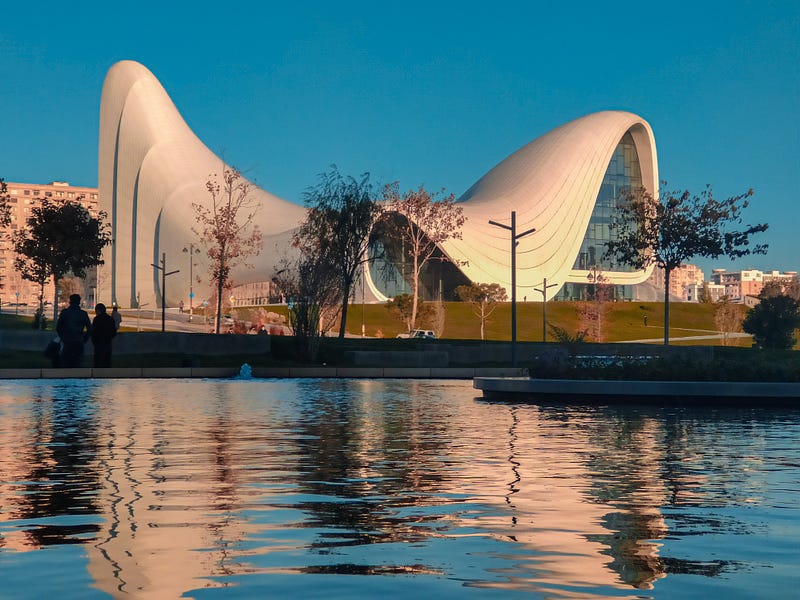
Within the city, we visited the Heydar Aliyev Museum, which commemorates the founding father of the modern nation of Azerbaijan. He’s from Nakhchivan. Being the only foreigner, I got treated to a free and private English-language tour led by an attractive Azeri girl (more on that later).
The Carpet Museum in Heydar’s native city is more modest but more substantial than the equivalent in Baku. Azerbaijan and Iran share a history of expert carpet-making.
When Jason dropped me off for the last time, he appeared embarrassed to talk about money. We chatted for a bit, and I finally paid him. The price was fair. I hadn’t known what it would be. It was the reverse of haggling. I almost wanted to pay him more.
Not all Azeri taxi drivers are nice guys. One from Heydar Aliyev International Airport tried to gouge me.
Jason gave me his number, and I passed it on to a fellow expat who later decided to spend a few days in this seldom traveled corner of the world. As special a place as Nakhchivan is, Jason is the part of the journey I remember most.
Would Jason have been the coolest dude I met in this enclave if we had met somewhere more commonly frequented by travelers? Somewhere not perceived as off the beaten path even by compatriots?
On that note, even my wife’s family, upon hearing I’d made a trip to Nakhchivan — oh, my wife is a Russian-speaking Azeri (not the museum tour guide), but that’s another story.


