It’s Your Hour, America
The whole world is watching
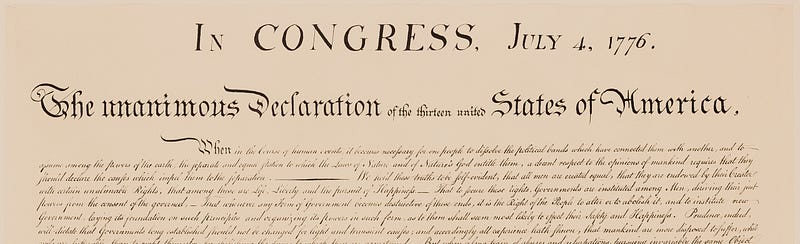
We hold these truths to be self-evident, that all men are created equal, that they are endowed by their Creator with certain unalienable Rights, that among these are Life, Liberty and the pursuit of Happiness. — That to secure these rights, Governments are instituted among Men, deriving their just powers from the consent of the governed…
It was many years ago. Washington DC was covered in snow — a new experience for this young Australian on her first visit to America — and I picked my way along the Mall to the Archives, careful to keep my balance in this strange and slippery world of whiteness. I’d gone from the middle of a baking Australian summer to a city of snowy parks, icy sidewalks, and frozen rivers in a single day of travel, and it was a whole different world.
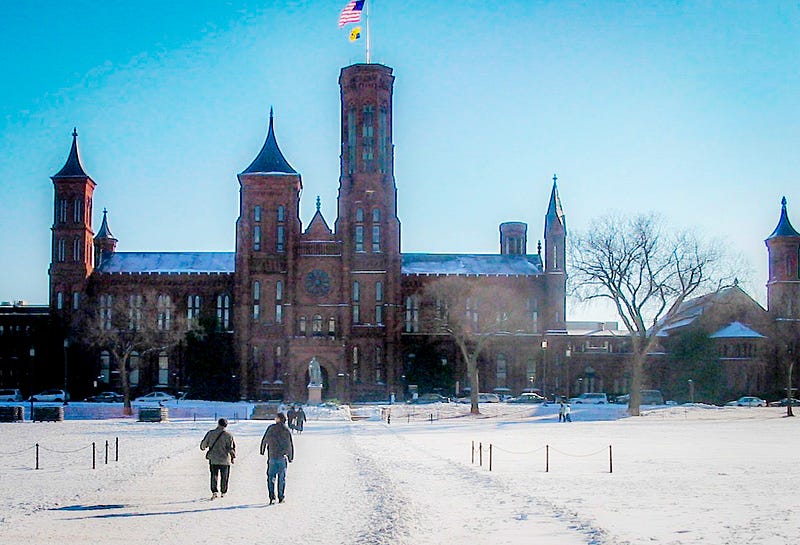
I entered the “Rotunda of the Charters of Freedom” where a handful of tourists looked at the Declaration of Independence, the US Constitution, and other significant documents.
The hall was arranged to handle thousands of visitors daily, such as school groups shuffling past so each student could look for a precious moment at the birth certificate of a great nation. This was history — vital, iconic, important, lasting — right here, and I had it almost to myself for as long as I wanted. And I could take photographs — flash off — which I did.
I was impressed and uplifted. On my way out, I bought facsimiles of the Declaration and the Constitution. I still have them somewhere, fifteen years later, and I value them highly. As souvenirs of a memorable trip, the first of so many I have made to America that I have lost count, and of an inspiring experience.
The flaw in the ointment
Even then I could be cynical enough to see the mythmaking at work. Something I was happy to go along with, because America holds a special place in the English-speaking world’s cultural makeup. The grand buildings and memorials and exhibits in the national capital tell a story, packaged and presented for millions of visitors, and labeled with keywords. Freedom, Democracy, History, Enterprise, Discovery, and so on.
It was American advertising at its finest, but there were people sleeping on the streets. In the snow. Bundled up in bus shelters or in nooks amongst park buildings. There were beggars living on the capital’s avenues, here in the heart of the richest nation on earth.
They were all Black people. As were the taxidrivers, and the cleaners, and the servers.
Washington DC was a snowy white city in more ways than one.
But the packaging says different
“…all men are created equal…” the words of the founding document declare, in phrasing which is known around the world, two hundred and fifty years on. And yet, the men who put their names to these “charters of freedom” owned slaves.
Thomas Jefferson, who drafted the Declaration of Independence, and served as the Governor of Virginia, Minister to France and later Secretary of State under Washington, Vice-President under Adams, and as President in his own right for two terms, derived considerable advantage from slavery. Slaves worked his fields, laboured in his workshops, and served in his house. Children were whipped for discipline, and his sexual relationship with his slave Sally Hemings was well-known at the time and documented through DNA later.
Sally, the Black half-sister of his own dead wife, was a child of 14 when she entered Jefferson’s household in Paris as a maid to Jefferson’s daughter Polly. Thomas Jefferson was 44. Although under French law Sally could have remained in Paris as a free woman, she chose to return with Jefferson to Virginia two years later, gaining promises of “extraordinary treatment”. She was pregnant at the time, and neither she nor any of the six children born to her in America were ever forced to hard labour, and all gained their freedom as adults.
Jefferson regarded his ownership of slaves as not only providing the labour that ran his plantation and paid for the expenses, but produced a 4% annual profit through their offspring.
That profit kept the enterprise of slavery going across the country. The children of a female slave were also slaves, and the legitimate property of her owner; as well as also being in many cases the illegitimate offspring. The fruits of a woman’s womb were not her own, and kept the whole thing running for generation after generation.
As a woman…
Let me at this point lodge a protest against that “…all men are created equal…” phrasing. What about women?
Sure, it is the wording of the time, but while these American Founding Fathers were creating the first modern republican democracy, rebelling against their king, and proclaiming all manner of unprecedented inspirational innovations, they did not see fit to make any commitment to liberating women. Not even in the language they employed.
Or abolishing slavery. Sally Hemings, as a member of both groups, was very much a fourth-class citizen. In fact, in the eyes of American law, she could not reject the sexual advances of her owner. Imagine that. Thomas Jefferson, a high member of the federal government, could have non-consensual sex with a child and it would not be rape. All that was asked of him was discretion.
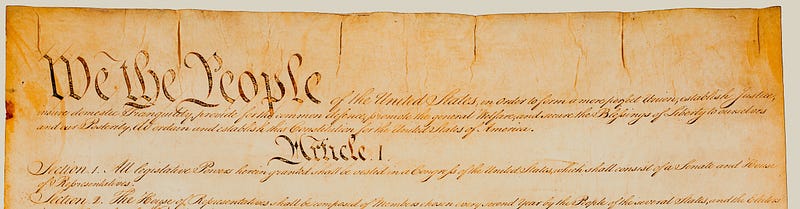
The Constitution
While Jefferson was enjoying himself in Paris, the United States replaced its initial unwieldy Articles of Confederation with a constitution. Jefferson would surely have had a hand in drafting it, but he was busy in France, helping Lafayette draw up the Declaration of the Rights of Man and of the Citizen which was adopted the month after the Bastille was stormed.
The famous Three-Fifths Compromise in the Constitution determined slaves as being not quite the equal of a White person in calculating representation in Congress. All men are created equal, but were not counted as such when it came to the crunch.
Created the month after the French Declaration, the Bill of Rights was a series of amendments to the United States Constitution, based around the same premise; that some of these inalienable rights of men needed to be codified and given the protection of fundamental law. These rights are familiar enough: the right to freedom of expression, protection against unreasonable search, the right to a jury trial and so on.
The founding documents of the United States proclaimed a host of noble ideals, and carried out the promise of many of those lofty statements. Every American schoolchild can list the high points.
But they fell short on the equality promised in the Declaration of Independence, and without equality, the rest held no force.
Sally Hemings, product of two generations of mixed-race pairings, was three-quarters White and fair-skinned. Her children fathered by Jefferson were able to pass for White, but they were legally slaves at birth, and in practice few if any of the protections accorded by the nation’s primary documents applied to them in that state. The inalienable right of liberty proclaimed in the Declaration of Independence was notably lacking.
Abraham, Martin…
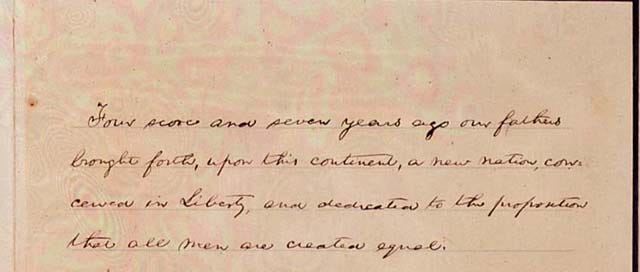
Lincoln, the great Civil War president, gave many inspiring speeches, but he is best remembered for the relatively short Gettysburg Address, which begins,
Four score and seven years ago our fathers brought forth on this continent, a new nation, conceived in Liberty, and dedicated to the proposition that all men are created equal.
I walked along the Mall in DC, that cold January, for I was anxious to meet Lincoln on his grand throne. I passed Washington’s Monument, and there was the Great Emancipator at the far end of the park.
I have often wondered what inspired Southerners to fight. Certainly, the upper classes of Southern society were slave-owners and depended on the labour and the profitable increase of their human possessions for their wealth and status. These were the politicians, the generals, the officers of the Confederacy.
But the rank and file of their armies would have owned precious few slaves. Why would they risk their lives and endure danger and hardship for a cause which could not benefit them at all? Were they fighting for the notional right to be slaveowners?
It was a puzzle, at least until I learned more about how human beings regard themselves and others.
Some of us like to hammer out a niche of comfortable thought to cement ourselves into the structure of the world. Here are the rules which bind us, there are the old, the wise, the teachers, the leaders. Over there are the children, the infirm, the enemy, the others. And here we are somewhere in between where we have sorted out the structure and nailed ourselves into it.
Some of us like to have people to dominate and abuse because we imagine — through some quirk of birth or geography or culture or appearance — that we are naturally better than they.
India constructed an elaborate caste system, but you will see the same sort of pecking order in any large group. Often it is completely artificial and nonsensical. Say my local sporting team deserves my support because it is local, not because it is better or more capable or worthy. And we hurl abuse and demean the opposing team because they are not our team.
I have never, in all my travels around the world, found that humanity is naturally ordered along any lines of merit or value. Everywhere I travel, I see individuals who are clever, or artistic, or wise, or loving, or honest, or any other human trait you might care to name. The colour of their skin or the language they speak has no bearing.
But there are those among us who want to have somebody to dominate, so that even if we are not successful or happy or wise, we have somebody more wretched and we may contrast our state to theirs and feel that we are superior beings.
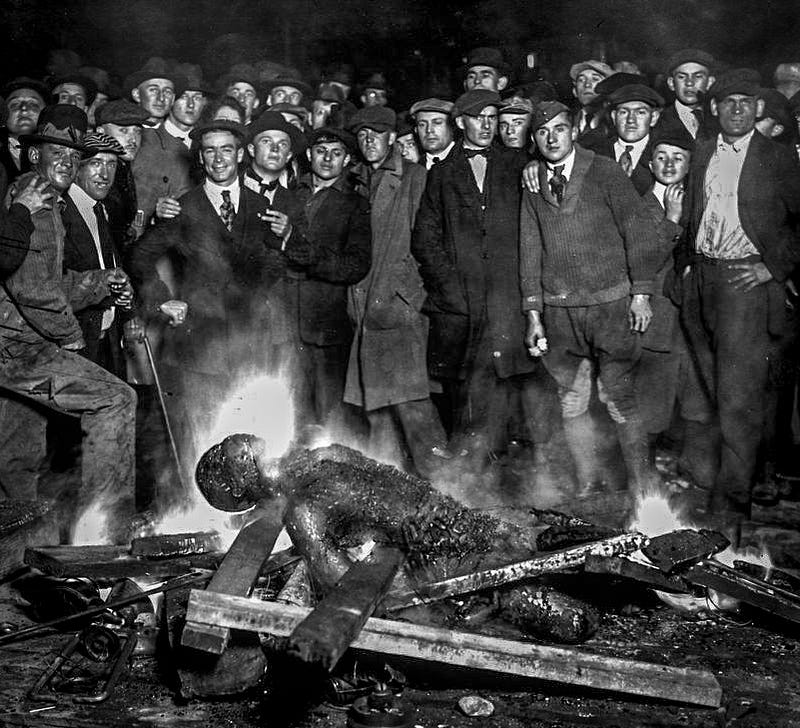
I do not subscribe to such a view myself, but I can see the principle at work.
Read the history of the United States and you will find this sort of stuff all the way through:
The blacks are immeasurably better off here than in Africa, morally, socially & physically. The painful discipline they are undergoing, is necessary for their instruction as a race, & I hope will prepare & lead them to better things. — Robert E Lee
“However much it is denied, however many excuses are made, the hard cold fact is that many white Americans oppose open housing because they unconsciously, and often consciously, feel that the Negro is innately inferior, impure, depraved and degenerate. It is a contemporary expression of America’s long dalliance with racism and white supremacy.” — Martin Luther King
The American Civil War was fought on the issue of slavery, whether it was because of the financial and other benefits to their White owners, or the desire of the citizens of the Southern states to have a class that was legally inferior to them.
Abraham Lincoln freed the slaves, although the amendment to the Constitution enshrining this was not ratified until after his assassination. His contemplative statue looks out over the capital city of the nation he preserved, and he is seen as a president who sought unity over division.
His memorial is, understandably, a place where the noblest of American ideals are celebrated, and as I climbed those icy marble stairs, I found words engraved into one of the steps, marking the place where Martin Luther King delivered his “I have a dream” speech to an audience that packed the Mall.
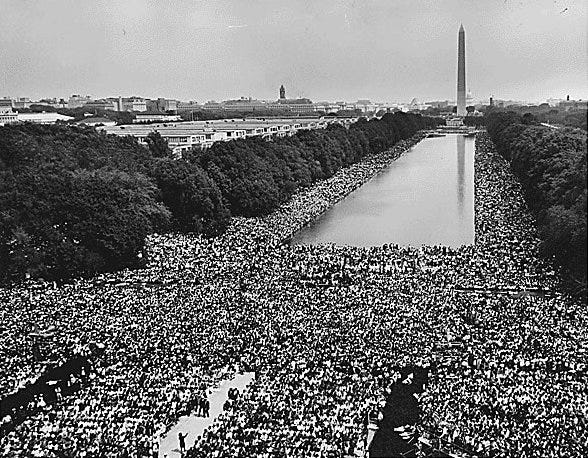
There were chills running up my spine that had nothing to do with the temperature.
I still have a dream, a dream deeply rooted in the American dream — one day this nation will rise up and live up to its creed, “We hold these truths to be self evident: that all men are created equal.” I have a dream … — Martin Luther King Jr. (1963)
King explicitly referenced the words of the Declaration of Independence, Lincoln’s Emancipation Proclamation, and the Gettysburg Address. His speech in 1963 redefined the American dream. It is not a dream of a house in the suburbs with a two-car garage. It is a dream of equality and freedom, at one with the highest ideals of those who made America.
…and John
The next day, I visited Arlington across the frozen Potomac. I had never seen a frozen river before, and this daughter of the Australian summer gazed at it in wonder.
The cemetery at Arlington, surrounding the old home of Robert E Lee, is where America lays to rest those who have given their lives in the military service of the nation. The rows of gravestones stretch out down the hillside, and the buildings and monuments of Washington DC rise beyond.

An eternal flame burns here, and a guard stands watch over the grave of John Fitzgerald Kennedy. He was assassinated a few months after King’s famous speech, and Kennedy had some words of his own on that topic.
I hope that every American, regardless of where he lives, will stop and examine his conscience about this and other related incidents. This nation was founded by men of many nations and backgrounds. It was founded on the principle that all men are created equal, and that the rights of every man are diminished when the rights of one man are threatened. — John F Kennedy 1963
America lifted itself up in the Civil Rights movement of the Sixties. There was a national conversation, there was controversy, and there was law to bring the nation towards unity and equality.
John Kennedy and Martin Luther King were leaders on that road, and neither of them were allowed to complete the journey.
The message of fear
From the very earliest days of the American republic, fear defined the subject of race. Fear of a slave uprising. Fear of financial loss if these valuable assets simply walked away. Fear that White women would be soiled by congress with Black men. Fear that property values, living standards, moral values would be diminished if Black families moved into White suburbs.
We see similar fears being whipped up today, used as a political message in an election campaign.
In reality, these fears were never truly justified. The real fear lay on the other side, where rape and violence and death was and is an everyday event for Black Americans. Today, the most deadly five minutes of a Black person’s life are those immediately following a traffic stop.
Lower down the scale of fear, fear of financial loss is an everyday reality for those whose salaries are lower, living conditions more wretched, risk of imprisonment and illness far higher.
Fear defines electoral systems. Across America, Black people find that their legal right to vote is often infringed and its effect diminished. Obstacles to registration and voting are raised through ID requirements, holding elections on a workday, limiting registration and voting places. Votes are diminished through gerrymandering and disproportion. The Electoral College skews voting power away from urban centres.
That unjust Three-Fifths policy may have gone the way of slavery, but census results to determine representation in Congress are being manipulated to the present day.
Democratic equality remains a distant ideal.
Likewise Liberty. America today has far more of its own citizens imprisoned that the Soviet Union did under Stalin and the Gulag system. And — here’s a surprise — Black Americans are over-represented in America’s vicious gulags.
Four Presidents
Thomas Jefferson drafted the Declaration of Independence, with its lofty statements about Liberty and Equality. And yet he treated other human beings as subhuman possessions. He lived a long and comfortable retirement in his country mansion.
Abraham Lincoln freed the slaves and restored the Union. He was shot and killed.
John Kennedy supported liberty, equality and democracy. The world watched him and listened to his speeches. He helped to bring Black Americans their civil rights. He was assassinated as well.
Don Trump is running for re-election. Americans may decide for themselves whether he is worth their support. I will, however, note that the whole world is watching with keen interest.
Now is the hour
Americans have a choice. They may choose to heed the declarations of the Founding Fathers and make progress down that long road to Life, Liberty, and the Pursuit of Happiness.
Or they may listen to those preaching fear and vote for that instead.
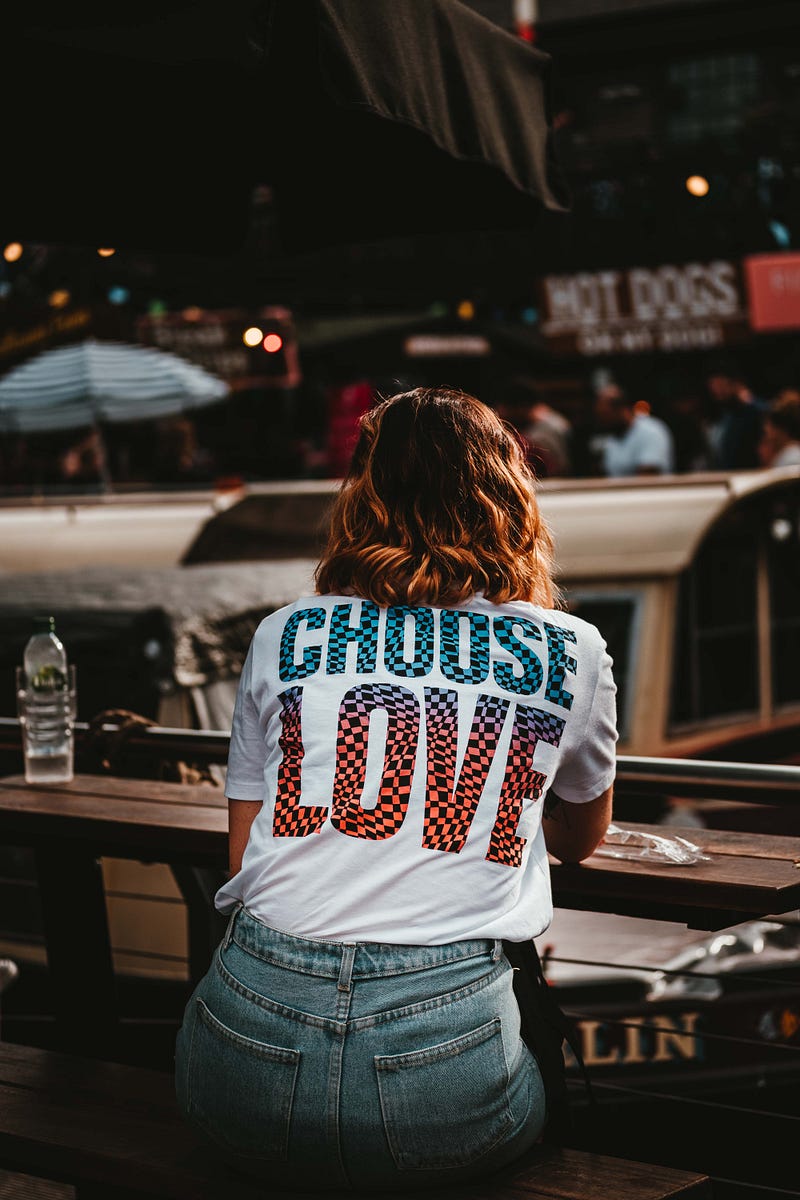
They should be aware that if they vote for progress and high ideals, they should vote for these at every level. We have seen what happens when a president is opposed by a hostile congress. There is very little progress.
If I were voting in America, I would choose Black candidates, and I would choose female candidates. I am biased, I know, but it seems to me that ordinary Americans, in choosing rich old White men, have seen their own power and fortune diminish while those that have wealth and power already gain more of the same.
Those Americans who are untainted by privilege are well aware of the dimensions of inequality, injustice, discrimination, and humiliation.
If it were in my power, I would take those I saw sleeping in the snow, driving the cabs, cleaning the tables, sweeping the floors, and I would say to them,
Your nation’s founding documents give you the right to be heard, the promise of equality, the dream of freedom. You understand America’s problems in a way that billionaires cannot. You have the power for change.
I would put the ability to drive the national conversation in the control of those who have been marginalised. I think that this conversation would turn to the ideals laid down in America’s fundamental documents in a way that would inspire the world.
As America once did, before becoming a laughingstock and sad humiliation.
This year of 2020 has been a nightmare for America and the world. Look up, America. The dream is there. All you need do is follow it.
For myself, I’d love to return to America once the current unpleasantness is over and look through the museums, the galleries, the monuments of DC once again.
I’d like to visit an America living in hope and happiness. Not a land of fear and hatred.
But I don’t have a vote. It’s up to you, America.
Britni