
It’s Time We Talk About the Department of Defense
Reminding ourselves to reallocate the nation’s checkbook.
Coyotes near the Golden Gate Bridge. Manhattan without smog. Seven weeks without a murder in Miami.
Welcome to a global pandemic.
With every worldwide tragedy comes with a silver lining. In this case Covid-19 had forced us to take a pause on both the good and the bad.
While we’re stuck at home and at war with a virus, there’s a question brewing in my mind: why aren’t we talking about the Department of Defense?
The DOD, an organization that takes approximately 16% of American tax revenue to operate, is by no means unnecessary. After all, it is the sheer strength of America’s military that can make us an intimidating foe to fight against.
Yet the question of how much is too much shall be brought to bear in mind.
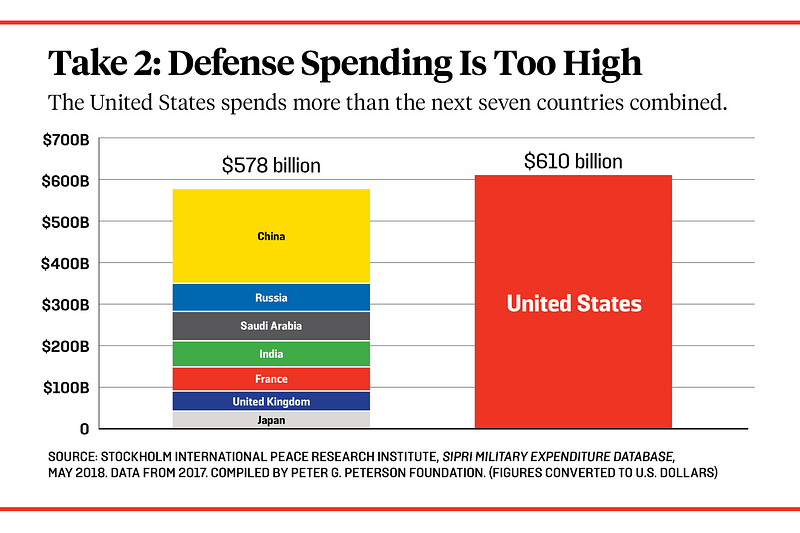
In addition to disproportionately outspending other countries, the DOD has a history of wasteful spending. Yes, other bureaucracies have done this — we are talking about the government after all! But the difference here is scale: incidents of “$125 billion in bureaucratic waste” can only be done via organizations with a deep purse.
Defense has experienced such saturation in its funding, and it partially is at the fault of poor accountability. Don’t believe me? Believe “Andy”, our friend who barely saved you and me money.
“A retired Air Force auditor — we’ll call him Andy — tells a story about a thing that happened at Ogden Air Force Base, Utah. Sometime in early 2001, something went wrong with a base inventory order. Andy thinks it was a simple data-entry error. “Someone ordered five of something,” he says, “and it came out as an order for 999,000.” He laughs. “It was probably just something the machine defaulted to. Type in an order for a part the wrong way, and it comes out all frickin’ nines in every field.” Nobody actually delivered a monster load of parts. But the faulty transaction — the paper trail for a phantom inventory adjustment never made — started moving through the Air Force’s maze of internal accounting systems anyway. A junior-level logistics officer caught it before it went out of house.” — Rolling Stone, March 2019
After spending an extra $400 million to audit the DOD, even that extraordinary amount of cash wasn’t enough to “offer [an] opinion”.
It makes me wonder why I haven’t seen a single thing on the news about Defense. If every other bureaucracy is the kid with their hand up in class, the DOD is the shy student who’s avoiding to be called out by the teacher.
Let’s face it: the worst is far yet to come for the pandemic. In less than three months of being in lockdown and quarantine, we’re examining just the beginning of a depressing path ahead.
“Small businesses went into this recession more fragile than their larger cousins: Before the crisis hit, half of them had less than two weeks’ worth of cash on hand, making it impossible to cover rent, insurance, utilities, and payroll through any kind of sustained downturn. And the coronavirus downturn has indeed been shocking and sustained: Data from credit-card processors suggest that roughly 30 percent of small businesses have shut down during the pandemic. Transaction volumes, a decent-enough proxy for sales, show even bigger dips: Travel agencies are down 98 percent, photography studios 88 percent, day-care centers 75 percent, and advertising agencies 60 percent.” — The Atlantic, May 2020
The sad part about this is that, even with stimulus packages already billed, they are more band-aids than stitches.
If only we used that money for a more robust social safety net.
Again, it’s not mutually exclusive to have the world’s strongest military, the world’s strongest economy, and one day the world’s strongest social safety net all tied into one. That’s one hell of a care package that lasts forever.
But alas it is partisan bullshit and polarized media outlets that prevent us from seeing that compromise turn into fruition.
Just remember that when this is all over. Because once this is over, we shall endeavor a new beginning.


