
I Don’t Want To Hear It
Why do we have to be surrounded by negativity and hate speech towards Black people in film and television? Having reached beyond boiling point, I have taken myself out of the conversation — and you should too.

Typically labelled as some form of biographical drama, when it comes to movies or television series’ about Slavery, the Klan, the end of segregation in the South, or five boys who happened to be in the wrong place at the wrong time etc., I have a spectrum of emotions.
The first is always anger. Pure, white-hot, unfiltered, spewing rage. Justified of course, as I emotionally connect to the carefully constructed protagonist who looks like me and whose story mimics that of someone who lived the images displayed before me. Someone whose situation was manipulated, stylistically shot, cut, and exaggerated to fit into three acts of two hours and fourteen minutes.
This anger somehow takes on a life of its own as it bleeds outside of its designated zone to impact my everyday life. It manifests sporadically and is directed irrationally towards the white male I sneak slit-eyed glances towards on my morning commute, though deep down I know that he doesn’t hold the weight of his race’s oppression towards black people on his shoulders.
A wave of crippling sadness hits next as the reality of the situation settles in; that this was life not even too long ago. If I was born in a different time this could have been my life, if I lived in a different town this could be my life. It’s 2020 and even though slavery was abolished over 200 years ago the unwarranted hatred towards a race of people, the unfairness and injustices, still exist today.
Disbelief, irritation, and finally numbness make up my five stages, not of grief but of circling back to the harsh realities of life until the cycle starts up again.
This impassion towards a piece of fictionalized drama or dramatized non-fiction, is ridiculous to many. Their indignation begins to flare when I state my refusal to watch movies such as 12 Years a Slave or give an episode of something like Underground a chance.
Whilst I, for the most part, choose to separate myself from such media, I ask in return why my Black friends opt for watching a piece of drama where the Black characters are degraded. Their answers like many others are often described in three words. For the culture.
But what culture are we supporting exactly?
Biographical drama’s give us a snippet of history. A clear picture of the past, bringing the more accurate information you can find in a weathered textbook to the big and small screen. History looks at people, places, and events that shaped the present day. Unfortunately, when it comes to Black history the focus is predominantly on one specific event.
With media focusing on Slavery, the Civil Rights Movement, the end of segregation, living in the South surrounded by White Supremacists, Black history feels limited. Though it of course far from.
Like the British and World War II movies, Black people are repeatedly hit over the head with the same, and often worst periods in our history.
Very rarely do I watch anything about the more painfully highlighted parts of Black history. I did, however, in 2019 talk myself round to watching Ava DuVernay’s When They See Us which is a series I am glad exists though I will never watch it again. It shows the pages of Black history are there to turn if we let them turn, to have a fresh take on a prevalent present-day issue.
There is, of course, value and strength in the movies that showcase Black history pre-1900, but I started to wonder; what is the point? Is ‘the culture’ we are to support blindly perpetuating a constant stream and borderline normative behavior of the inequalities and discrimination towards black people?
How much negativity are we supposed to take?
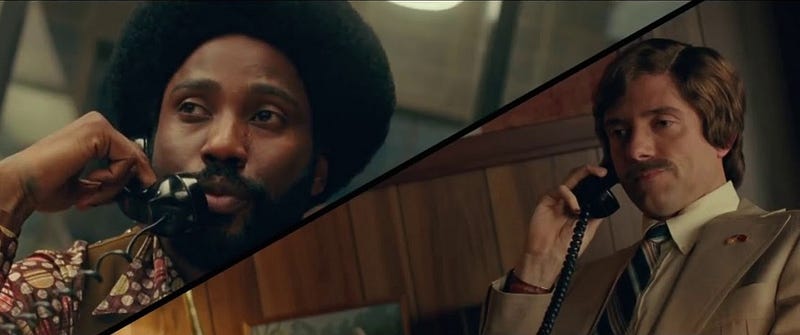
During my annual, A Movie a Day in the Month of May, I decided to see what the hype was about with the 2018 movie, BlacKkKlansman.
The movie looks at the true story of a Black police officer, Ron Stallworth, who infiltrated the Ku Klux Klan in the late 1970s. It is a black comedy from Spike Lee that though told an interesting and untold piece of Black history, I found lacking in purpose and for the most part distasteful.
We had a great way of life until the Martin Luther Coons of this world and their army of Commies started their civil rights assault against our holy white Protestant values. Do you really want your precious white child going to school with Negroes? They’re lying, dirty monkeys, stopping at nothing to gain their equality with white men. Rapists, murderers, craving the virgin white, is it “virgin pure”? — BlacKkKlansman (2018)
The above is a quote from the start of the movie and sets the tone of what was to be expected from the remaining 130 minutes. On and on the slurs and hatred went as I sat bored, watching a group of racists periodically call Black people every name under the sun. There was no anger, no sadness disbelief irritation, or numbness — instead, I reached the sixth level to my emotional spectrum…fed up.
BlacKkKlansman allowed a voice to whisper — what’s the point?
Sure, you could argue that the movie was only ‘portraying a realistic idea of the language and conversations people had at the time’, but what did it pass on to the audience other than a crudely overinflated emphasis on something we already knew?
We continue to clap for staled and oversaturated media that has tied the boundaries of Black history to three specific posts, bordering ourselves in from allowing other content to be created.
No matter the level of wit, satire, or attempt to objectively rise above, newer movies like BlacKkKlansman and Django Unchained envision, in 2020, what purpose do these movies serve the culture who are supporting it.
Though they may not be as instantaneously hard-hitting, for the culture I choose to instead support Issa Rae’s Insecure, Empire, Black-ish, Dear White People. I opt for biographical dramas such as Hidden Figures, Netflix’s Self Made, and The Butler. I support, though I may not watch The Hate U Give, Detroit, or When They See Us.
It could be argued that I am choosing to look away from harsh histories, and refusing to acknowledge the past — but don’t you worry in the present I am all too aware of the injustice that plagues the Black community across the world. From consistent and unchecked police brutality to microaggressions in the workplace.
We need an injection of positivity in the form of inspirational people throughout our history. To teach people to stop equating being Black with needless suffering, that it might be difficult but the journey isn’t always filled with bloodshed, it’s also filled with friendship, love, and just living. There is more than enough media to choose from in regards to our oppression at the hands of others. It’s time to change the narrative.
It’s our responsibility to shift the conversation and show that the roles for Black creatives aren’t boxed into one story type.
Let the culture be having a say in the type of media we actually want to see, not just accepting what we are presented with. We are the ones being depicted on screen, and so we should make sure that a fair number of conversations and stories whether fiction or dramatized non-fiction, are positive.


