
It’s Time to Release Our Own Kraken!
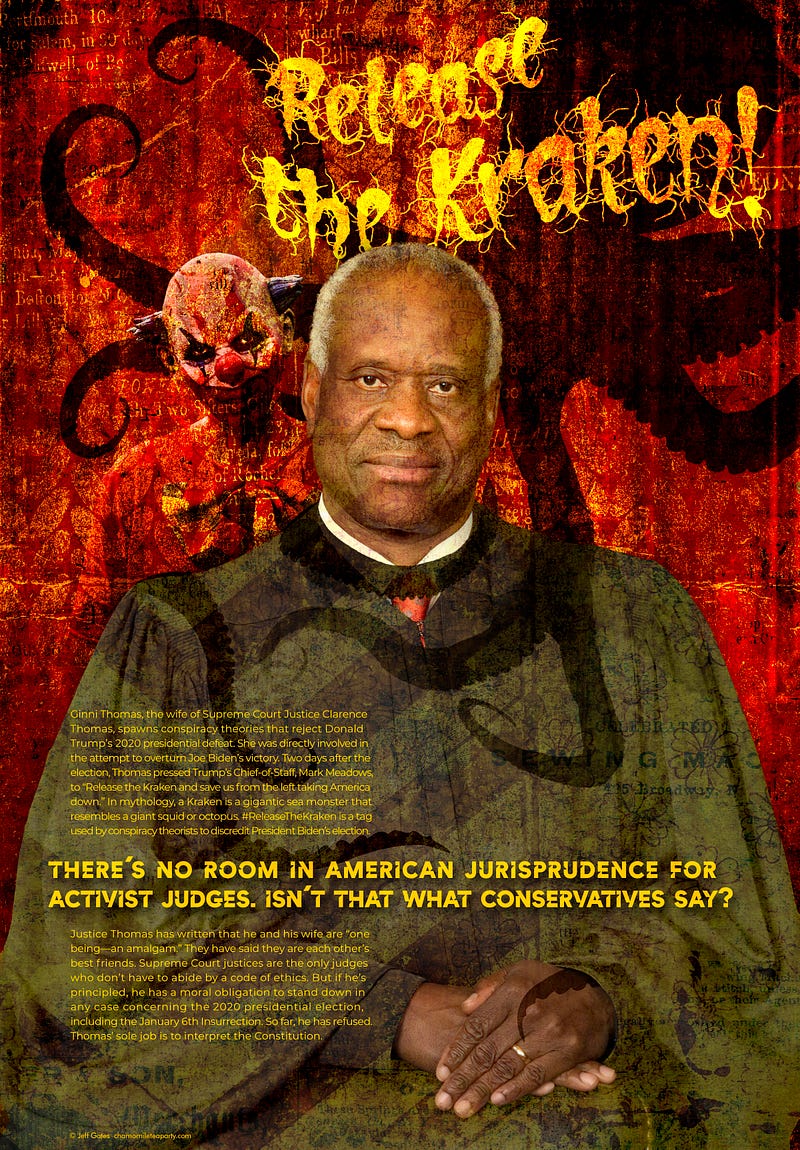
There’s No Room in American Jurisprudence for Activist Judges. Isn’t That What Conservatives Say?
In 2000, my wife and I sat on the edge of our bed watching CNN. The Supreme Court had just announced that time had run out on the weeks-long series of recounts for Florida’s 25 electoral votes. George W. Bush had beat Al Gore and was declared the winner in the state. Bush won the Electoral College and the presidency by one electoral vote. Disappointed? You bet. But I remember thinking, “The office of President is one of compromise. Those around him will temper the effects of his decisions.” I was wrong.
Twenty-one years later, I sat on that same bed watching as Trump loyalists, incited by President Trump and others, stormed the Capitol shouting, “Stop the Steal” and “Hang Mike Pence.” After Trump’s 2016 campaign, his four years of authoritarian reign, and the aftermath, I no longer believed that Constitutional checks and balances would hold back the right. Our culture had changed. In the Republican Party, conspiracy theories replaced common sense and critical thinking. This is the world of Ginni Thomas, the wife of Supreme Court Justice Clarence Thomas. How did we get here?
The Road Downhill: Lee Atwater
We find deceit at every level of American politics. As mass media developed, backroom deals gave way to more public dirty tricks. In the 1980s, Lee Atwater was this strategy’s most prominent disciple. As South Carolina Republican Congressman Floyd Spence’s campaign consultant in his 1980 re-election bid, he released the results of a fake survey aimed at White suburban voters. The survey showed that Spence’s opponent, Tom Turnipseed, was a member of the NAACP. At a press briefing, he hired a fake reporter to say, “We understand Turnipseed has had psychiatric treatment.” Atwater replied that he “got hooked up to jumper cables,” referring to electroshock therapy Turnipseed had as a teen. Spence was re-elected.
Atwater went on to greater notoriety later that decade by suggesting Ronald Reagan could extend the GOP’s Southern Strategy (a racial appeal to White Southerners) without it appearing racial. In an anonymous interview for political scientist Alexander P. Lamis’ book The Two-Party South, he said:
“Y’all don’t quote me on this. You start out in 1954 by saying, ‘Nigg*r, nigg*r, nigg*r.’ By 1968, you can’t say ‘nigg*r’ — that hurts you. Backfires. So you say stuff like forced busing, states’ rights, and all that stuff. You’re getting so abstract now [that] you’re talking about cutting taxes, and all these things you’re talking about are totally economic things, and a byproduct of them is [that] blacks get hurt worse than whites.”
As Atwater’s star rose in the GOP, its zenith was the infamous Willie Horton television ad during George H. Bush’s 1988 presidential bid. In 1976, Bush’s opponent, Massachusetts Governor Michael Dukakis, supported a prison furlough program for felons started by Republican Governor Francis Sargent in 1972. The state legislature passed a measure outlawing the practice, but Dukakis vetoed it. Shortly after that, the state released convicted murderer Willie Horton on a weekend furlough when he assaulted, robbed, and raped a couple.
The ad showed prisoners going through a revolving exit from prison. Only one was African American, and he was the only one who looked directly into the camera. “That’s the guy to be afraid of,” said ABC newsman Sam Donaldson. Atwater used this incident to suggest that Dukakis was too liberal and soft on crime. He vowed to “strip the bark off the little bastard” and “make Willie Horton his running mate.” Dukakis’ seventeen-point summer lead vanished, and Bush won the race.
Slash and Burn: Newt Gingrich
Lee Atwater’s vision was to get Republicans elected no matter what it took. The man who led those Republicans on a slash and burn sortie into our legislative process was Newt Gingrich. Running in his first successful race for Congress in 1978, he told college Republicans, “One of the great weaknesses of the Republican Party is we recruit middle-class people. Middle-class people, as a group, are told you should not shout at the table, you should be nice, you should have respect for other people, which usually means giving way to them.” He admonished the students to “raise hell” if you’re going to be in politics. And during his twenty years in the House, raising hell was precisely what he did.
Gingrich upended the niceties and conventions of Congress. As Congressional scholar Thomas Mann has stated, “Most members still believed in the idea that the Framers had in mind. They believed in genuine deliberation and compromise … and they had institutional loyalty.” Gingrich’s focus was less on legislation and more on tactics to discredit Democrats and moderate members of his party. He did this by ignoring etiquette, sensationalizing issues for TV viewers, and using ethics regulations to spotlight one’s political enemies. “He thought a lot about confrontation and saying things that were explosive because he believed that the more confrontational, the more outlandish you were, the more the media would cover you, and the more the media would replicate what you said about your opponent — whether it was true or not true,” according to Julian E. Zelizer, in his book, Burning Down the House.
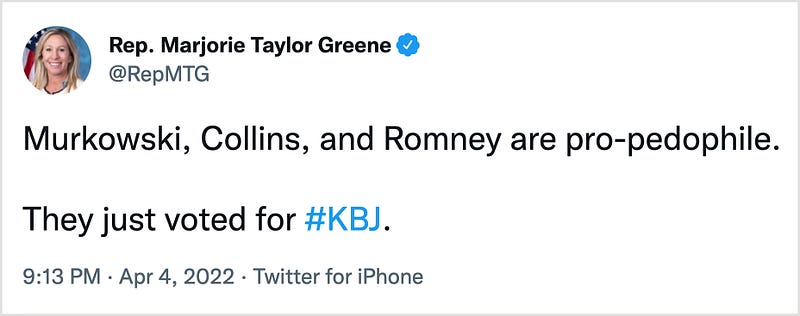
We can credit Gingrich with the “fierce, institution-destroying partisanship” that gave birth to the tactics of the Tea Party and Donald Trump. Newt sent out a memo to aspiring Republican candidates entitled “Language: A Key Mechanism of Control,” in which he listed words for them to use to describe Democrats. They included words like sick, pathetic, lie, anti-flag, traitors, radical, and corrupt. When you hear Trump give people obnoxious nicknames like President Biden’s “Sleepy Joe,” that comes directly from Gingrich’s playbook.
Release the Kraken: The Ginny and Clarence Thomas Story
In our present rarified atmosphere, when laws do get passed, partisan objections often end up on the docket of the Supreme Court. As the ultimate arbiters in legal matters, we hope justices base their opinions on their interpretations of the Constitution. But unlike lower court judges, there are no ethical standards by which they must abide. Each justice determines their own ethics. The only safeguard we have for a rogue justice is impeachment. That has only happened once.
The founders of our country envisioned a court that rose above the politics of the Legislative and Executive branches of government. But partisanship has seeped into the court with justice nominees’ confirmations decided by today’s factional Senate. In February 2022, Justice Neil Gorsuch gave a speech behind closed doors to the Federalist Society, a group of conservatives and libertarians. So what did he speak about? We’ll never know. The Society barred the media from the Justice’s talk. That veil of secrecy only magnifies the aura of politicization, questioning the court’s impartiality.
This is the backdrop to Ginni Thomas’ power and activism. As the wife of Supreme Court Justice Clarence Thomas, she has been a forceful advocate for Trump’s attack on our democratic process. She firmly believes the Democrats stole the election despite a long list of dismissed court challenges to the election results. Former White House Press Secretary Stephanie Grisham confirmed Ms. Thomas’ direct access to President Trump on a recent episode of The View. She said that Thomas would often have lunch with the President, bringing lists of people who should be fired and hired. Grisham described the damage control the staff would have to do after these meetings.
Two days after the 2020 election, Ms. Thomas texted Trump’s Chief-of-Staff, Mark Meadows, to “Release the Kraken and save us from the left taking America down.” In mythology, a Kraken is a gigantic sea monster that resembles a giant squid or octopus. #ReleaseTheKraken is a tag used by conspiracy theorists to discredit President Biden’s victory.
She also texted Meadows, “Help This Great President stand firm, Mark!!!… You are the leader, with him, who is standing for America’s constitutional governance at the precipice. The majority knows Biden and the Left is attempting the greatest Heist of our History.” Also, “Biden crime family & ballot fraud co-conspirators (elected officials, bureaucrats, social media censorship mongers, fake stream media reporters, etc.) are being arrested & detained for ballot fraud right now & over coming days, & will be living in barges off GITMO to face military tribunals for sedition.”
Thomas and Meadows exchanged twenty-nine texts he released to the House committee investigating the January 6th Insurrection. Adam Liptak, who covers the Supreme Court for The New York Times, said, “It is one thing, experts in legal ethics said, for the spouse of a Supreme Court justice to express political views, even ones shot through with wild conspiracy theories. That may not by itself require the justice’s recusal from cases touching on those views. . . . But the text messages from Ms. Thomas . . . revealed something quite different and deeply troubling.” The texts Thomas sent to Meadows clearly showed she was directly involved in the attempt to overturn the election.
So should her husband recuse himself in any case about the 2020 election? Any judge with close relationships with people or institutions associated with an issue should do so. That’s what Justice Elena Kagan did when she ascended to the bench in 2010. Because of her former job as Supreme Court Solicitor General (the court’s chief legal representative to the court and lower appellate courts), she recused herself in 25 of 51 cases during her first term.
Justice Thomas has not recused himself in at least one case concerning the 2020 election. In January 2022, he was the lone dissenter in litigation Trump brought to the Supreme Court to prevent the January 6th Committee from obtaining his presidential records. The US Code of Laws expressly prohibits judges from participating in cases where their impartiality might be questioned. Title 28, § 421(5) states that judges shall disqualify themselves when a spouse is likely to be a material witness. Yet there are no penalties when a Supreme Court Justice violates this law.
The Thomases are very close and share many political views. In his memoir, Justice Thomas wrote that he and his wife are “one being — an amalgam.” They call each other their best friends. If he’s ethical, he has a moral obligation to stand down in any proceeding concerning the 2020 presidential election, including the January 6th Insurrection. If he doesn’t, he should resign or be impeached. Thomas’ sole job is to interpret the Constitution. There’s no room in American jurisprudence for activist judges. Isn’t that what conservatives say?
The System Is Broken. What Can We Do About It?
What can we do when people like Ginni Thomas and Mark Meadows (political elites with direct access to power) strongly believe in these conspiracy theories? Or when our legislators aren’t interested in solving the economic and social issues that affect millions of Americans. This animosity is destroying our country. Having to call for Clarence Thomas’ recusal on cases where his wife is deeply involved reveals a much larger problem.
The Problem
Sixty percent of Americans approve of a woman’s right to an abortion. Sixty-four percent support a “wealth tax” to fund public programs. Seventy-six percent of the public wants to protect LGBTQ rights. Why can’t we have reasonable gun control legislation when 84% of Americans approve of universal background checks (including 77% of Republicans)? The effects of climate change concern 60% of Americans. These issues are under attack or considered unimportant in Republican-run states. Yet the majority of Americans support them.
Negative partisanship is creating an existential threat to our democracy. “In today’s environment, rather than seeking to inspire voters around a cohesive and forward-looking vision, politicians need only incite fear and anger toward the opposing party to win and maintain power.” According to the Economist magazine’s “Democracy Index 2021,” the United States is no longer considered a full democracy. We’re now considered a “flawed democracy.” Eighty percent of Americans have no confidence in our legislators.
In a Princeton University study, Testing Theories of American Politics: Elites, Interest Groups, and Average Citizens, the impact of average citizens’ influence on public policy is near zero when compared to economic elites and organized interest groups. This is the fundamental problem with our political system.
The Answers
RepresentUs suggests that fixing our elections and ending political bribery will restore influence to the American people. Consulting with Constitutional scholars and strategists, they found that 87% of all Americans (no matter their party affiliation) supported an anti-corruption law that would reduce the influence of special interests. Their model, The American Anti-Corruption Act, provides a plan for ending bribery at all government levels, restores the public’s influence over moneyed interests, and fixes our broken elections.
Enact Campaign Finance Reform. The costs of a political campaign are staggering. Congresspeople spend 50% of their day fundraising instead of legislating. Political candidates are beholden to large donors to win elections. In 2020, only 1.44% of Americans donated more than $200 to political campaigns and political action committees. Mega-donors have more clout, while the public has little to none. And with these high rollers come the strings of special interests. Lobbyists ply politicians with money to ensure their support. So, instead of legislating on issues important to most Americans, they pass laws that favor these special interests. Where’s health care reform? Why are drug prices so high, and why is Medicare prevented from negotiating with pharmaceutical companies for lower prices? Because “Big Pharma” makes sure any attempt to change the system will be defeated.
RepresentUs hired Tulchin Research, a polling and strategic consulting firm, that polled a diverse group of Americans on the financial problems with our elections. Their findings are revealing.
While we’re aware of the deep divide in American politics and ideology, voters across the board agreed political corruption is rampant. Instituting reforms is critical to restoring health to our system. Reframing political finance reform as ending political corruption was compelling to poll respondents.
Conflict of interest reforms are most important to voters. The Supreme Court’s 2010 Citizens United decision damaged financial election reform by allowing corporations and other groups to contribute unlimited funds to elections. This exacerbated the advantage that wealthy donors have and increased the use of “dark money” in our elections. The top three anti-corruption measures supported by those polled were: prohibiting politicians from taking money from the industries they regulate, reducing how much money lobbyists can contribute to political campaigns, and instituting clear limits on unregulated Super PACs.
Public Funding is critical to reform. The tax refund and public voucher model was the most supported by those polled. Many local jurisdictions are developing these types of programs. Seattle gives every voter a publicly funded voucher to contribute to candidates. And as the number of jurisdictions using public financing rises, this can eventually have ramifications on the national level.
We should also reinstate a nationwide matching fund program, and institute total fundraising and spending transparency. Former elected officials should be prohibited from working for lobbyists, and legislators should be banned from fundraising during working hours (they’re raising funds on our dime!).
Eliminate Gerrymandering. One of the most egregious misuses of power is gerrymandering. It makes races less competitive and reduces voters’ say. Several states (both Republican and Democrat) are being called to task for gerrymandering after the 2020 census. State courts are forcing both Republican and Democrat-run states to redraw their maps. Only 16% of Congressional districts are competitive (64 districts are still under review). So 75% of elected officials are winning office without having to communicate outside of their own party.
According to Gallup, Independents represent the largest group of voters in America. Yet registered Independents can’t vote in most Democrat or Republican primaries. Nor are third parties invited to take part in presidential debates. Not every vote is equal.
But a different way of holding elections would change that. Using Ranked Choice Voting (RCV), you get to rank your choices for public office. This reduces voting for the “lesser of two evils,” candidates with similar platforms form coalitions, and campaigns become less divisive. Forty-three jurisdictions used RCV in their most recent elections.
We already know that voter participation increases when we make voting more accessible. But look at how many times the GOP challenged automatic voter registration and voting by mail during the pandemic. The party knows that if more Americans vote, they’ll lose support. Even Trump admitted that. In a Pew study, the number of voters in the US was 31st out of 35 developed countries. Full democracies encourage voter participation.
The Electoral College. As our country has developed, we’ve made changes to the Electoral College. We’ve refined the role of electors and allowed citizens to vote for these electors in every state (some states initially gave that role to their legislatures). In addition, we have expanded voting rights (initially, only White male landowners and taxpayers could vote). So the process for electing presidents is not historically set in stone. It’s time to consider making changes that reflect our present society.
Some of our Founders thought that most 18th-century voters didn’t have the resources to make fully informed decisions. So they rejected direct voter participation. They also feared mob mentality relying on the populous to make such an important decision. Today, mass media saturates society with information. And, as for mob rule, the Electoral College didn’t prevent the storming of the Capitol on January 6th.
Our Founders also believed that this system would stop a drawn-out national recount. But look what happened in 2020. Donald Trump refused to accept the results of the Electoral College and filed over sixty suits to overturn elections in crucial states. Eighteenth-Century concerns about the tyranny of the majority (another original reason for the Electoral College) have given way to the tyranny of conspiracy theorists today.
The Electoral College was a compromise when our founders first implemented it. Small states feared the power of larger states. Today, that dynamic has shifted. Now the system emphasizes the role of a few swing states. This means that candidates spend much more time and money in those areas than broadening their campaigns nationwide.
Since our country’s inception, there have been five presidential elections where the loser of the Electoral College received more popular votes. The 2000 election between Bush and Gore and the 2016 election between Donald Trump and Hillary Clinton are the latest examples. Partisan politics would make it an uphill battle to amend the Constitution to change how we elect presidents. So, many states and the District of Columbia have signed on to the National Popular Vote Interstate Compact. They promise to give their electoral votes to the popular vote winner. This provision will go into effect when enough signatories’ electoral votes reach 270, the amount required for the Electoral College to declare a winner. So far, the Compact has 195 Electoral votes. They need only 75 more to implement the pact. But that could be an uphill battle, as the red states fear the voter’s will.
Let’s Not Forget Ginni and Clarence Thomas
Ginni Thomas’ desire to overthrow our government is a clear example of a corroded political system. Justice Thomas’ refusal to recuse himself in cases that are apparent conflicts of interest should concern Americans. Together, their power undermines the foundation of the American ideal. It smacks of special interests and political corruption at the highest levels of our government.
As David Frum wrote in The Atlantic, “Washington has always been full of polarizing people like the Thomases, and always will be. What’s been different in the Donald Trump years has been the complicity and cowardice of the people who should have kept those polarizing figures in check.” My initial expectations about the people surrounding the president (or any government official) were correct. Trust in our politicians demands constant oversight.
It’s time we the people release our own Kraken.
This image is part of a series of posters about the sorry state of American political discourse. Jeff Gates does these under the guise of the Chamomile Tea Party. Download a high resolution copy of this poster for free. In fact, all Chamomile Tea Party posters are free to download under a Creative Commons license.
Follow the history of our country’s political intransigence from 2010–2020 through a seven-part exhibit of these posters on Google Arts & Culture.


