

It’s Time to Embrace Volatility in Investing (If you know what you’re doing).
Risk and volatility are two totally different things — don’t be fooled by traditional investment advice.
What’s safe is risky. What’s risky is safe. It’s time to embrace volatility.
If later you find this article valuable, throw us some Medium love! 🥰 What you can do to support us: Clap up to 50, leave a message, highlight some text if you see fit & be sure to follow. 💌
Safe is the new risky. The old models are broken. The new model is to take charge of your financial freedom by taking risks and embracing volatility.
Conventional investment advice can be misleading and put your investments in danger, especially when people in the investment community confuse volatility with risk.
In this backed-by-data article, we will clarify huge misconceptions regarding risk and volatility.
💡 People overrate the safety of “safe” and overrate the risk of “risk.”
💰 Why are the average investors’ returns so low?
These are four main reasons why investors’ average returns are only 3.6%:
1 — Confusing volatility with risk
2 — Not understanding that: - Investments seen as safe might be risky in the long term; and - Investments seen as risky are actually safe in the long term
3 — Survivorship bias (covered in this article)
4 — Not understanding risk/reward ratios (covered in this article)
Understanding these four concepts will unlock the right investor mindset you might be missing to make truly profitable investment decisions and position you closer to financial freedom.
Now, hold on a second. Am I telling you to blindly discard risk?!
Absolutely not!
I’m not telling you to discard risk and go straight to the casino or to start buying random shitcoins. What I’m saying is that there are a ton of misconceptions regarding risk that even experienced investors continue to get wrong.
💡 Saying this, let’s talk about volatility and risk — one of the big reasons why investors don’t make more money in the market.
⚠️ Confusing volatility with risk
Unfortunately, people use the words volatility and risk interchangeably when they actually mean two totally different things. As a result, people tend to run away from volatile assets because they assume that volatility = risk.
💡 Bitcoin (as well as the stock market) is one of the victims of misreading volatility by risk.
Bitcoin’s volatility makes it risky, right? Actually, that’s a myth!
Let me explain:
- Volatility: Volatility refers to the degree of variation of a financial asset over time. High volatility means that the price can fluctuate a lot. This is usually measured with standard deviations.
- Risk: On the other hand, risk refers to the potential for financial losses. It is the uncertainty that an investment will not achieve the expected return or that it will return losses.
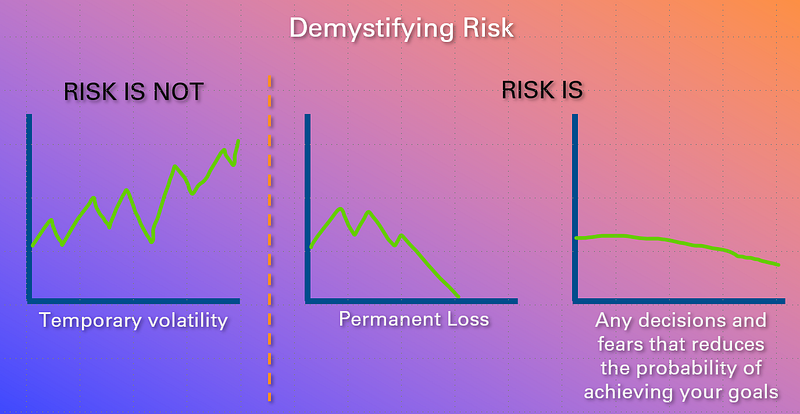
💡 Bitcoin and Bonds are perfect examples of confusing volatility with risk
— Bitcoin
While Bitcoin is volatile and its price sometimes fluctuates by 10% in one day, the likelihood of incurring losses over time is quite low:
👉🏻 Over the last 12 years, Bitcoin returned negative returns only in 3 years.
— Bonds
On the other hand, the 20+ Year Treasury Bond ETF (TLT) — supposedly a very low-risk investment, it’s actually a RISKY one: 👉🏻 Presented the investors with 6 negative years out of 10, and if you invested 10 years ago, your investments would have returned ZERO.
I’m using the 20+ Year Treasury Bond ETF (TLT) for comparison, but it’s exactly the same as other short-term T-bill ETFs like BIL and SGOV, some of the safest financial products in the world. Their returns are equal to zero.
For me, having zero yields on my investments over a 10-year period is a big price to pay for having low volatility.
There are better investments out there that, although volatile, can give investors way better returns.
Volatility is only risky in the short term, as prices might decline by 10% tomorrow. However, when we dilute volatility over time, the story is quite different.
👉🏻 Let’s look at the 1-year chart of Bitcoin and TLT ETF:
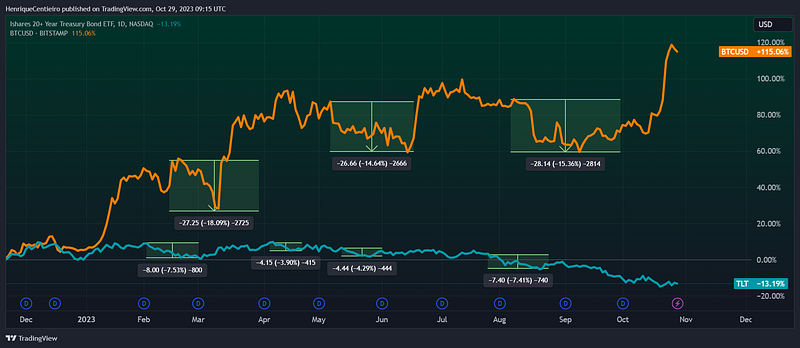
💡 Volatility is the price you pay for performance.
In this 1-year chart, we can see Bitcoin in orange and the Treasury Bond ETF (one of the “safest” investments in the world) in blue. I have highlighted some of the negative volatility in both assets.
As you can see, Bitcoin’s volatility is higher, and over the last year, it had down movements that chopped -18%, -14%, and -15% from the price. Despite that, over the last 1 year, Bitcoin returned an impressive 115%, being the best-performing asset in the investment space.
On the other hand, 20+ Year Treasury Bond ETF (TLT) experienced a maximum decline of only 7%, making it less volatile as compared to other investments. However, the returns on TLT are not satisfactory with a negative -13% in just one year. While it is less volatile, the returns are not good at all.
👉🏻 Let’s now look at the 5-year chart of Bitcoin and TLT ETF:
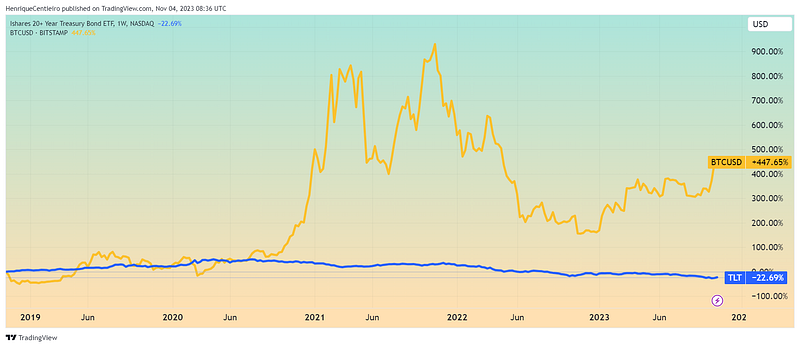
As we can see in this 5-year chart, Bitcoin is indeed way more volatile than TLT — the T-bill ETF, which is literally a flat line.
However, as we can see, the risk and volatility are pretty different. While TLT investors lost 22%, Bitcoin investors made 447% during the same period.
Increased short-term volatility can lead to decreased long-term risks as the potential for higher returns can provide much better investment outcomes.
💡 Volatility corresponds to risk only in the short term.
Other volatile assets, such as stocks, behave the same way. In the short term, they are hard to predict. However, in the long term, the volatility gets diluted away, and the risks are way lower.
🤔 Let’s look at more evidence that shows that “What’s safe is risky. What’s risky is safe.”
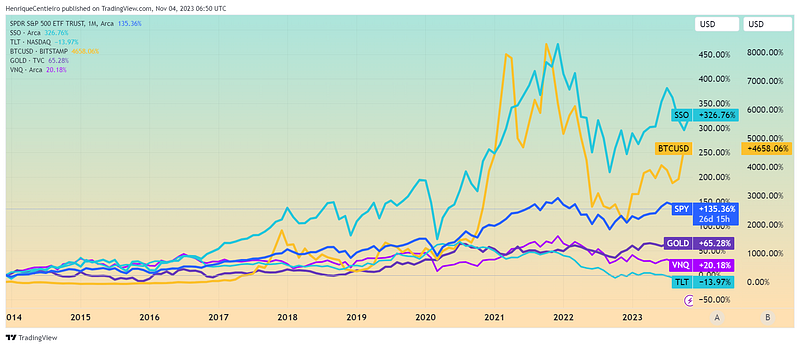
In the chart above, I put a few well-known assets that offer investors different levels of volatility and risk. Starting from the least volatile to the most volatile, here are the 10-year returns for each of them:
- TLT — Treasury Bond ETF: -13%
- VNQ — Vanguard Real Estate ETF: +20%
- Gold: +65%
- SPY — S&P 500 ETF: +135%
- SSO —ProShares Ultra S&P500 (2x leveraged ETF): +326%
- Bitcoin (second scale on the chart): +4658%
💡 As you see, for the low-volatility assets, you do have a risk: You have the risk of having very low returns.
In fact, the Treasury Bond and the Real Estate ETFs didn’t even beat cumulative inflation of 25% over the last 10 years.
If you are investing in the long term, with a diversified portfolio, choosing the volatile assets with the biggest upside is more rational, rather than seeking the safety of assets that will not give you any assurance of retirement (especially if you are into FIRE).
Remember, volatility is the price we pay for performance. This can also be measured by the Sharpe Ratio, but I will probably cover it in another article.
🤕 Even market crashes won’t hurt you!
Should we be afraid of market crashes?
I was finishing university when the 2008 “Great Financial Crisis,” aka “Subprime Crises,” happened. I remember hearing stories of people jumping off buildings because they lost a lot of money in the stock market.
💡 However, the reality is that the market always recovers!
👉🏻 This table below shows us the biggest stock market crashes in history and their performance 1 year, 3 years, and 5 years after those crashes:
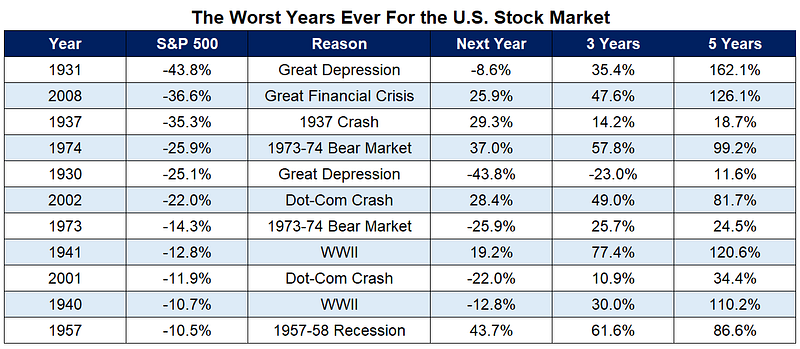
Out of these 11 crashes, only the Great Depression of 1930 failed to recover within 3 years fully.
So, if you are afraid of market crashes, don’t be! This is one more evidence that shows that volatility and risk are different. Yes, the stock market (as well as crypto) is volatile. But how about risk?
💡 Risk comes from the investment time horizon.
The shorter, the riskier. Volatility dilutes with time.
✨ Pro-tip to deal with volatility:
If you really can’t stomach volatility, DCA — Dollar Cost Average — is an investment strategy that will definitely smooth out the volatility. In this article, I detail how DCA can increase profitability in volatile assets.
By the way, if you want to increase the profitability of your investments and reduce risks, you should definitely look at these articles:
- 🎯 I have Found the Winning Investment Strategy to Beat the Odds & Outperform God
- 💪 The Powerful Investment Strategy You Didn’t Know You Need — Portfolio Rebalancing
- 🚫 Ditch All those Get-Rich-Quick Passive Income Strategies: Use this Proven & Reliable Way Instead
- 🎭 The Big Fat Lie: “The Rich Get Richer & The Poor Get Poorer”
- ⚠️ Fear of Taking Risks when You Invest? Use This New Approach Instead.
🧠 Conclusion
There might be, of course, other reasons why 95% of the investors underperform the market.
Some people blame factors such as: trading too much, trying to time the market, mixing emotions in your investment decisions, and a lack of patience.
That’s true but…
Not understanding the risks and confusing volatility for risks are also to blame!
Investor age should also impact choices. Over a long enough time horizon, most volatile assets smooth out volatility and award the best returns. However, if you don’t have time, for example, close to retirement age, less volatile assets are best.
💡 Risk comes from short investment horizons rather than from volatility.
The best way for you to reduce risks and have successful investments is to:
— understand risk and volatility; — have a decent investment thesis; — do the proper due diligence before investing; and — you are diversifying your portfolio
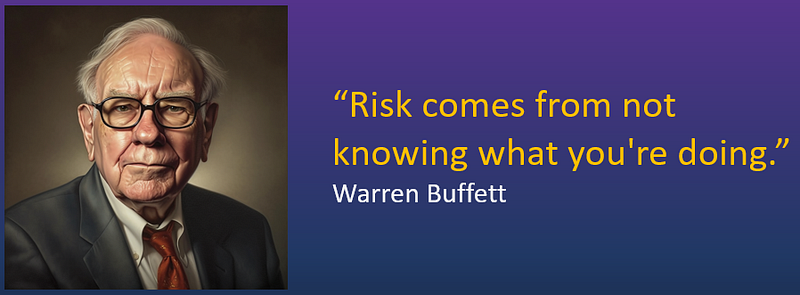
⚠️ And remember what Buffett said:
So I want you to read the next article, where I’ll continue to talk about risks and biases, and check this crypto investing course.
💡 Knowledge increases your surface area for luck. This is true for everything in life, but especially for your investments!
If you found this article valuable, why not throw us some Medium love? 🥰 What you can do to support us: Clap up to 50, leave a message, highlight some text if you see fit & be sure to follow. 💌
🌞 Stay in touch with me:


