
“It’s only a cat”: Grieving the loss of a cat
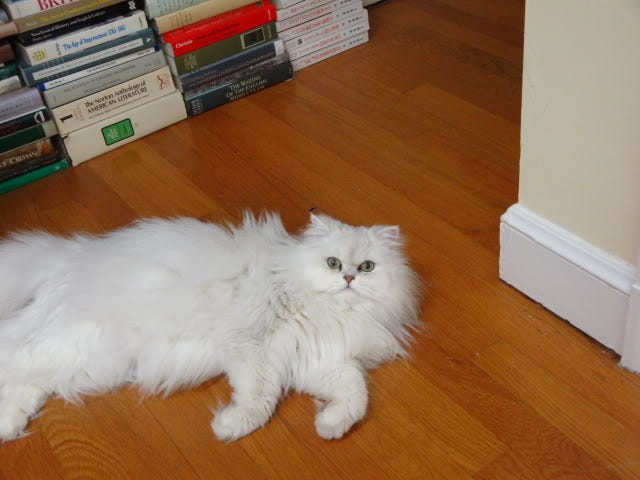
(R.I.P., my sweet Georgie peaches, Georgie girl, Fur Queen, Snow Blossom)
“It’s only a cat. Get another one.”
“I am so sorry for your loss. But you were aware that you would outlive your cat… right?”
“It’s been three months already. You need help, girl!”
These are only some of the comments cat owners hear after losing their pets — whether to illness, accident, or old age. Adding to the fact that cats are still regarded with suspicion and sometimes even derision in a world that overwhelmingly prefers dogs makes it much harder for those of us firmly planted in the ailurophile camp to properly grieve the passing of our fantastic, furry felines. We are inevitably led, if not compelled, to believe that our expression of grief is too strong and taking too long to process — and that it is time to move on.
And yet the fact that our grief is “too strong and taking too long” is exactly a manifestation of the strong and loving bonds that we’ve built with our cats over the years, cuddling with them, playing with them, fretting over their illnesses, and bringing them to their annual check-ups, praying for no issues. Is it so surprising then that we feel so devastated when they pass away or are euthanized?
It really isn’t. Considering that you’ve had your calico Misty for some fifteen, eighteen, or twenty years, are you truly going to just “get over it” in a few days, weeks, or even months — especially when some marriages don’t even last that long? Or even if you’ve only had your tuxedo Mr. Darcy for four years, tending to his every accident and wounds after he somehow managed to escape and return home — are you suddenly going to forget how overjoyed you felt when he miraculously reappeared? Nor should we forget either that for some, a cat, dog, rabbit, snake, or any other pet may be the only relationship they presently have in their lives. But perhaps more significantly, this is all secondary to the fact that we live in a culture that is fundamentally uncomfortable with the expression of grief. That it is somehow mawkish and overly sentimental in a world that frowns upon anything that urges us to stop and reflect for a moment. Keep a stiff upper lip. Just move on, we’re told time and time again; life goes on.
Yet, “too strong and too long” is an undeniable fact for many grieving pet owners. This is regardless of our age, gender, race, level of education, marital or socio-economic status. Over the decades, from the age of five, I’ve experienced grief for three cats at various levels of intensity — and have known many friends and acquaintances, both personally and online, who’ve also grieved their feline losses whether they’ve had their cats for two years or twenty. Let me mention too that this is in addition to the losses of friends and parents I’ve suffered over the years. I’ve learned what it’s like to suffer the loss of a dear mother and be told to “get over it” — just as I’d reluctantly come to tamp down my effusiveness when confessing the pain I felt after the loss of my second cat, Sir Fopling Flutter, six months after he had succumbed to liver cancer.
So I understand all too well how frustrating it feels to have grief dismissed, discounted, or diminished in any way. The fact is simply that attachments to any human or animal are borne of the love we cherish for one another. It’s a reason, for instance, why we might grieve the loss of one celebrity far more than that of another; maybe one has touched our hearts with a special song, book, or performance while the other hasn’t. The stronger the bond, the longer the grief. The more intense the love, the stronger the grief.
That’s why I’m writing this blog with the intention of letting you know that it’s OK to grieve for your cat, no matter how sad and anguished you feel or how long it takes. That there is nothing odd, shameful, or ridiculous about feeling intense loneliness or even depression after losing a cat. I want to share stories of cat loss in all circumstances, so you know you’re not alone. But I also want to share stories of how many of us eventually came to heal too. Because we are all so different with different backgrounds and experiences, it’s not surprising that our grief — and healing — also take on different forms, manifestations, and intensities. There is simply no “one way” or “one process” to grieve or heal.
As you read my blog, I hope you’ll feel the way I did when I first heard these stories: sad, empathetic, but ultimately, comforted. You’ll know you are not the only one who feels a sudden pang when you realize that never again will you see your fluffy little Rosco sitting at the window on a sunny afternoon watching the squirrels with rapt attention. Or hearing your tabby Mindy whisper her good night mews before you fall asleep. Or when the gotcha anniversary is right around the corner — not to mention the anniversary of your miniature black panther Queenie’s passing. Or even hearing the special song you’ve come to associate with your cat. You’ll learn ways of addressing your grief while also knowing that your bond with your pet never disappears even after you’ve healed.
The fact is this: we are humans and sentient beings. Just as Tennyson once wrote of his friend, Arthur Henry Hallam, who passed away after suffering from a cerebral hemorrhage in 1833, “Better to have loved and lost than never to have loved at all.” We feel. We cherish. We love our cats, each and every one that we’ve shared our lives with. Nothing truly replaces that bond — not even another cat: just as one spouse rarely replaces another. Cats, like humans, are individuals, which is why we mourn their losses. And so we will forever cherish the distinct ways that our cats have expressed their love for us, whether sitting behind us at the computer, standing up for a hug, nestling under our chin in bed, or just meowing as they enter the room where you’re reading.
But perhaps we might say we’ve never truly lost them–because they will always be in our memories and in our hearts, forever memorialized in our social media and online photos: just as I’m doing with my 15-year-old shaded silver Persian cat, Duchess Georgiana aka Georgie girl, Georgie peaches, Fur Queen, Snow Blossom, who was unexpectedly euthanized last Wednesday at 3:30 on May 17, 2023. Let’s learn that it’s more than perfectly fine to grieve for them just as we would any person we loved–or anyone who’s loved us freely and unconditionally.
I invite comments. Let me know if YOU would like to have your story featured in my book.
© Frances A. Chiu, May 2023
#grief #cats #pets #heal


