
It’s Okay to Say, “I Can’t.”
Knowing your limitations is your greatest personal finance superpower
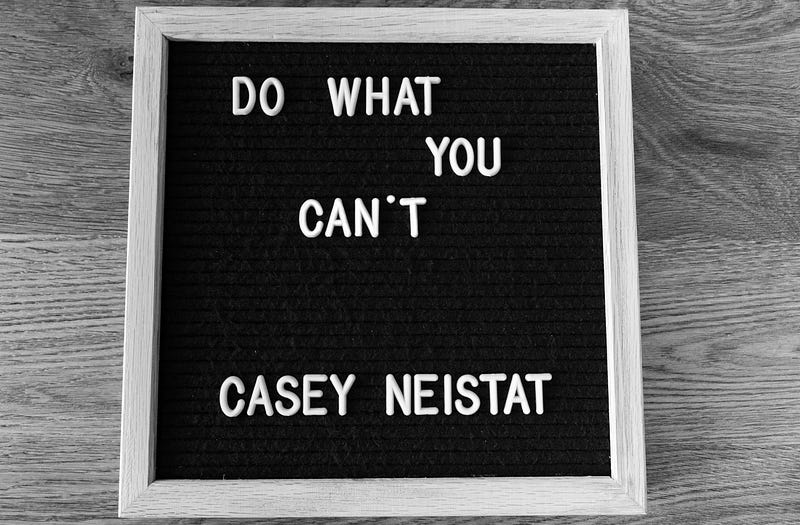
One of the dumbest things we tell kids is to remove the word can’t from their vocabularies.
Just because we like to push the you can do anything you set your mind to platitude doesn’t mean it’s wise to render can’t a bad word, particularly in our relationships with money. We really can have it both ways. In fact, you have a better chance of doing anything you set your mind to if you first determine the things you, for one reason or another, can’t do.
We all have limited intellectual, emotional, and practical capacity. There’s nothing wrong with this. It’s part of being human.
We set ourselves on precarious paths when we subscribe to the popular edict that it’s not okay to say, “I can’t.”
In this article, we discuss how a refusal to admit and understand what you can’t do can create toxic personal financial conditions that can be difficult to reverse.
In a recent Making of a Millionaire article, I riffed:
A critical element of the mindset necessary to skirt our biggest personal finance crisis — being screwed on the way to and in “retirement” — is to realize your limitations. This is our greatest strength — acknowledging, recognizing, and adapting to our limitations.
On the ground, that looks like this.
We’re told we need $1 million — and probably a lot more —to retire. We’re told we need to start saving something in the neighborhood of $500 a month when we’re like 25 if we want to stand a snowball’s chance in a warming climate of reaching that magic number by like, say, 65 years old. We’re told this is pretty much the only way to comfortably “retire,” and, even then, it might not be enough. And the people who tell us this often gloss over the “you need to earn about 8% annually on your money” to actually get their part.
This is hard. Given the data (see the above-linked article for a starter on the data), we know millions of Americans literally can’t do this. It’s sabotage if not straight personal financial suicide to cling to the absurdly American can-do attitude.
Wouldn’t it be better to say something like, “I’m sorry, I just can’t” and move on to a more realistic plan B?
This is what I did. And do.
I go into each month with about zero idea of how much money I’m going to invest in the stock market. It might be $500. It might be $2,500. It might $0.00. I collect income throughout the month. I allocate it, as needed, to my various pots of money. I contemplate discretionary purchases. Then, I take what’s leftover and invest it in an ever-growing and evolving dividend stock portfolio.
No expectations other than sticking to my plan. My plan B. Because I said, “I’m sorry, I just can’t” to mainstream personal finance and the retirement industry’s impossible (for many of us) and seemingly inflexible plan A.
One of my life mottoes comes courtesy of the Gin Blossoms:
If you don’t expect too much from me You might not be let down
The theoretical matters more here than how I actually implement what I can do.
The way I approach personal finance means I fail less and succeed more than I used to. I presume I fall less and succeed more than people who have chronic problems with money. This doesn’t make me better than these people or my past self. It just means I finally learned how to recognize my limitations. I finally came to grips with recognizing my limitations.
Recognizing and truly knowing your limitations might be the key to being good with money — from budgeting it to saving it to investing it. However, you can’t get there if you refuse to swallow your pride and say, “I’m sorry, I just can’t.”
Actually, don’t say you’re sorry. There’s nothing to be sorry about. I can’t. That’s all you need.
Saying “I can’t” isn’t the weak route quitters take. It sucks that so many segments of society bring children up, drilling this perverse and unproductive piece of conservative dogma into their heads. Because, as it turns out, saying “I can’t” might be one of the best ways to empower yourself and actually get shit — good, exciting shit — done.
This is what savvy and resourceful people do. They don’t bang their heads against the wall. They don’t fail at something, repeatedly, sometimes for years, if not entire decades. They conclude it’s not working. They look internally. They look externally. They look internally again. If it checks out that plan A isn’t working and simply can’t work, they don’t beat themselves up or waste more precious time trying to squeeze water from a rock. They regroup, adapt, and, more often than not, successfully execute plan B.
There might not be a more important money lesson to learn. I go as far as saying there’s not a more important life lesson. Saying “I can’t” signals that you have developed a strong sense of self-awareness and humility. You’re not giving up. You just know yourself well. And, most importantly, you understand that you can achieve the same goal by setting your own series of relatively unique objectives.


