
It’s Okay if Your Semester Abroad Didn’t Change Your Life
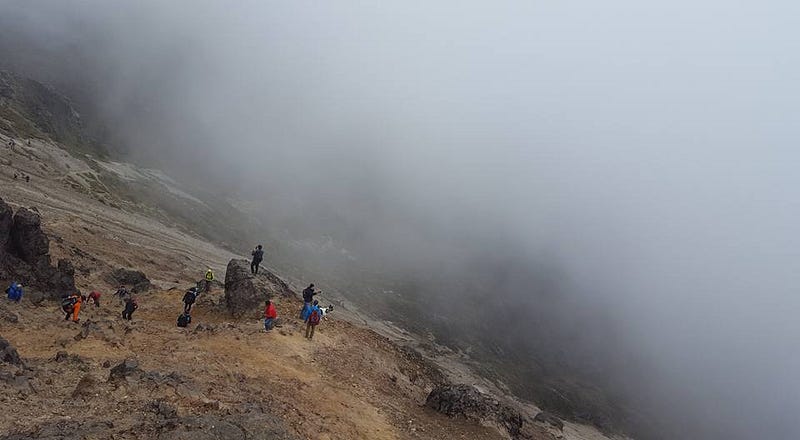
One day at the beginning of my semester in Ecuador, I was late. I was supposed to meet a group of other exchange students to go on an adventure to Papallacta, a hot springs an hour and a half southeast of Quito where I was staying. My host mother told me she would make me breakfast in the morning, but ten minutes before I needed to leave, she was still asleep. I paced around the house debating whether I should wake her up, which felt intrusive, or grab something from the kitchen myself, which would be a faux-pas. Finally, she got up sleepy-eyed of her own accord.
I ended up simultaneously eating breakfast and talking on the phone to perturbed students asking me where I was, while the taxi waiting to pick me up honked outside. I told the taxi to make a quick stop at the pharmacy down the street so I could pick up some cough drops for my sore throat, but when I tried to pay with a card, the cashier asked for my passport. Outraged, I got back in the taxi, which took me on a wild goose chase to find the bus I was supposed to be on. We stopped in a traffic circle, where the chaperone pulled me out of the cab into the road and walked me across the street to the bus. I stepped up, said, “I’m sorry guys, I’m the worst person in the world,” and started to cry.
There was some half-hearted crooning and I crawled into a seat by myself. After a while I stopped crying enough to simply look miserable. The chaperone touched me on the shoulder and said, “Anna, try to enjoy this day,” at which point, of course, I started sobbing. His wife asked me if I needed a hug and I nodded, so she slid into the seat next to me and wrapped me up in her big soft mother’s warmth while I soaked her shoulder with tears. She was confused. What happened? she asked. Did they rob you? I tried to explain. It’s just, I said, that every little thing I do goes wrong. I couldn’t say in Spanish, or really with any words, that I, a college student used to living on my own, had to ask to have my laundry washed or to get toilet paper, and that I was always hungry or too full or sick or lost or late, and that it was my best friend’s birthday, and back home Trump had been inaugurated two days before, and that the only natural recourse was to cry openly on a bus in front of the people who were supposed to become my new friends.
The woman whispered impassioned things in my ear about maturing, and how if I opened my spirt that could happen here, I think. She told me I had to remind myself, “eres fuerte, eres hermosa, eres valiente.” I don’t do that, of course, because nobody does. But maybe we should.
When I made the decision to spend a semester in Quito, I had scarcely been out of the country before. I didn’t know anything about Ecuador. I ended up there practically by chance. When I left home to start the journey, I thought that by the end of it I would be fluent in Spanish and know how to dance. I decided I would figure out what it meant to open up your spirit and mature. The day after I arrived, I folded my clothes into my closet in my host family’s house, and all I could think about was how excited I was for the day I would get to pack it all back up again. I wondered if I would be just as excited then, four and a half months in the future.
These days, I’m sure every study abroad student has hours (even days) of orientation — you know, where they tell you about all the diseases you could get and all the ways you could get kidnapped, in addition to all the things about the people that may astound you, or vice versa. Certainly every one of these orientations must talk about culture shock. What they imply about culture shock, however, is that you inevitably adjust. It’s like a bill you have to pay to get to the good part. The word shock suggests an event that comes on suddenly, shakes you up, and then ends, like the shock of dunking your head in the swimming pool. For me, the shock never ended. It was more like a four-and-a-half-month daze.
Some things never changed: When I was in Ecuador, I was always sick, either from the food and water or from head colds that turned into sinus infections that turned into eye infections that turned back into head colds.
I was always confused. My Spanish was passable but not fluent, and every thing from bus systems to doctors’ offices to social interactions were just different enough to throw me off.
I was always tired. I would fall asleep in front of my computer doing homework almost every night at 9pm.
I never connected with my host family. They were perfectly lovely, but I always felt like a guest in my own home, and their attitudes towards illness and stress were too different. “Are you good at making friends?” one of them asked me in the first week. I said no. “Well then, you need to make friends.”
Culture shock wasn’t a set period of learning and suffering. It was one small problem after another. Once I took a bus in a complete circle back to where I had started. Once the domestic servant’s grandson made me breakfast not knowing I had already eaten, and he hid the food and begged me not to tell anyone. Once I went out to buy flowers for Mother’s Day, and when I came back proudly clutching my bouquet, my host mother exclaimed that she didn’t know where I had gone. Once, in one of the more traumatic experiences of my life, I lost all of my valuables when I was robbed on a beach at night.
I felt guilty that I wasn’t having a better time — or a worse one. We all have that friend who constantly regales you with stories of love, heart-break, and near-death while abroad. You ask them how it was over there and they say, “Oh, life-changing. I never wanted to leave.” As for me? In May, I was in fact still excited take everything back out of my closet, and when I did, I was not fluent in Spanish. I certainly didn’t feel any more mature, and my spirit still felt as tightly shrink-wrapped as before.
So what do you do with that? What do you do when our culture has hyped up studying abroad your entire life, and you couldn’t live up to the hype? For me, it meant coming to terms with having had an imperfect experience, not in that there were ups and downs, but in the failure for things to really take off running. And I truly believe that there is value, too, in imperfect experiences. You can learn from them just as much as from success or tragedy. I learned a lot, not always gratifying, about my abilities to adapt, accept, and open up when things were hard. I learned a lot about how I treated other people in those situations. I hope a few of those things I learned can serve others in similar situations:
Don’t feel guilty: Not every experience works out for every person. There are countless reasons why that might be. Don’t overanalyze, don’t blame yourself. Just take it a day at a time. Remember: eres fuerte, eres hermosa, eres valiente.
At the same time, don’t be complacent: If you’re not at your best, notice that and take responsibility for it. Maybe there are in fact a few proactive steps you can take. I probably should have told my host family how uncomfortable it made me not to be able to grab my own yogurt for breakfast. Take care of yourself. Be braver than I was.
People aren’t going to understand: No matter how fervently you want them to, no matter how upset you are when you tell them, you can’t force someone to understand your experience and make them feel bad for you. I have to fight the urge not to be the opposite of your friend who won’t stop talking about how amazing their semester abroad was. Get me talking about Ecuador and I turn sour, giving one example after another about how I failed the experience or it failed me. People aren’t going to lean into that — they’re going to pull back.
However, it’s still okay to talk about your experience: You don’t have to pretend everything was ducky. Whether it went well or not, it was still an important part of your life and you deserve to impart that on the people around you. Just be gentle with yourself and your audience when you do so.
Don’t ruin it for others: When someone tells me they’re going to Ecuador, it can be tempting to spew all of my misfortune on them, to discourage them, almost like I want them to have a bad time so that I know I wasn’t the only one. Instead, do your best to be enthusiastic, to give them tips about how their experience can be successful, and to offer recommendations for towns, restaurants, and hostels. The beauty of an imperfect experience is the potential to help make life more perfect for someone else.
And lastly, don’t forget about the good stuff: I have the tendency to become so bitter that I forget all of the amazing things I did do. Almost every weekend, I would take off across the country to see other towns, rainforests, giant waterfalls, and busy markets. Ecuador is a beautiful country. It’s about the size of the state of Colorado, but so biodiverse that in an hour by bus, you can go from coats and numb fingertips to sweating on the coast. And moreover, Ecuador is a country with a rich and beautiful culture and history. My upset stomach doesn’t negate that. And to be honest, my Spanish probably improved more than I thought it did at the time. Be realistic about what happened. Don’t let one end of your experiential spectrum blind you to the rest.
I’m still actively learning about the virtue of imperfect experiences. They are, if nothing else, a wonderful exercise in mindfulness. I wish I could have been more mindful at the time, but seeing as it didn’t turn out that way, I can at least work to create an honest and balanced mental reconstruction of what happened. I still cannot dance. I did not make friendships that will last the rest of my life, nor did I tearfully leave behind any Ecuadorian loves. I have, however, read all of One Hundred Years of Solitude in Spanish, thrown up during the Ecuadorian election results, clung hysterically to the side of a volcano, and lost most of the photo evidence of all of that. I am trying to believe that some day soon I will be thankful for a few more high-altitude red blood cells, a few good empanadas and a few bad ones, and memories of mountains streaked with farmland and covered with fog.