
It’s Not Just You: Why Engagements Can Cause Extreme Emotional Mayhem
Cheers to the happy couple — I think?
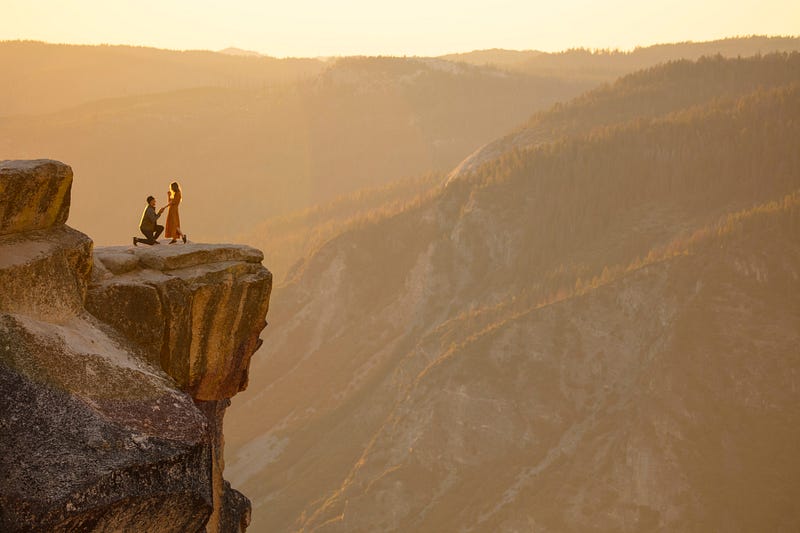
Engaged. Affianced. Intended. Betrothed. Off the market. Getting hitched. All words and phrases that people across the world (hope to) use to describe themselves at some point in their lives — and have for all of eternity thus far.
In fact, Jane Austen’s opening line of Pride and Prejudice reads:
“It is a truth universally acknowledged, that a single man in possession of a good fortune, must be in want of a wife.”
This book was first published in 1813 and has been read by every English major, Regency era fan, and history buff — in addition to being reluctantly skimmed by Sparknote-savvy high school seniors.
Essentially telling us that at some point, when you’ve got yourself together — or not — you should be looking for a significant other.
I love proposals and weddings more than anyone, and I know I’m not alone. The inspiration for this article came when a friend sent me an over-the-top proposal video the other day and said, “I don’t know why this makes me so happy but so sad at the same time!”
It’s no secret that the wedding industry is booming — all because we love Love, right?
We do — but it’s much more complicated than that.
Get married is something you’re expected to do at some point — right?
You’ll will find “The One” — and subsequently:
- Have a captivating, romantic proposal
- Take stunning engagement photos that will be pinned to many refrigerators
- Get married at the perfect venue with your friends and family in tow
- Have 2.5 children
- Adopt a loving dog
- Live in a beautiful house with a white picket fence
That’s the dream that has been romanticized over-and-over, and if you haven’t achieved that by a certain age — you may start to have subconscious anxiety that you’re not where you should be.
Even though being married “young” seems to be a timetable that’s moving up, it hasn’t taken away the urge to feel settled with the person you love.
The median age at first marriage has been steadily increasing:
In fact, it has gone up about 8 years on average since 1950. This is most likely due to career changes, advancements in health technology, and in my opinion… choice.
I’ve never read Aziz Ansari’s book, but I have heard of the “Paradox of Choice” that he describes.
That, essentially — if you have too many choices, you will be unhappy with the one that you select. I have to say, the logic makes sense in this case.
The more you know, the more opportunity you have to overthink — a blessing, and a curse.
The more people you know, the more likely you are to think that any one of them could be “The One”.
In the world of swiping left and right:
We have an extreme amount of options that did not exist even a few years ago. Sure, we had online dating in its infancy as soon as the internet was created.
People from around the world met each other, fell in love, and the rest is history.
It’s quite fascinating to see all of the people who have the opportunity to find each other who would not have otherwise — just look at the fandom behind 90 Day Fiancé and its spin-offs.
There are thousands of singles at your fingertips:
All over the world — ready for direct comparison. Jane Austen might be rolling in her grave — or maybe she’s just wondering if Netherfield Park is let at last.

If you’ve ever had any sort of emotional reaction to news of a proposal — or even while witnessing one, you know they can be very polarizing:
- Is it someone you love?
- A family member? A friend?
- Someone you dislike?
- Are you seeing it in person, or is it an announcement on social media?
- Will you be invited to the wedding — or just see pictures posted on Instagram and Facebook later?
- Will you be asked to be a member of the coveted bridal party?
Weddings are an industry, but are ironically one of the most personal — and emotional — days in a person’s life.
But — how does it impact their guests and witnesses?
Here are four enigmas on why engagements can cause intense emotional mayhem, even if you’re excited for the happy couple.
Hopefully next time you witness someone get down on one knee, or see a shiny ring photo on Facebook, you can take a deep breath and identify what you’re feeling.
#1: A Self-Imposed Or Society-Fueled Timeline
As I mentioned, society heavy implies that women should be married by the time they’re 30. If you’re reading this and shaking your head — it might not be a written rule and it might sound archaic — but it’s subconsciously there.
Married by 30, be happy for a few years as a couple, and then you have kids.
You might even accelerate this process, but 30 seems to be the age that society projects should be appropriate for a first marriage. Most people hope for an only marriage, but it often doesn’t work out that way.
Are you happier getting hitched at a certain age? Maybe — but maybe not. I’d like to think it’s a point of maturity, not the number of times you’ve journeyed around the sun.
But… to get married by 30, you need to find your person by say, 24 — date for a few years, be engaged for a few more — there’s your standard timeline.
Of course, these are general terms, but it seems like this is around the age that family members, co-workers, and friends start to wonder — are you dating? Have you found your person yet?
#2: You Wonder If It’s Real
I was once sitting atop the Space Needle observation deck enjoying the stunning nighttime views of Seattle when I witnessed a man get down on one knee. It was a romantic backdrop — even surrounded by hundreds of strangers.
My friend and I gasped audibly and looked at each other — then back at the scene not 10 feet in front of us.
Oh my god!
A proposal!
How romantic!
Until — the prospective bride nodded her head quickly, put the ring on her finger, and all in one smooth motion — the couple stood up for a selfie, ring hand up.
All of this happened within 30 seconds or less, and my friend and I went from “how cute!” to “what just happened?” on our very own emotional rollercoaster that we didn’t stand in line for.
Was this a real proposal?
A re-creation that wasn’t caught on video during the actual moment?
To this day we’re still not sure, but it’s fair to wonder if your friends are actually in love — or just in love with the idea of finding their person, walking down the aisle, and “leveling up” in life.
After all, a proposal is a symbol for their relationship, right? If it’s not right — will their marriage last?
Usually, this is severe over-analysis:
Proposals are nerve-wracking and it’s hard to get the details right. It may not pan out how it’s planned, or the surprise may not play out.
Regardless, it shows that you care — and the best you can do is be there for your friend, even if you find doubts creeping into your mind post-proposal.
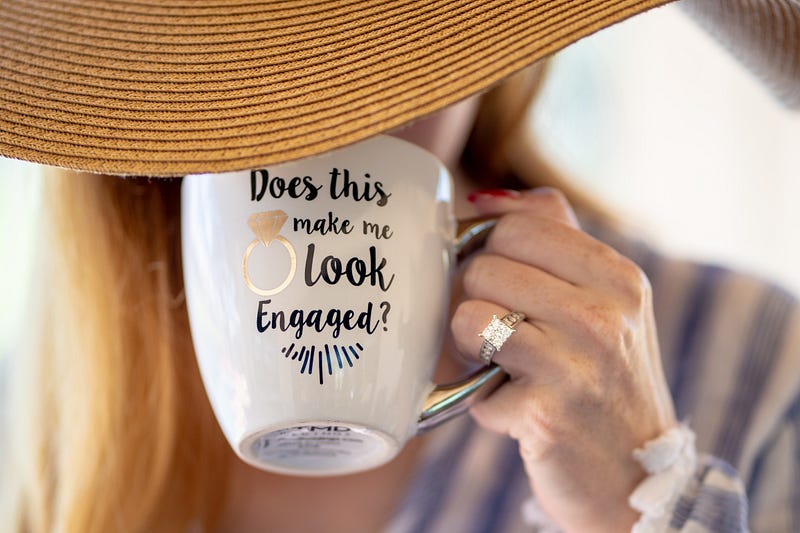
#3: Will Mine Be Like That?
A few things apply here:
- The proposal
- The ring
- The person
- The wedding
- The marriage
After looking at that list, it’s no wonder people decide to elope.
The Proposal:
So many proposals these days are filmed, elaborately planned out, and maybe even put on YouTube.
If they’re insanely over the top we wonder — will my person love me enough to plan out something as elaborate?
But is that what signifies love? To some, absolutely.
Does your proposal need to be seen by 2.5 million people on the internet, or a crowd of hundreds at a famous landmark?
If that’s what fits your relationship — sure!
The days of a quiet, intimate, private proposal are not gone, but we obviously don’t see them as — that’s kind of the point.
Countless friends have sent me photos, videos, and podcasts about the perfect proposal. “I want mine to be…” is an easy sentence to finish with wedding idea Pinterest boards galore.
It’s great to have the ideas ready, but it can cause pre-proposal anxiety if it’s not happening in your timeline, the way you want it, or maybe it didn’t go as planned when it did happen.
In reality, your partner will choose something that they think you’ll like, and that will be fitting for your relationship. That’s pretty romantic, if you ask me.
The Ring:
Re-enter: Pinterest boards.
I would guess that 80% of people have some kind of photo album, idea in their head, or Pinterest board detailing what they’d like. I even saw that you can drop a “hint” — it’s about as subtle as a gun — to your partner via Tiffany’s website:
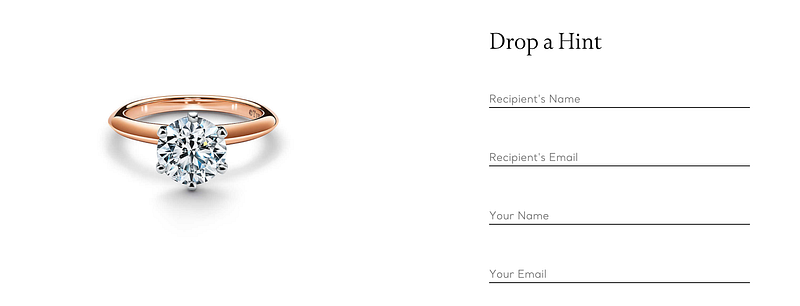
Who doesn’t want to see that baby-blue box? But — it’s about the love, not the ring, right?
Rings symbolize eternity — a commitment, at least, but quite honestly they also symbolize social status — even if that’s a bit archaic. Just like in Pride and Prejudice — it’s a display that a partner is “in possession of a good fortune”.
In other words, they’re ready for you.
They’re ready for you to wear this metal thing on your left hand and show the world that you’re together — forever.
#4: Will I Ever Find My Person?
The Person. The One. Star-crossed lovers. Meant to be. True love. We’ve met before… once upon a dream.
It’s a huge amount of pressure that we put on ourselves.
Yet — for as long as we can remember, that’s what is perpetuated by society and by almost every story imaginable since childhood.
Even if it’s not a story about romance — it could be about finding yourself, and then finding your person.
Even books like The Alchemist — deep down, have quite a star-crossed undertone and sub-plot. As the protagonist finds out — how far do you have to journey to find what you think you’re looking for, only to find that the person you’ve been looking for is within you?
Once you’ve found that person, you can find your “other half”.
I’m a believer that unless you’ve done your self-work, you won’t truly be able to have the love that fables, sonnets, and novels all promote.
You are always a work in progress, but you need to be able to grow together.
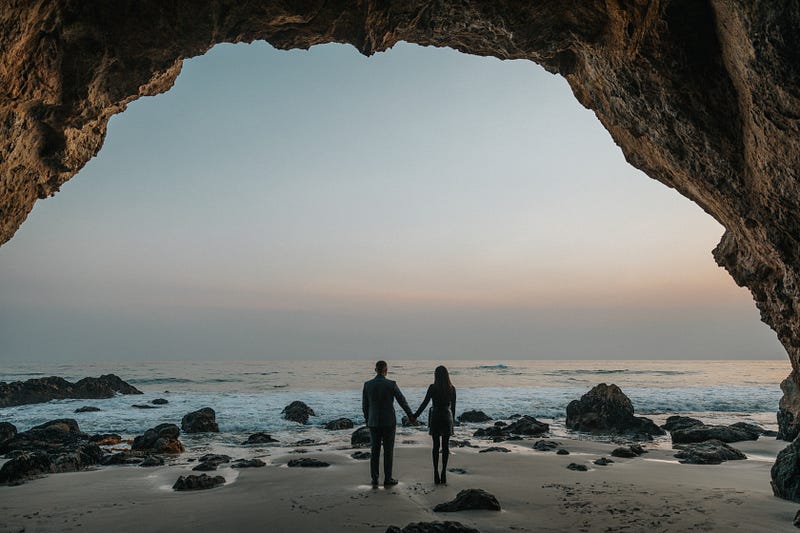
Until the time is right, you might find yourself frustrated at engagement announcements and crying at random side tables at weddings instead of breaking it down on the dance floor.
Until then — it’s okay to be a little bit upset.
Deep down, you’re the biggest supporter of true love — and you will find yours, if you haven’t already.
Finding yourself, and love — requires:
- Time — even Darcy and Lizzy didn’t fall in love at first sight — or did they?
- Patience — and quite a few moments where you just want to give up and become a hermit in a small town in the middle of nowhere. No swiping, and no strange tension with people of your age group on public transport
- Self love — you deserve some credit
- Putting yourself out there — when you feel it’s right
Until then, give your friends a break. If they think they’ve found true love — support them unless it’s an unsafe situation.
Only you will truly know your love story — but I can’t wait to hear the parts you choose to share.


