
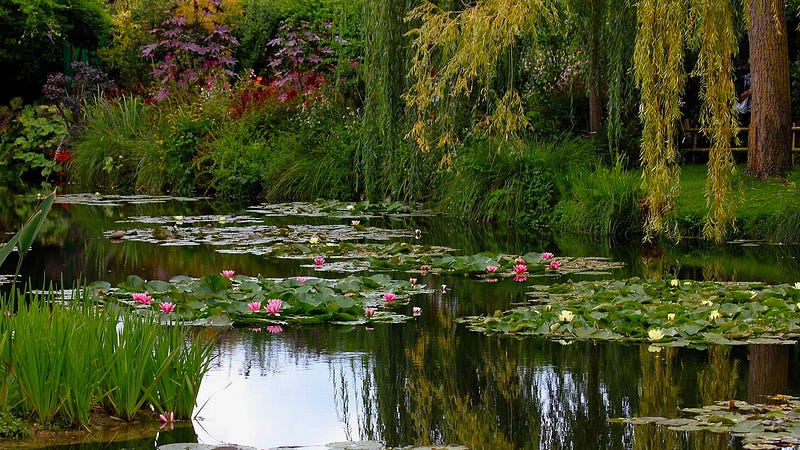
Monet Wanted to Teach Us to See Life.
Hint. It’s not about the water lily.
It’s so easy to create fairy tale versions of people. Take Monet. You look at his paintings and think — one happy dude! No doubt true some of the time, but he was also driven and tragedy often touched his life.
Using beauty to balance tragedy
His father’s business failed when Monet was 5 years old. An aunt saved them from the street. His mother, who suffered from depression, died when he was seventeen.
As an adult, Monet had serious financial problems. His father, now financially recovered, refused to help unless he abandoned his pregnant girlfriend. In 1868, his desperation drove Monet to suicide. He jumped off a bridge into the Seine.
He watched his first wife, Camille, fade from life at 32. His beloved stepdaughter died in 1899. In 1911, his second wife, Alice passed followed by his son three years later.
Did he overcome these events by observing beauty? This quote from his son makes me think so.
“Monet’s discouragement was triggered either by dissatisfaction with his work or by a change in the weather that thwarted or interrupted it… little by little his malaise abated and everything returned to normal. Afterward, he was constantly in his gardens, his great consolation.” Jean Hoschedé (Monet’s son)
Takeaway
Looking at beauty soothes us and opens doors to inner light we didn’t know we had. Though being content with the feeling and not recording it for all time is probably easier.
Find the extraordinary in the ordinary.
Shifts in light and color fascinated Monet. It was akin to a spiritual experience for him. How to present this so that others could understand? Inspiration whispered, “do a series to reveal the changes.” What to paint? So many things. Why not…
HAYSTACKS!
Yes, Monet did not go for glam. Every day for 7 months he trudged across the field next to his house to paint the same haystacks. Others might have been bored to tears. For Monet? It was paradise.
He started with two canvases. Those exploded into as many as the wheel barrel would hold. As the light and weather shifted, he would take out the one closest to what he saw and work until it changed again. Sometimes a matter of minutes.
He wasn’t particularly interested in haystacks; his interest lay in the transience of light. The haystacks captured that miracle without interest in the subject interfering. Haystack envy is rare.
Now you, too, could see what he saw: the interplay of light, color, atmosphere, and form.
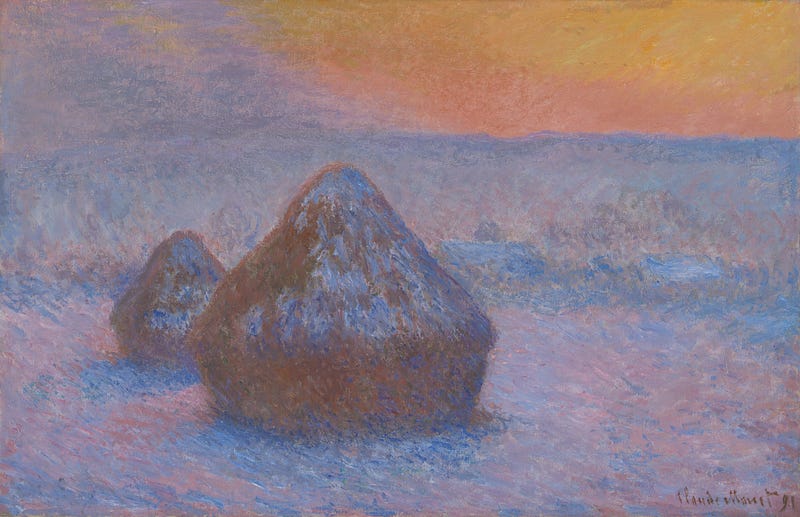
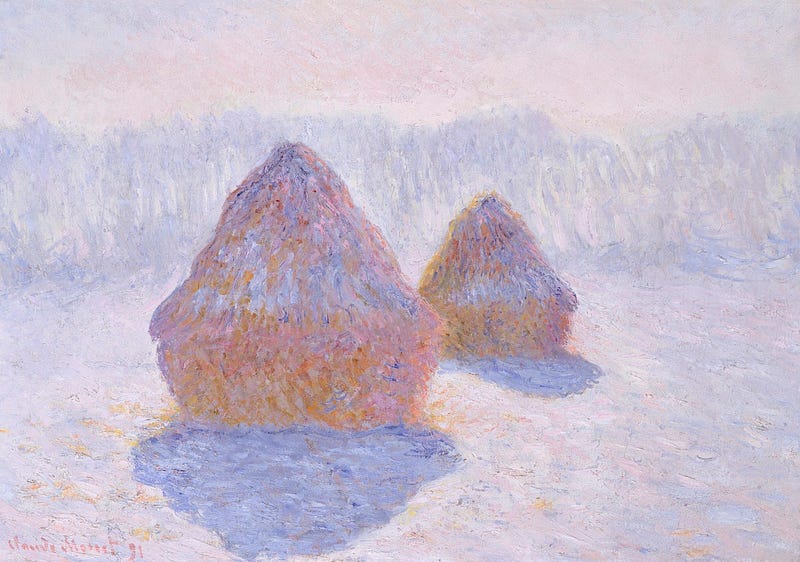
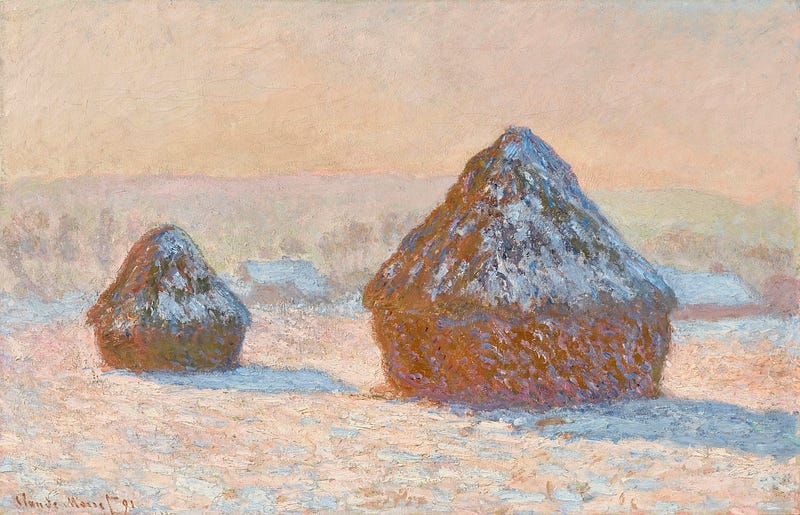
Le Grand Monsieur puts it this way.
“For me, a landscape does not exist in its own right, since its appearance changes at every moment; but the surrounding atmosphere brings it to life — the light and the air which vary continually. For me, it is only the surrounding atmosphere which gives subjects their true value.”
“While you philosophically seek out the world itself, I exercise simply my effort on a maximum of appearances, in straight correlation with unknown realities”
Takeaways
Look to see if what you need is right in front of you.
What is the simplest way to convey to people what you want to express?
Listen to internal signals telling you when you need to move from one thing to the next. Then (this is key), do it.
From Inspiration to perspiration. The hard work of exuberance.
We envision Monet furiously painting, slapdash, dab, dab until an hour later voila! A masterpiece!
Nope.
“Most people think I paint fast. I paint very slowly. ” — Claude Monet
He trundled all the canvases back to his studio where he wove them into a harmonious whole. Twenty five canvases in all. He was the first painter to do this.
Haystacks were only the beginning.
Rouen cathedral — 31 canvases — 1892–1894 Poplars — 23 canvases — summer/fall 1891 Houses of Parliament London — 19 canvases 1899 Water lilies — at least 100 canvases over 20 years
By the time he reached the waterlilies, he made studies and painted indoors. He’d absorbed color and light into his imagination and drew it out at will.
Takeaway
If you dedicate yourself to something long enough, it becomes a part of you. Caveat: Make sure it’s worth it.
Look for what others don’t see.
Monet did not paint waterlilies; he painted the totality of what was before him. The reflections, the ‘empty’ spaces were as important as the supposed subject.
“The essential subject is the mirror of the water whose aspect, at any one time, changes itself thanks to the expanses of sky which is reflected in it, and spreading life and movement. The passing cloud, the freshening breeze, the threatening and falling rain, the sudden gust of wind, the light failing and shining again, so many reasons, elusive to the profane eye, which transform the tint and disfigure the body of water.” Monet
“…the illusion of a whole without end… …of water without horizon and without banks where nerves over-strained by work would be relaxed following the restful example of the still waters. It would offer an asylum of peaceful meditation in the center of a flowery aquarium to whoever experienced it.” Monet on the paintings now in the Orangerie in Paris
Have a look at this painting. Let your gaze drop where it wants to and scan it without identifying what you are looking at. How did you feel before? How do you feel now?
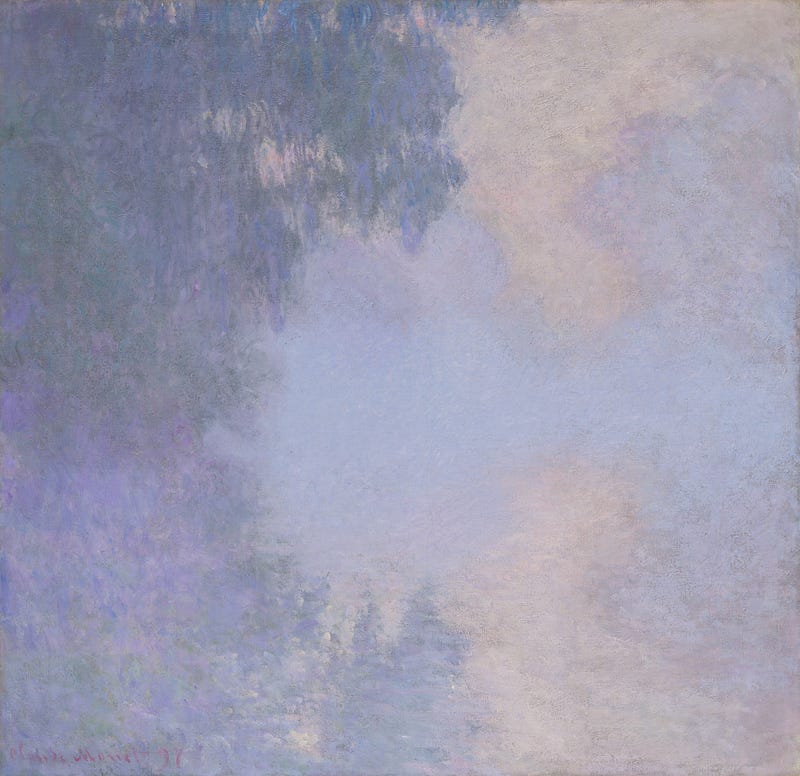
Takeaway
Spend time looking at the spaces between things or at a particular color, shape, whatever. This will break you and your mind out of the humdrum. New vistas and possibilities will open.
Or go see someone who’s done it for you, like Monet.
Adapt to adversity.
Already nearsighted, Monet started developing cataracts in his sixties. What could be worse for an artist entranced by light and color? But, like Beethoven writing symphonies while deaf, Monet saw the colors without sight.
He meticulously arranged his tubes of paint by number. The number replaced the color he could no longer see accurately with his physical eyes. He did everything possible to continue, though railing mightily about it. He did not have an easy temperament.
“… my poor eyesight makes me see everything in a complete fog. It’s very beautiful all the same and it’s this which I’d love to have been able to convey. All in all, I am very unhappy.”
Despite this, he continued to do what he always did. Paint. It was a choice.
He later allowed an operation on one eye to let in the colors again.
Take away
Have your moment of woe and doom (we’re all human), then look for the gift in the obstacle and keep going.
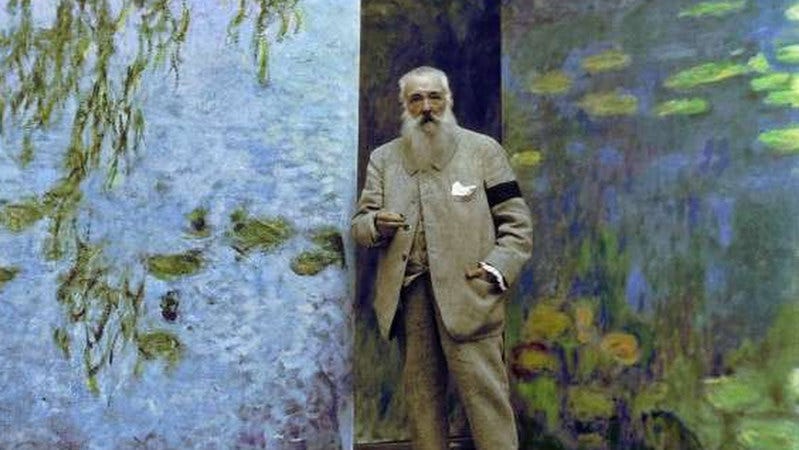
Go out with an enormous hurrah!
Lest you think he slowed with old age, know Monet painted up to the end. Not little vignettes, many of his final works were over two feet high by thirteen feet long done from age 78 to 86. Placed end to end, the 22 panels of his monument to peace in Paris is almost 300 feet long. The length of a football field. Impressive
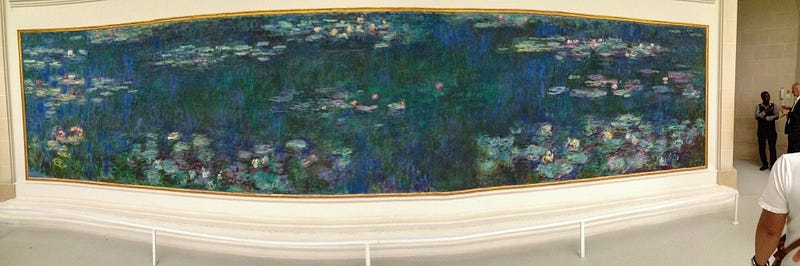
No longer content to stay inside the box of impressionism — painting exactly what you see — his painting became fluid, even abstract. My art history grades were crap. So I’ll let someone else explain his evolution.
Monet saw his last works, however radical they might have become, as a continuation — we might now say a culmination — of a lifetime of studying nature.
In his words: “My sensitivity, far from diminishing, has been sharpened by age, which holds no fears for me so long as unbroken communication with the outside world continues to fuel my curiosity, so long as my hand remains a ready and faithful interpreter of my perception.”
You can even see how different this looks than his earlier Impressionist brushwork. We don’t really see that broken brushstroke anymore. The brushwork is larger, broader, freer. … So we’re talking about ideas that are very much twentieth-century ideas — and which verge on abstraction. There’s this idea that a painting is no longer simply a record of what is seen.
I think he was charting his own course. Late in life, he begins to talk about wanting to capture what he feels… Kathy Calley Galitz: Art Historian
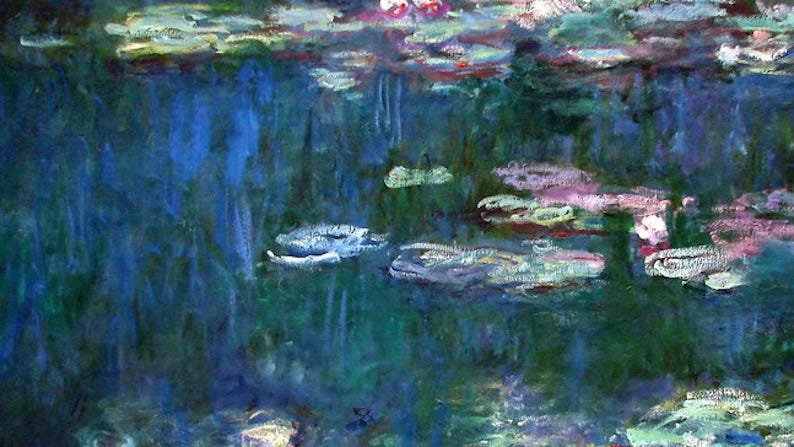
“These landscapes of water and reflection have become an obsession for me,” he wrote to a friend in 1909. “It is beyond my strength as an old man, and yet I want to render what I feel.” Claude Monet
Color was key even in death. Seeing Monet’s coffin covered in a mourning cloth, Georges Clemenceau exclaimed, “No! No black for Monet! Black is not a color!” With a grand gesture, he ripped down a curtain of violets, blues, and pinks and draped it over his friend’s coffin.
Beyond painting and gardening, I am good for nothing. Claude Monet
Takeaway
I’d settle for being as good at one thing as he was. Wouldn’t you?
I leave you with part of Monet’s gift for peace. Feast on 360 degrees of Monet at the Orangerie, Paris
Questions? Reflections? I’d love to hear from you. [email protected]